Best Division Templates
Section · Division templates
Division templates in Hearts of Iron IV
Ready templates for the task at hand: hold the front, break a province, land on a beach, drop by parachute, sit in the mountains — or simply not go broke on the first hundred divisions. This is not one perfect division for the whole war. It is a map: which template to take when, and where to go for the numbers.
Section overview
This article is about division templates in HoI: which lineup to take for the task, not one magic division for the entire war. This is single-player Hearts of Iron 4.
The ready templates live in the tabs: cheap, infantry, tanks, defense, breakthrough, motorized infantry, and special forces. How to assemble a template from scratch is in the How to build tab.
I am writing for a beginner: what you can copy, and what a small country should leave alone.
In HoI4 a template is the blueprint for a division. Change the blueprint, and every division of that type on the map starts living by the new stats as soon as rifles and manpower arrive. The question is not which template looks strongest on the card to the right. It is what that division has to do every day.
What’s here
- How to put a template together properly: role, Combat Width, Organization, armor
- Ready lineups: infantry, tanks, motorized infantry, defense, and breakthrough
- Special forces: mountaineers, marines, paratroopers, Rangers
- Cheap templates that a minor can field without hundreds of military factories
What’s not here
- Why infantry exists at all — that lives in the neighbouring section on division types
- A breakdown of every battalion and company button by slot
- Hour-by-hour combat math: Organization, breakthrough, Combat Width as a system
How is a division put together? A division is built from combat battalions in the middle of the designer, support companies on the right, and regiment support under a column — more in the section on battalions, companies and regiment support.
Where do the numbers come from? The numbers in the designer come from the lineup: which battalions, regiments, and companies you drop in. That is your Organization, attack, armor, and Combat Width — more in the section on division stats and combat.
What a working template is usually made of


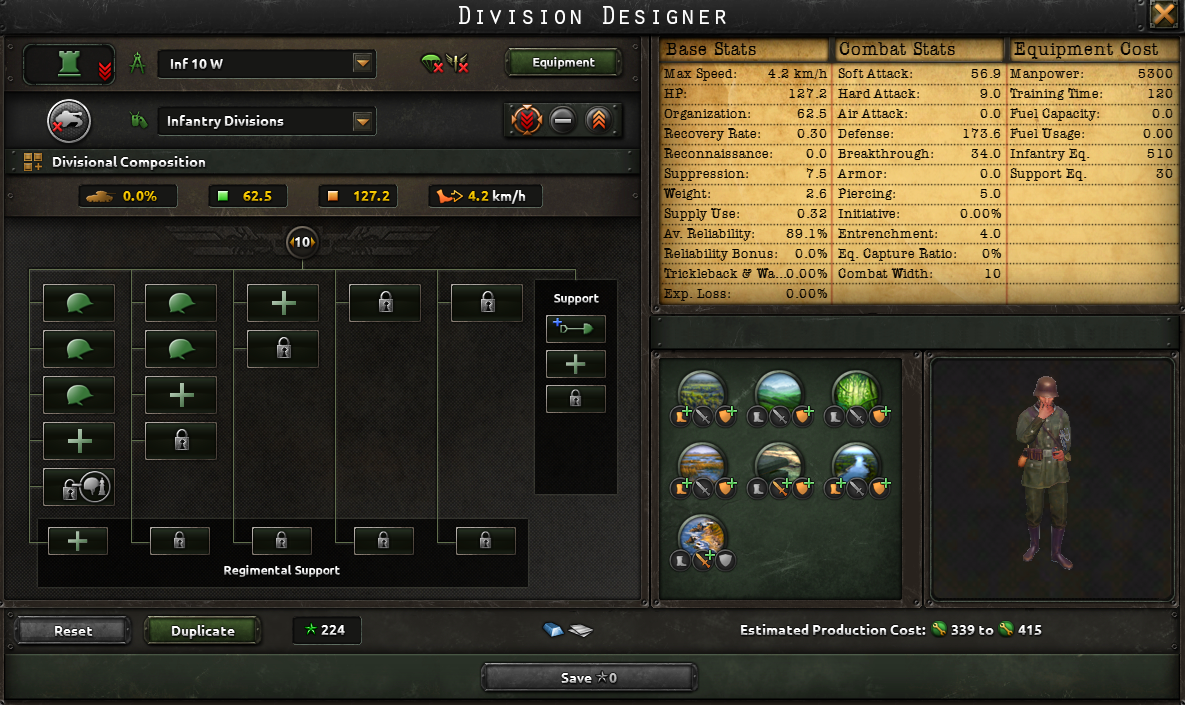
On the line, infantry and an Engineer Company are often enough. Artillery, tanks, and special forces show up when you have something for them to do and the factories to feed them. Five companies on the first template is the classic beginner mistake: Army Experience is gone, Support Equipment isn’t even in production, and the divisions leave the queue full of holes.
Where to start
- How to build — if you still don’t understand why Organization and Combat Width matter in the designer.
- Cheap or infantry — if you need to cover provinces without going broke.
- Defense / breakthrough — once the line is already there and the task has become specific.
- Tanks and motorized infantry — the striking fist and closing the pocket, not a replacement for the whole army.
- Mountaineers / marines / paratroopers / Rangers — only for that terrain and that theater.
From practice: one “does everything” template for the whole war is almost always a middling one. It holds worse than straight infantry and punches worse than real tanks. Two simple templates beat one that pretends to do it all.
A quick map of which tab to open
| The task | Open this first |
|---|---|
| I don’t know how to build a template | How to build |
| A tiny country, almost no factories | Cheap |
| What to hold the front with | Infantry → Defense |
| The line will not give | Breakthrough → Tanks |
| Need to close a pocket in time | Motorized |
| Mountains and hills | Mountaineers |
| Landings, rivers, marsh | Marines |
| A drop behind the line | Paratroopers |
| Forest and jungle | Rangers |
How to build a template properly
This is not the Train Division button, and it is not a tour of empty designer cells. It is an order of thought: task → type → Combat Width → Organization → armor, if the factories can actually pay for it.
What to look at in the designer
- Combat Width for the terrain this division will live on most of the time
- Organization: infantry is usually 45–50+, tanks 30–40
- Armor only makes sense while the enemy is not piercing it in bulk
Support companies add stats without eating Combat Width. You do not have to fill all five slots on day one.
The usual mistake
You stack battalions because the card looks pretty, then land on Combat Width 23, and nothing fits a province without a penalty.
Pick the Combat Width first, then fill battalions to that number. 10, 14–15, 18–20, 25, and 36 are working anchors. Not 21 “because it fit”.
More in the article on how to create a division template properly.
Practical takeaway: first decide what the division is for, then pick the type (infantry, tanks, and so on), then choose a Combat Width your industry can feed, then add battalions while watching Organization.
Cheap templates
Five ready lineups for a small country. A major usually has the factories for something heavier and more expensive. These five still help at the start of a game, or on a quiet stretch of the front.
Tanks, Combat Width 20
- For a minor
- Attack
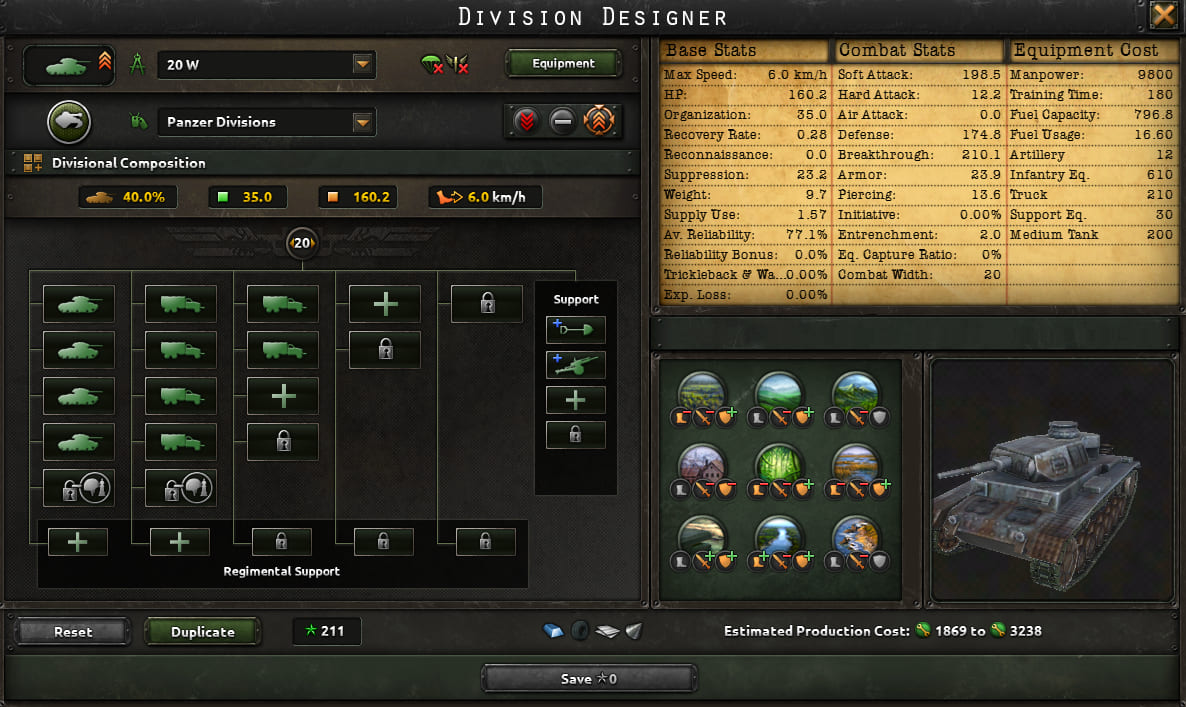


Park 2–4 of these divisions in the same province. An Interwar hull can fight other minors. A 1938 hull is simply stronger: better armor, speed, and reliability. Unlock it if you can. If you cannot, Interwar is still enough against a small country. Do not string these tanks one by one along the whole front: trucks and tanks run out, and one division will not break the line.
Verdict. This is a small country’s attack template. Against a major it is not enough. No rubber — don’t assemble this template.
Infantry, Combat Width 14
- For a minor
- Flexible
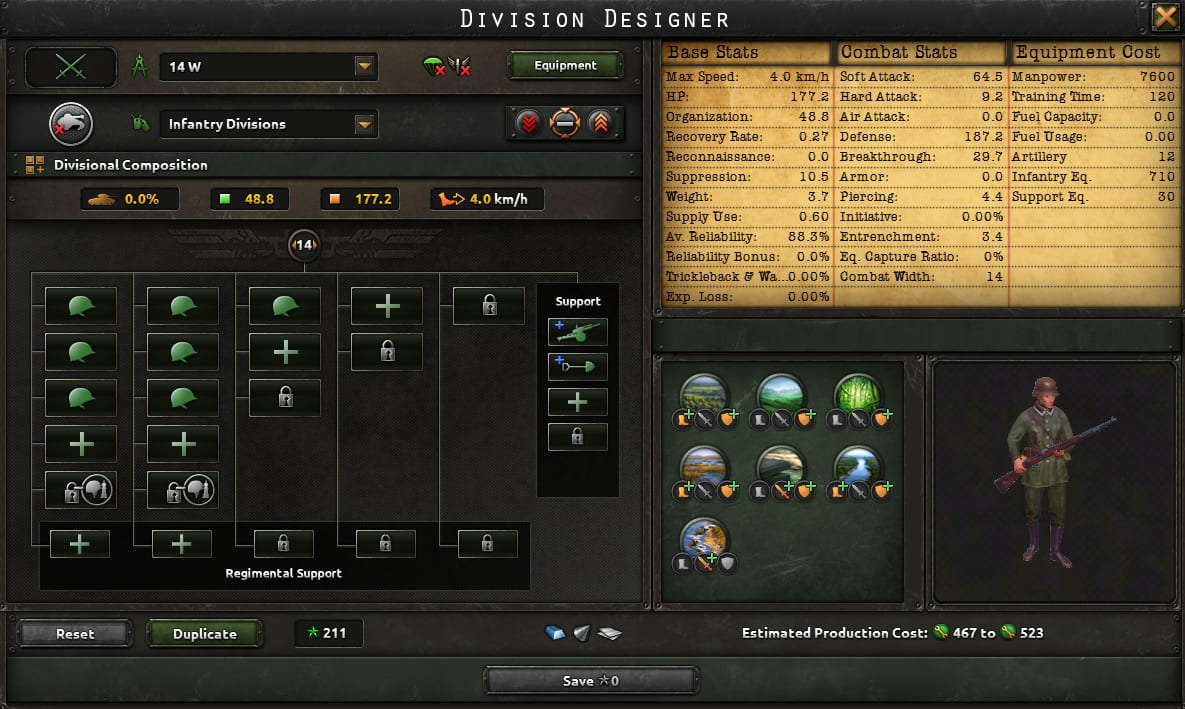
This template holds the front and can attack now and then. These are not tanks, and this is not an occupation garrison. If you barely have any military factories, take width 12 infantry — it is cheaper.
Verdict. This is the main line for a small country when width 10 is already too thin and width 20 is still too much.
Infantry, Combat Width 12
- For a minor
- Cheap
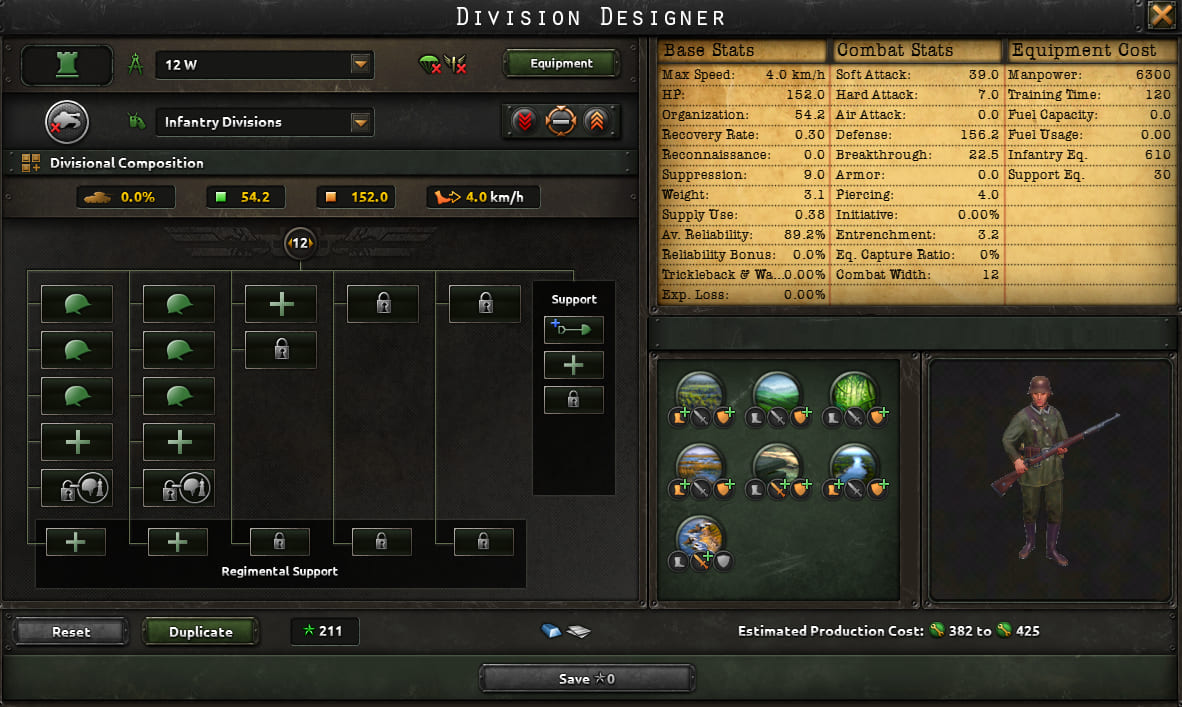
This is cheaper than the width 14 template. You cover the front with numbers. One of these divisions will not hold a line — you need a lot of them.
Verdict. Use this when the rifles barely cover you. Once the factories grow, width 14 is the better line.
Armored infantry, Combat Width 10
- For a minor
- Armor
- Defense
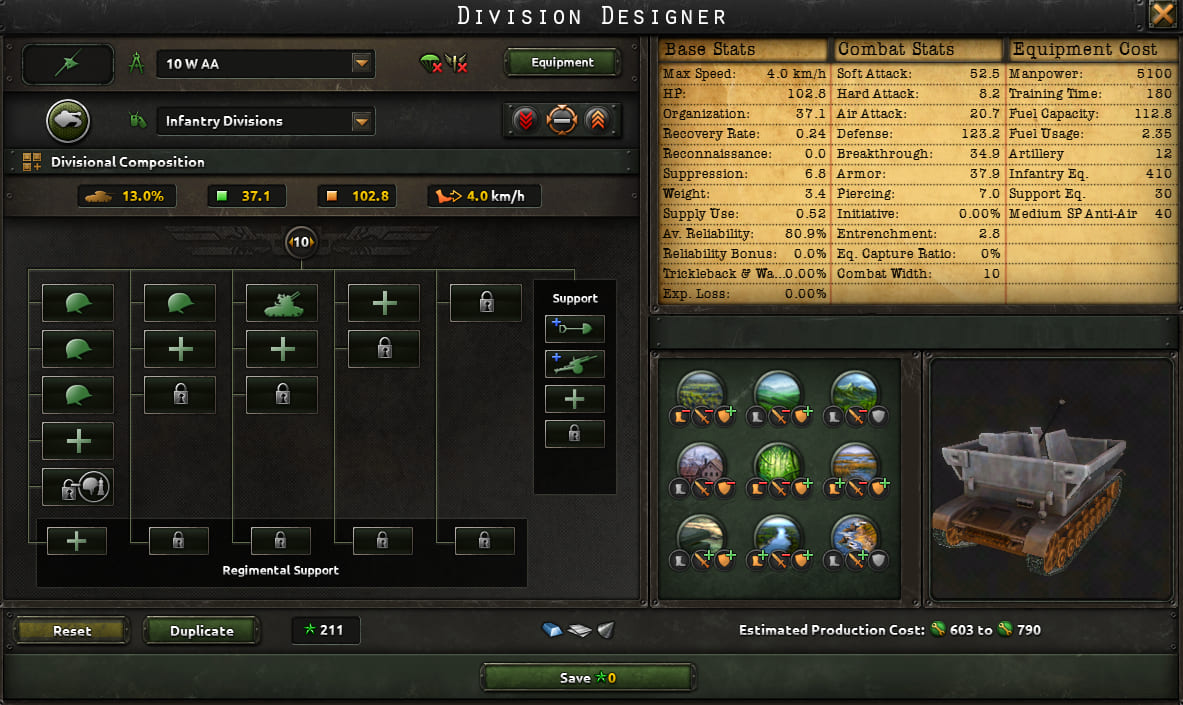

These are not tanks. Cheap Medium SP Anti-Air is what gives the division its armor. An Interwar hull is fine for the SPAA; max the armor in the tank designer. One or two of these in a province next to ordinary width 10 infantry is enough.
Verdict. Use this only if the factories are actually turning out SP Anti-Air. If you have no vehicles, stick to ordinary width 10 infantry.
Cavalry, Combat Width 2
- Garrison
- Not for combat
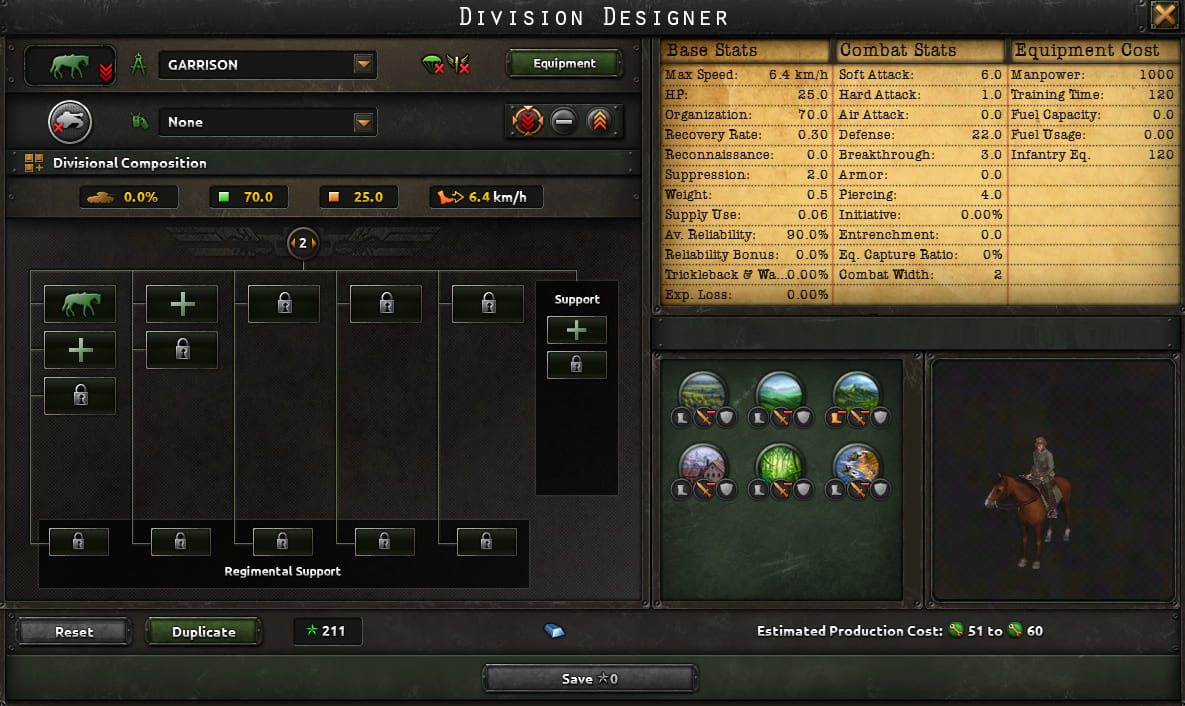

This template is for occupation, for army size under a national focus, and for grabbing empty provinces. Do not park it on the front against regular infantry — it folds in combat.
Verdict. This is for the work around the war, not for the fighting itself. Do not mix it up with line infantry.
More in the article on cheap templates.
Infantry division templates
Infantry by Combat Width: from a cheap width 10 to a heavy width 36. The Armor tabs are infantry with SP Anti-Air or SPGs — not a tank division.
Infantry, Combat Width 10
- Weak minor
- Cheap
- Defense
This is the cheapest line infantry you can run. One division will not win the war — you need a lot of them. There is no regiment support on purpose: that keeps the template cheaper, and Organization easier to hold.
Verdict. This is for a weak small country with no vehicles. Add a support AT company and artillery only if Organization and the factories can take them.
Armored infantry, Combat Width 10
- Minor
- Armor
- Defense
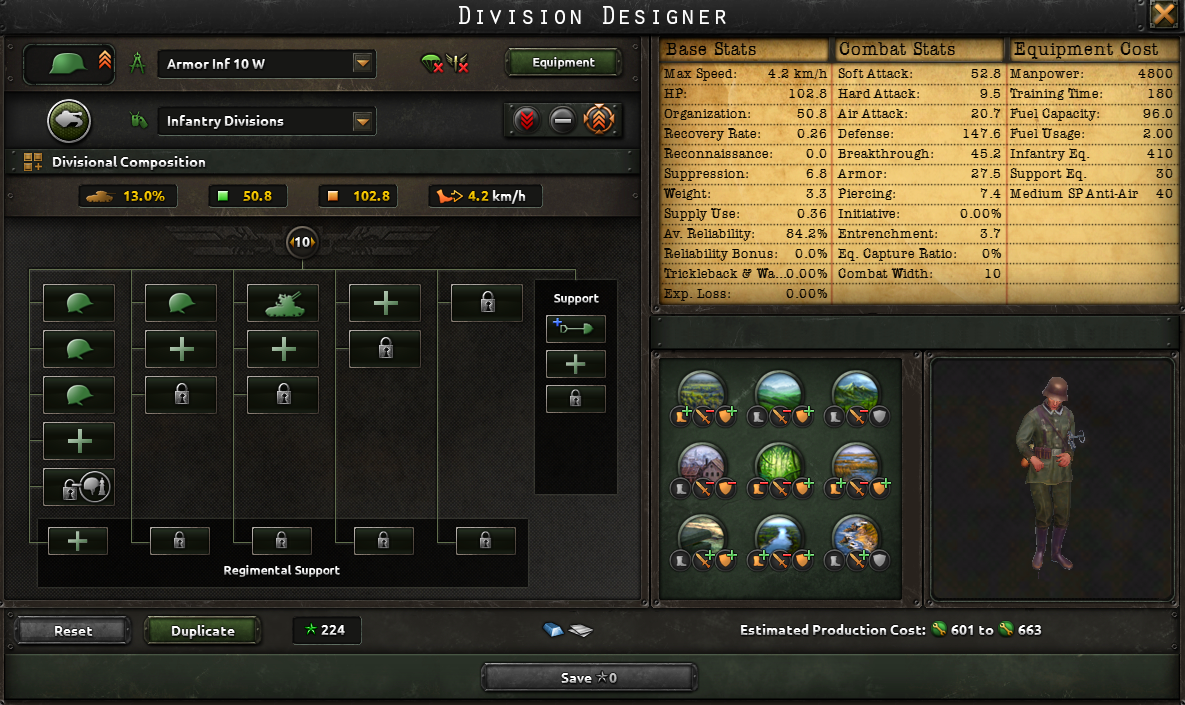
These are not tanks. Cheap Medium SP Anti-Air is what gives the armor. Max the armor in the tank designer. An Interwar hull is enough for the SPAA.
Verdict. Use this only if the factories are actually turning out SP Anti-Air. If you have no vehicles, use ordinary width 10 infantry.
Infantry, Combat Width 14
- Minor
- Weak major
- Flexible
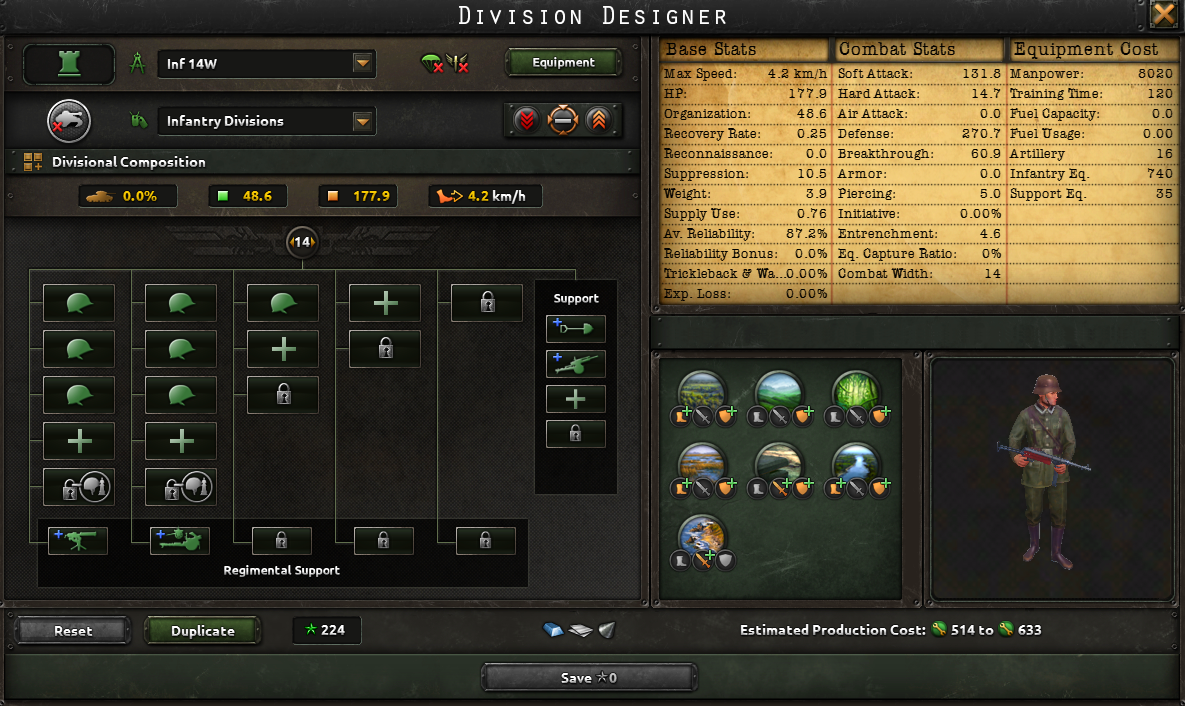


This template holds the front and can attack a little. If Organization is dropping or equipment is short, drop the support regiments.
Verdict. This is the main template for a small country and a weak major. It is not a copy of Soviet width 36 infantry.
Infantry, Combat Width 15
- Minor
- Attack
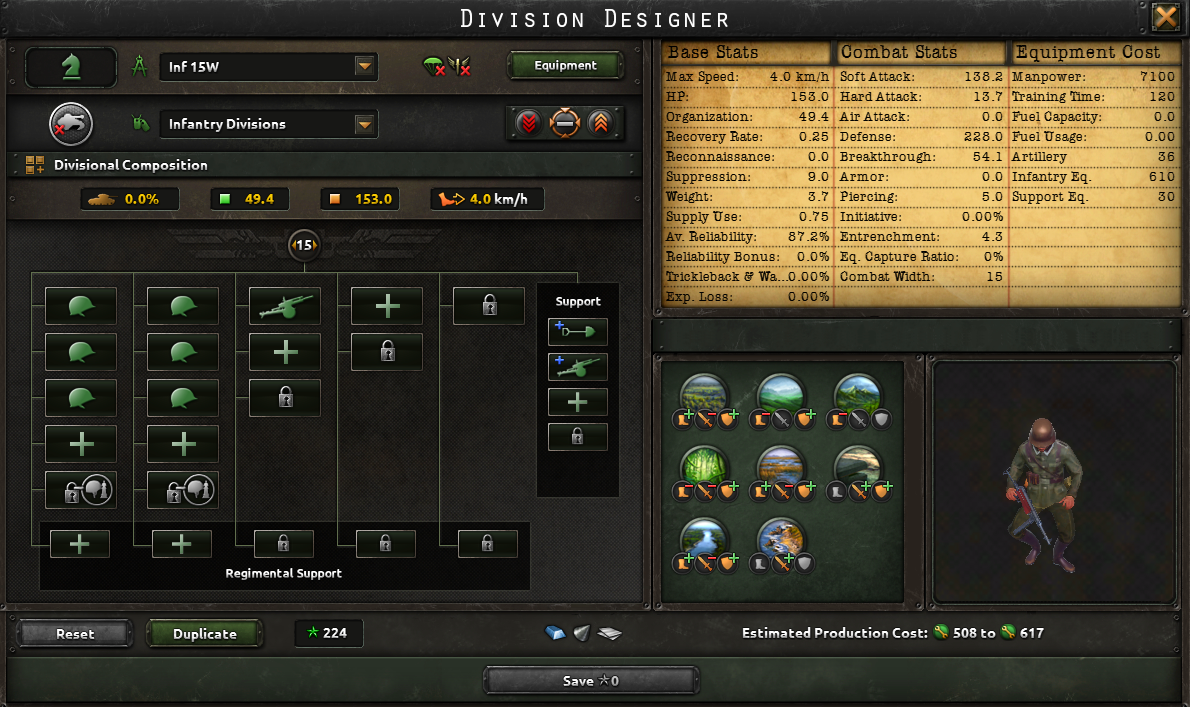
This template hits harder than it sits on defense. In a forest, four of them fill the province cap of 60. Add recon only if Organization can take it.
Verdict. This is for a small country that is attacking. Do not park this template on the whole national defense.
Infantry, Combat Width 18
- Weak–mid major
- Defense
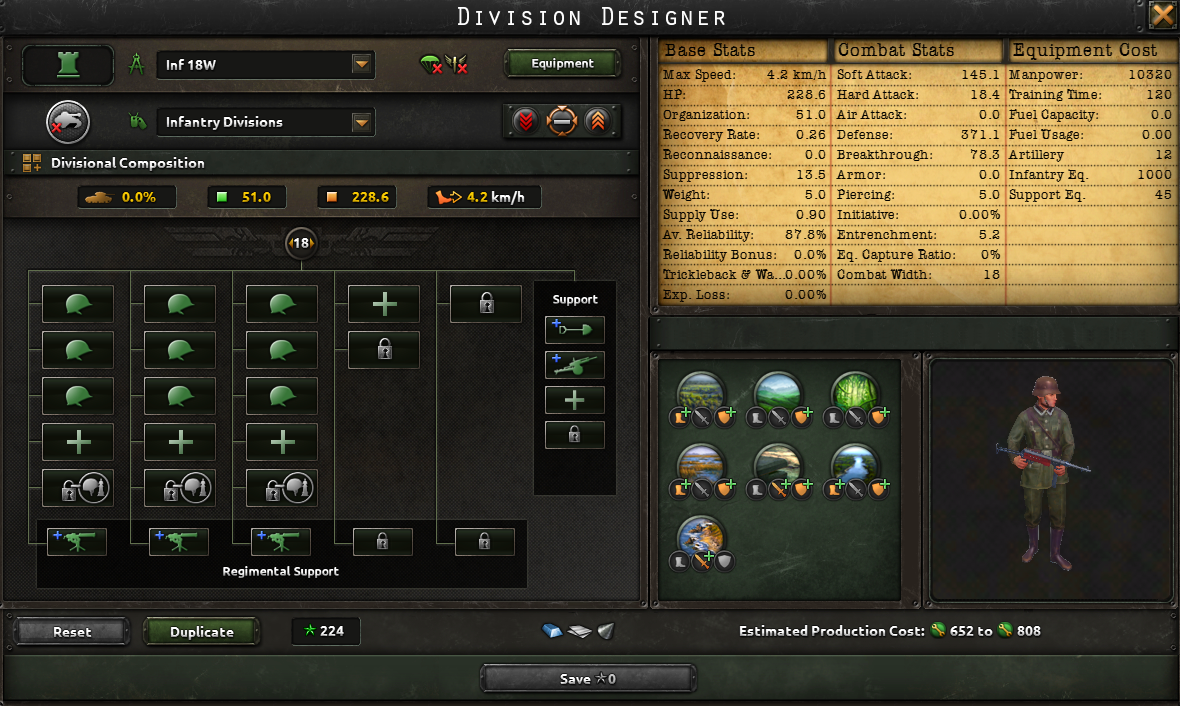
This is strong defense for the provinces that matter, not for the whole border. Three regiments chew through a lot of equipment. If the stockpile is empty, drop the regiments.
Verdict. This is for a weak or mid-tier major — on the stretches of the front that matter.
Infantry, Combat Width 20
- Mid-tier major
- Defense
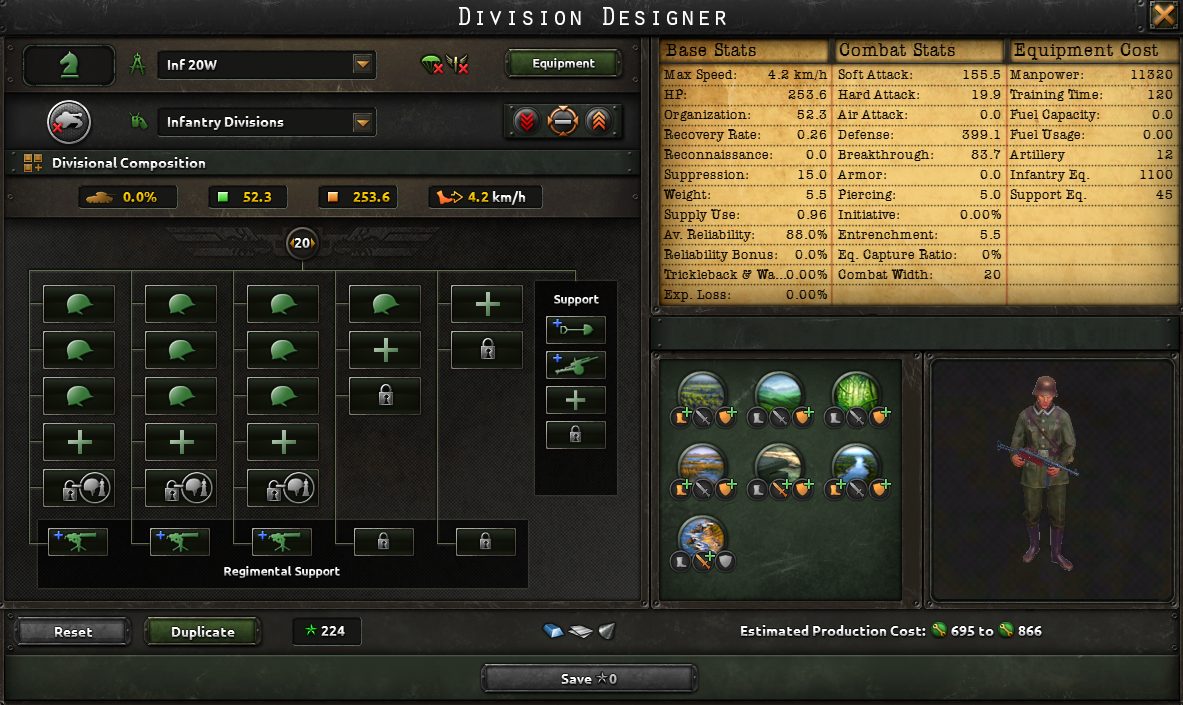
This is denser than the width 18 template. It is too expensive for the whole army. Cover the quiet stretches of the map with width 10 infantry.
Verdict. This is for the key provinces of a mid-tier major. Do not run this template coast to coast.
Armored infantry, Combat Width 20
- Major
- Armor
- Defense
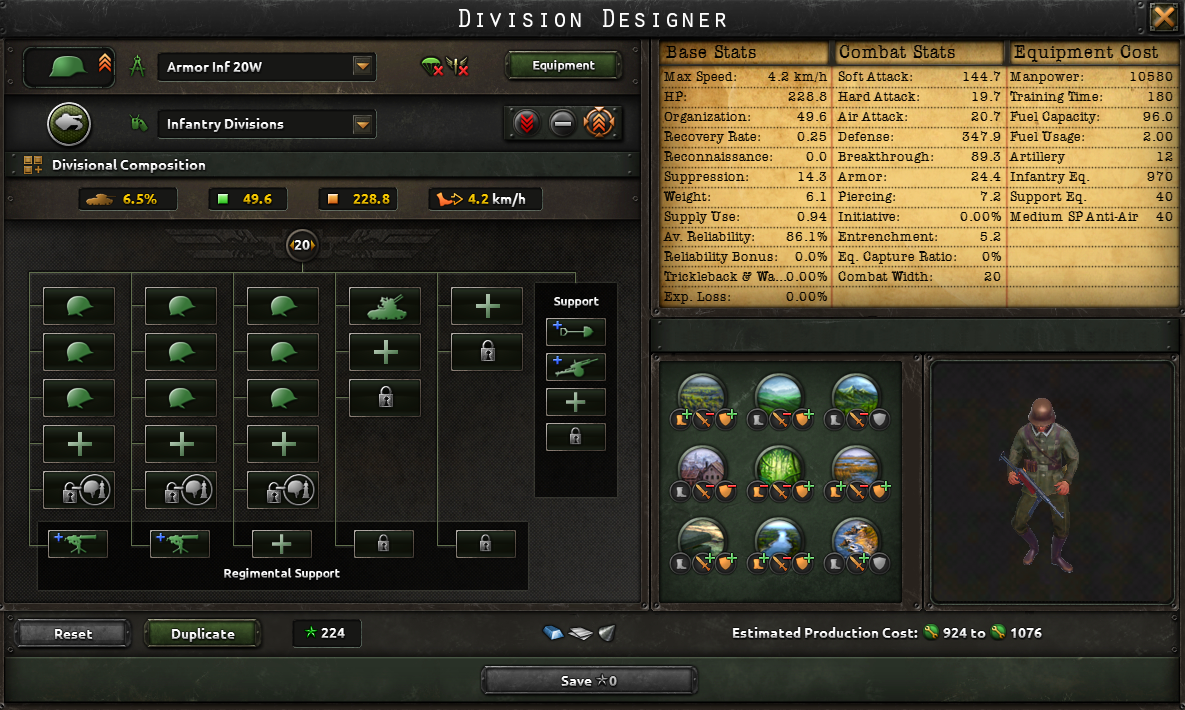
The line holds on SP Anti-Air armor, not on tanks. A 1938 or 1940 hull is better for the SPAA; put armor first. If Organization is weak, drop the regiments.
Verdict. This is for a major that already stamps SP Anti-Air steadily. Do not copy this template onto the whole front.
Infantry, Combat Width 25
- No special forces
- Mountains and marsh
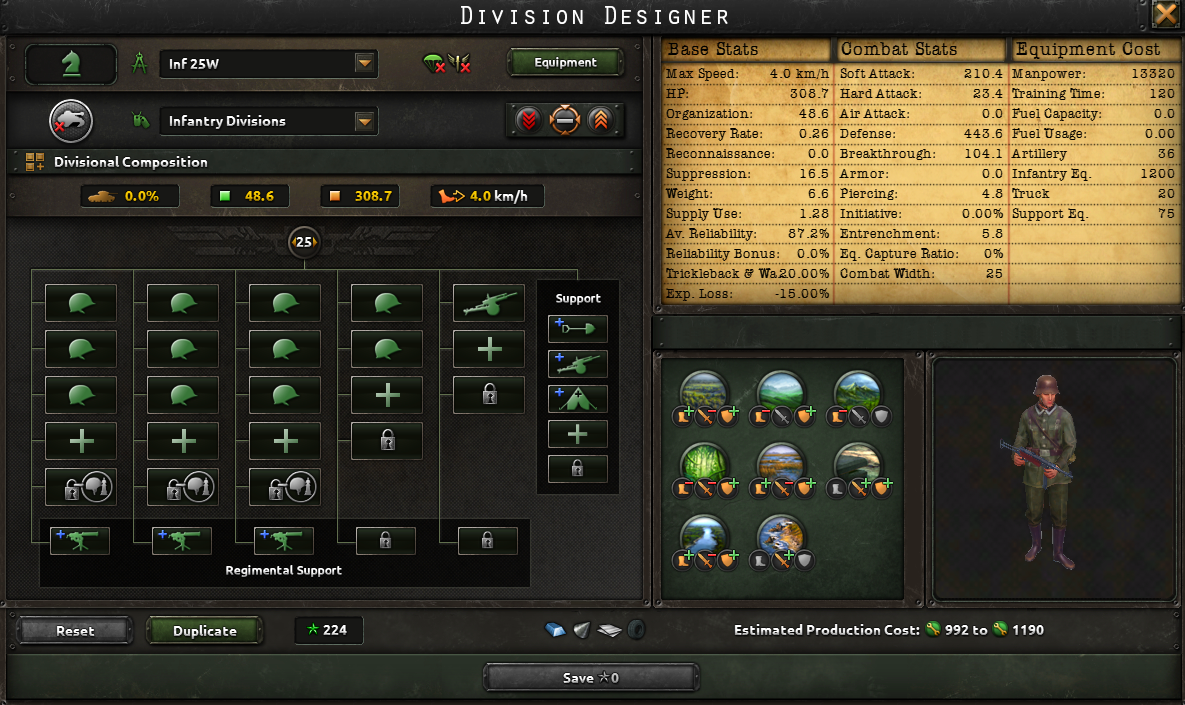

This is the replacement if you have no mountaineers and no marines: two of these fill a mountain or marsh province (cap 50). A Field Hospital eats trucks.
Verdict. Use this when you have no special forces and the front is already in the mountains or the marsh. On open ground, width 18–20 is cheaper.
Infantry, Combat Width 36
- Major
- Attack
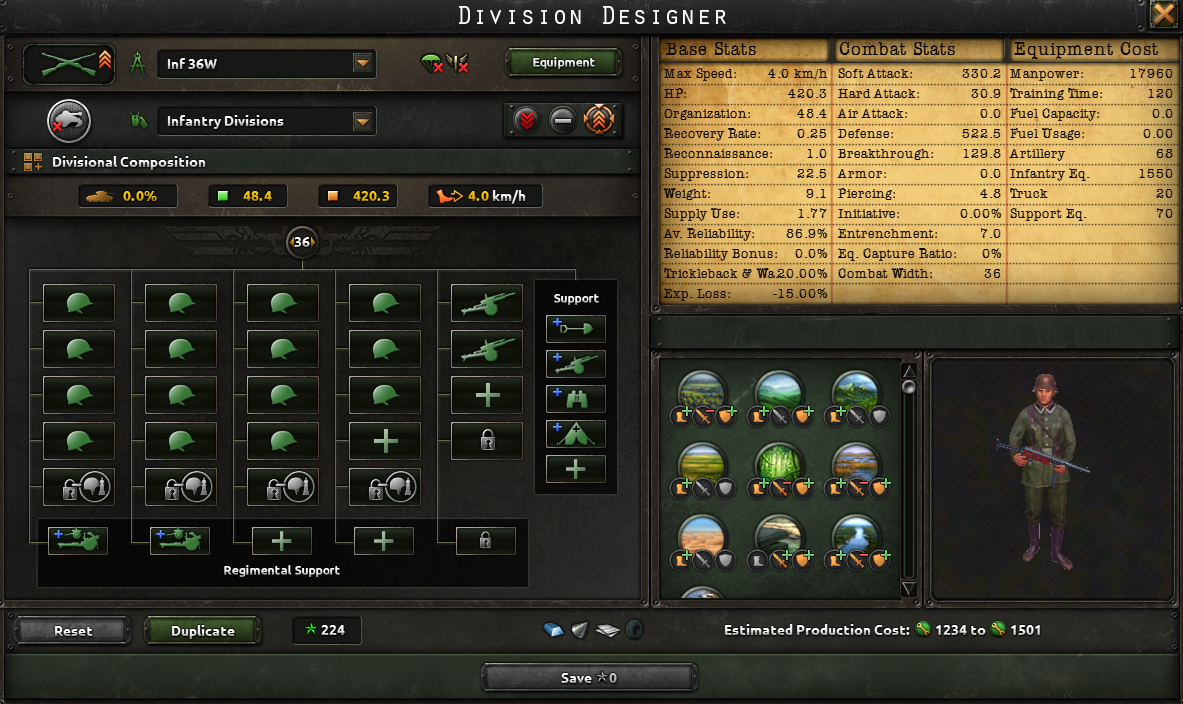

This is offensive infantry for a major. Leave the fifth company slot for AA or AT as the war goes — don’t park both in advance.
Verdict. Use this once you already have enough artillery. Do not cover the whole front with this template.
Armored infantry, Combat Width 36
- Mega-major
- Attack
- Armor
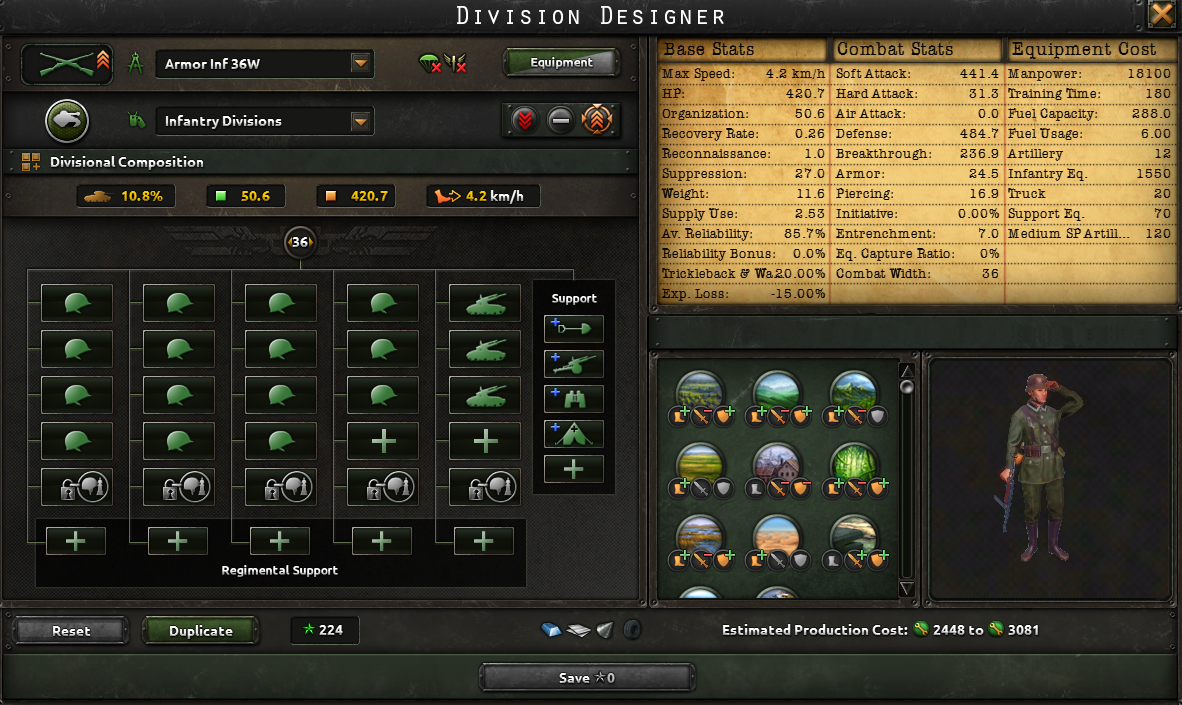

Soft Attack comes from the SPGs, not from tanks. A USSR-sized industry can carry this template. Tiny Portugal cannot.
Verdict. This is only for a very large country once SPGs are actually in production. A small country is not ready.
More in the article on infantry division templates.
Templates for defense
These lineups exist to hold a province. They are not breakthrough templates: Organization and the cost of the line matter more here than a fat attack number.
Infantry, Combat Width 10
- Cheap
- Defense
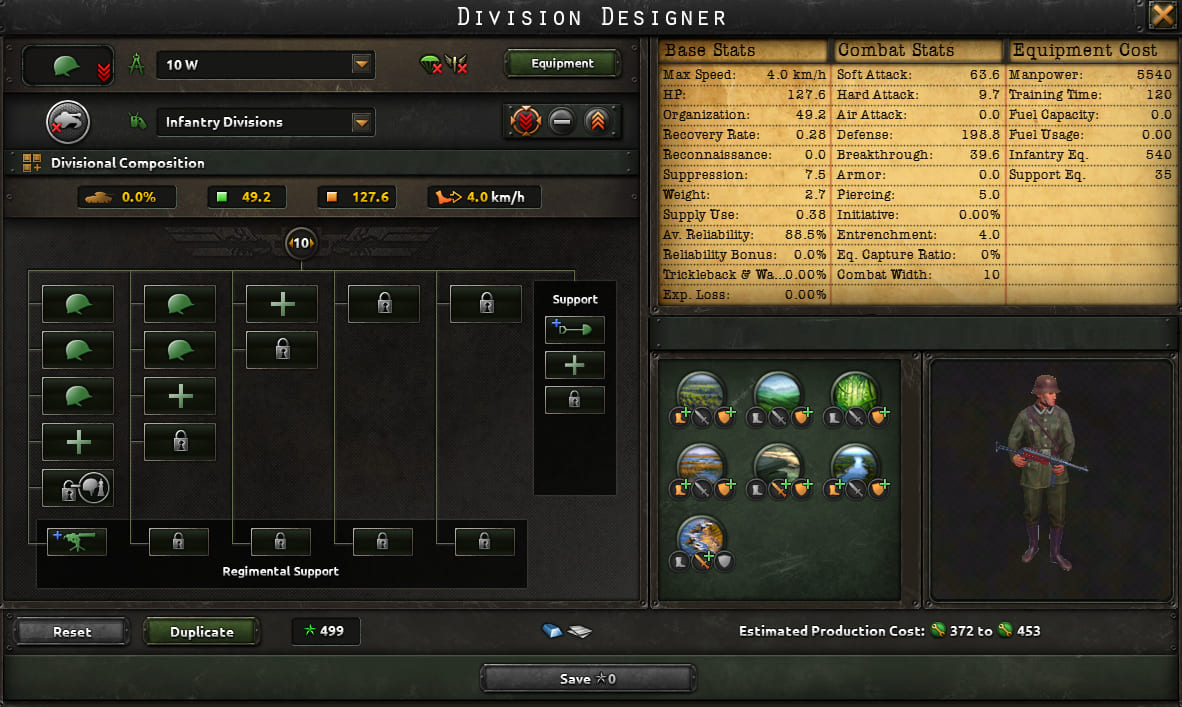
This is the default defensive template for any country. A really tiny start can drop the Heavy Weapons Company. Against tanks this template stays soft until you add an anti-tank company.
Verdict. Stamp a pile of these on the line. One division does not hold an army.
Armored infantry, Combat Width 10
- Minor
- Armor
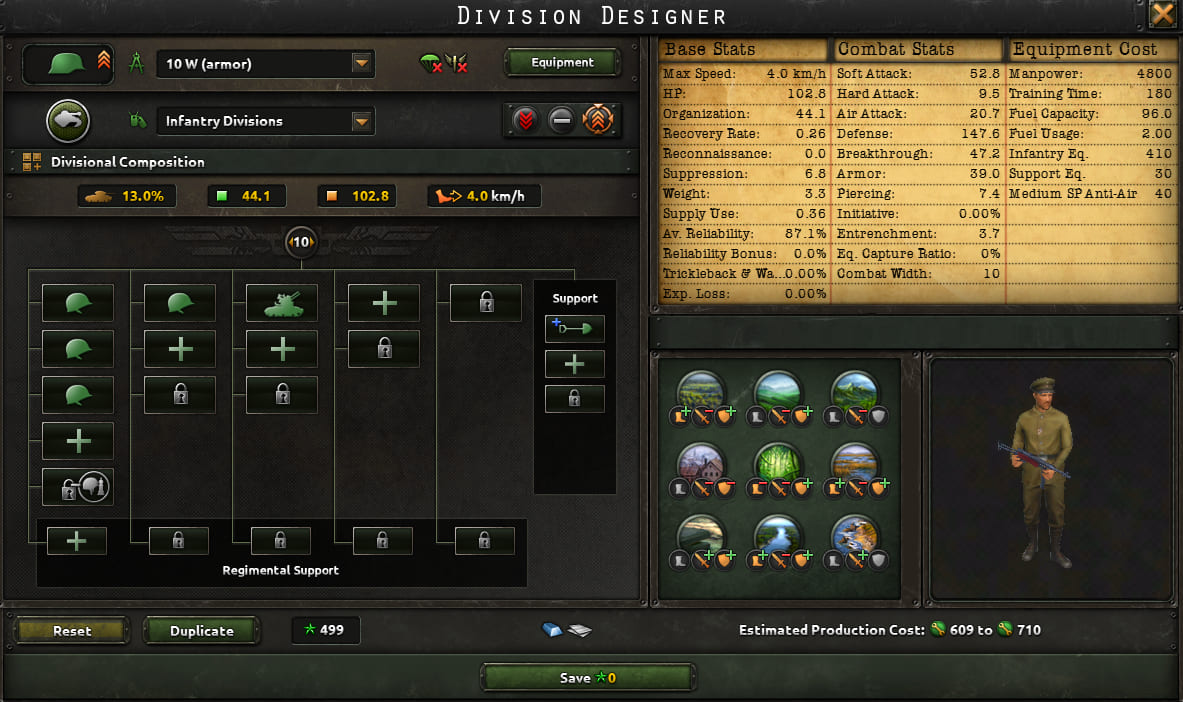
Keep the SP Anti-Air cheap; max the armor in the tank designer. An Interwar hull is enough for the SPAA. Park one or two of these in a province next to ordinary width 10 infantry.
Verdict. Use this only if you really have 7–10 factories on SP Anti-Air. A large major should look at width 20 armor instead.
Infantry, Combat Width 15
- Defense
- Counter-attack
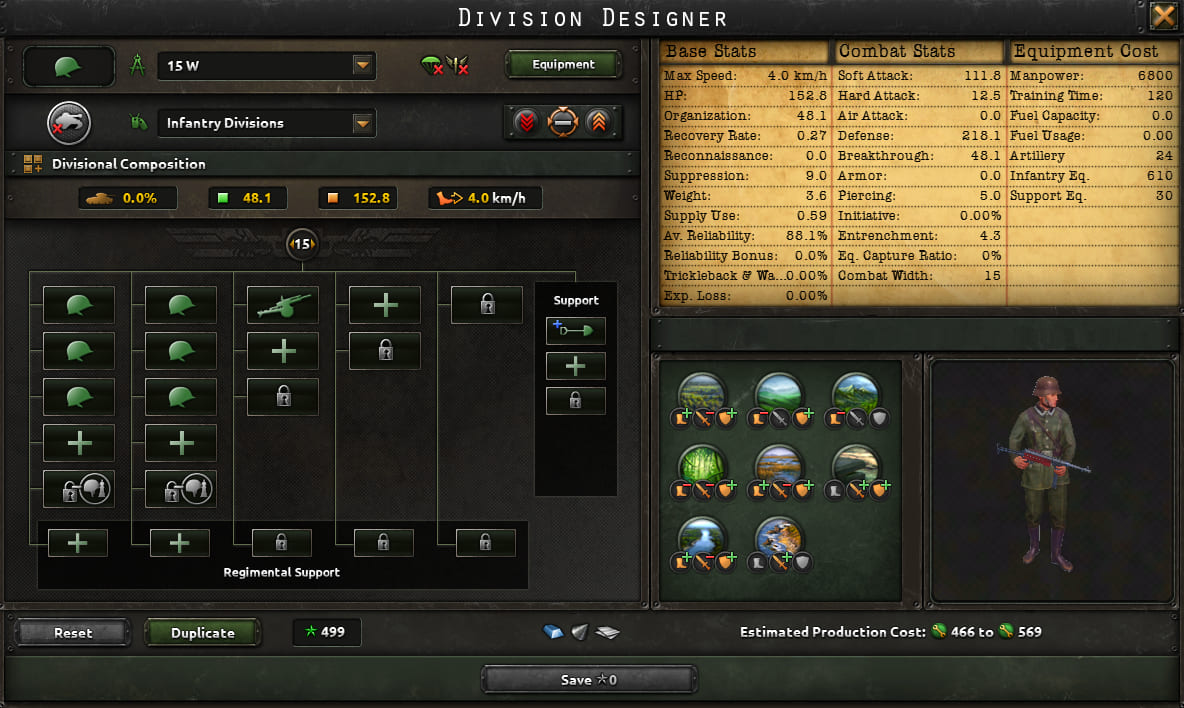
This template holds the province and can shove a little on your own soil. It is not a dash across half the map.
Verdict. Use this once the line already exists and ordinary width 10 infantry is no longer enough.
Rangers, Combat Width 15
- Forest
- Special forces
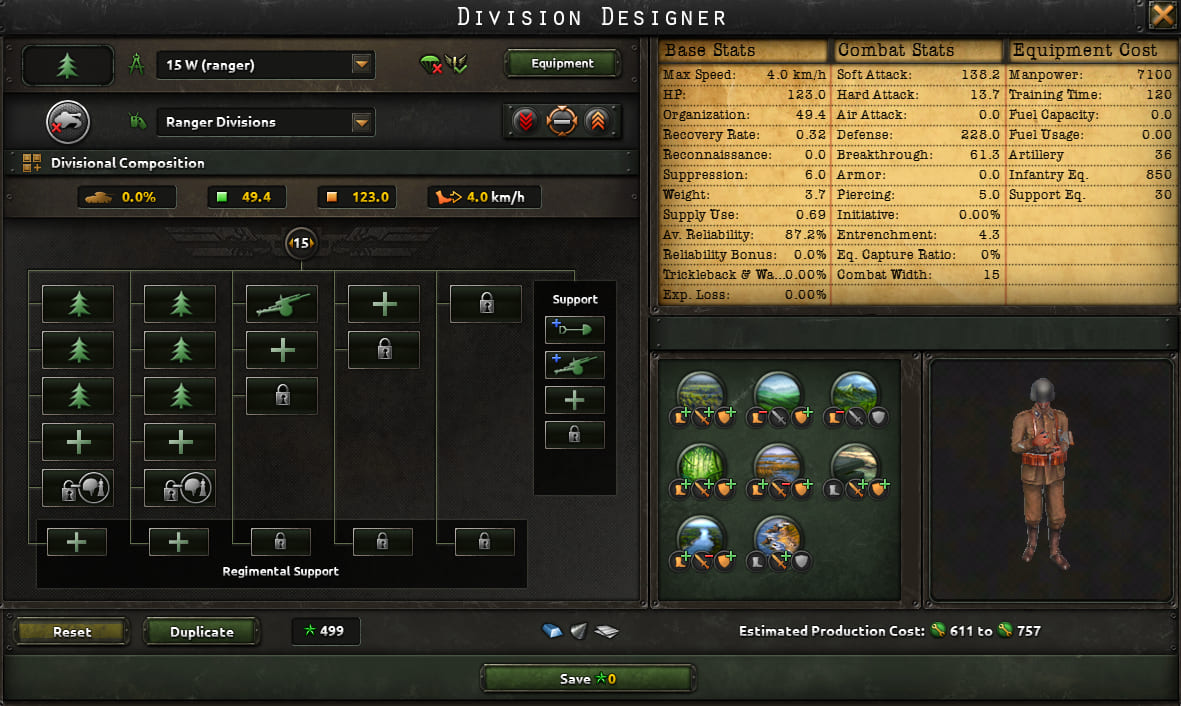

Four of these divisions fill a forest province (cap 60). The special-forces cap is shared across every special-forces type — don’t wrap all of Europe in Rangers.
Verdict. Forest and jungle only. On open ground, spend the special-forces cap on mountaineers or marines.
Armored infantry, Combat Width 20
- Major
- Armor
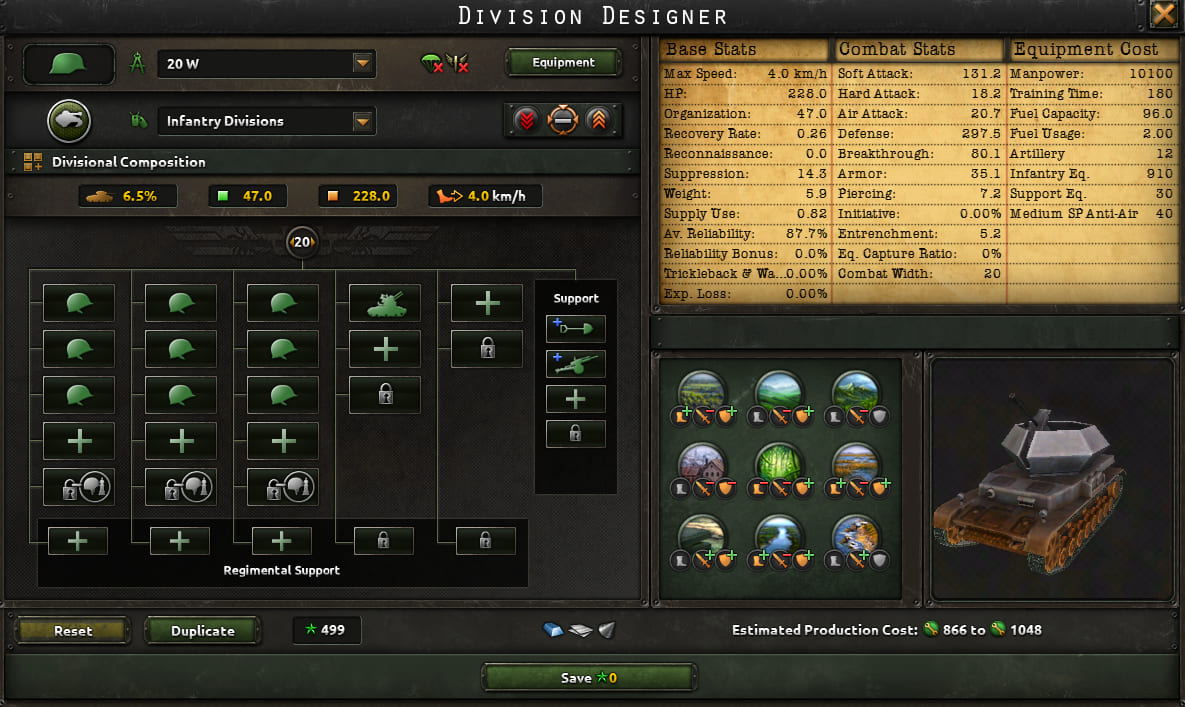
This is costlier than width 10 infantry. Don’t clone this template onto every port and the whole border. Put it only on the provinces you cannot afford to lose cheaply.
Verdict. This is for Germany and similar countries — on key provinces. A small country is not ready.
Mountaineers, Combat Width 25
- Mountains
- Special forces
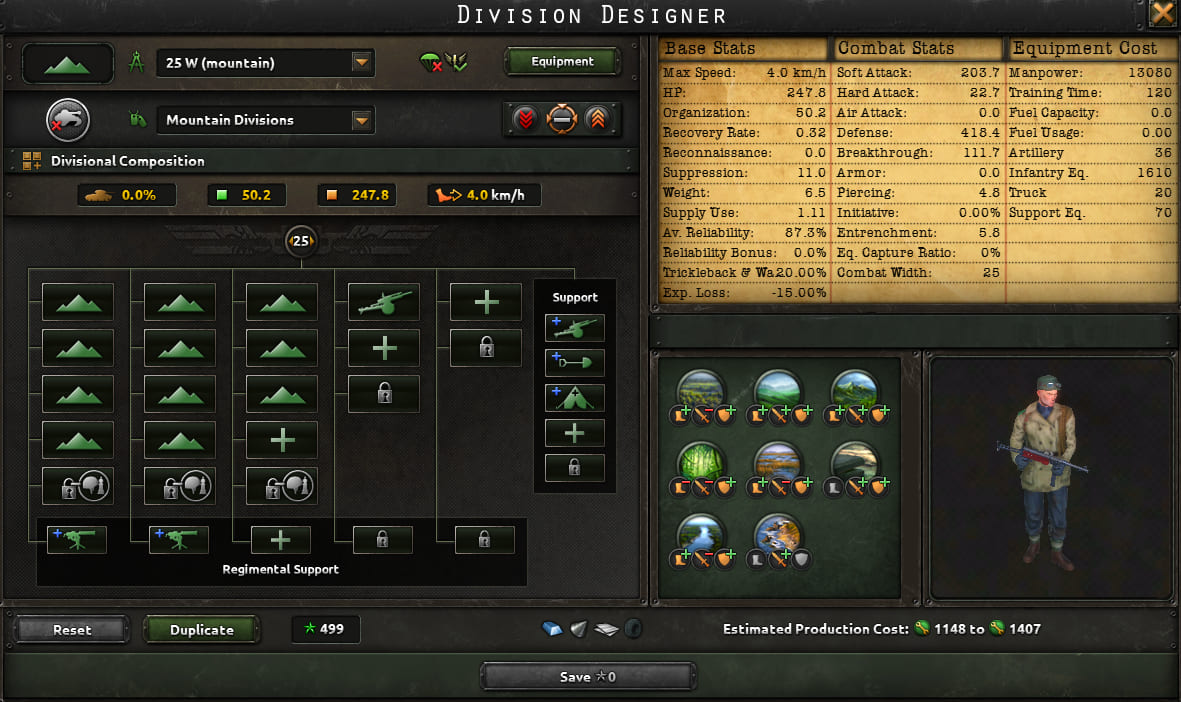

The Alps, the Caucasus, hills. On plains this is expensive infantry that also eats the special-forces cap.
Verdict. A handful of divisions for mountains and hills, not the whole army.
Marines, Combat Width 25
- Marsh
- Special forces
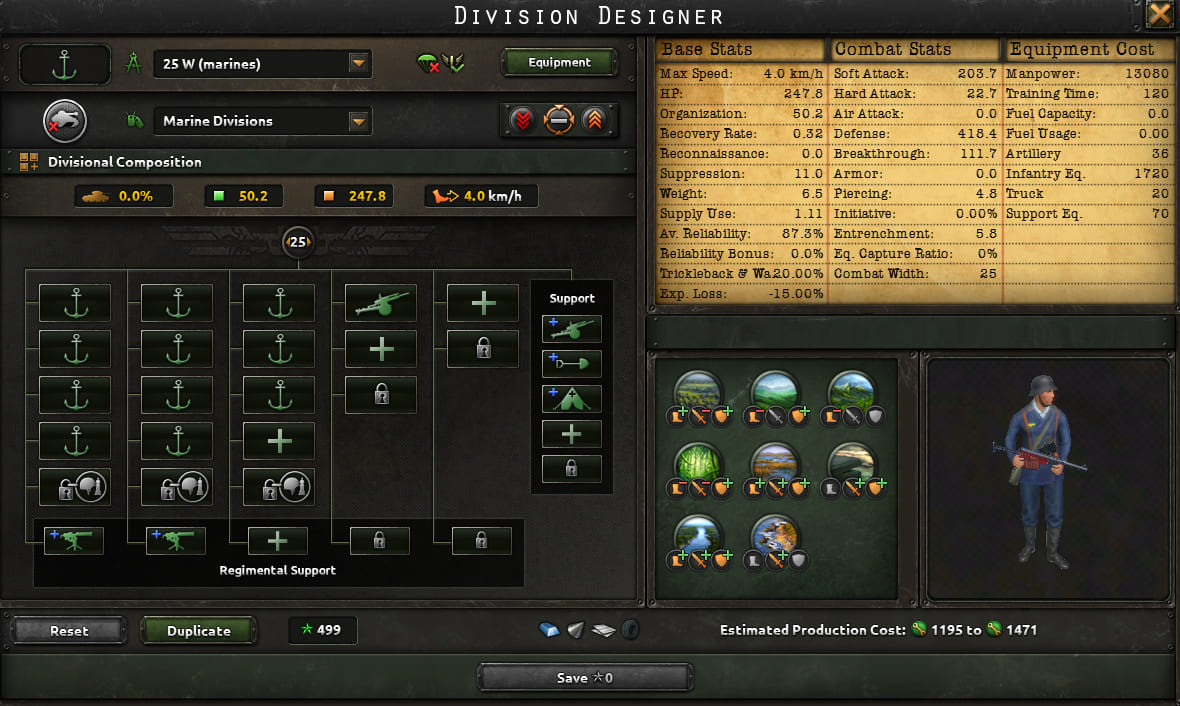

Marsh and coast. Ordinary infantry takes −40% there. This template does not replace infantry inland.
Verdict. This is for a narrow front by the water. Count the special-forces cap before you recruit.
More in the article on templates for defense.
Templates for breakthrough
The task is to shove one province and stay there. Stack 2–5 of these in that province, with infantry on the flanks. Do not park them along the whole border.
Tanks, Combat Width 36
- Major
- Attack
- Tank
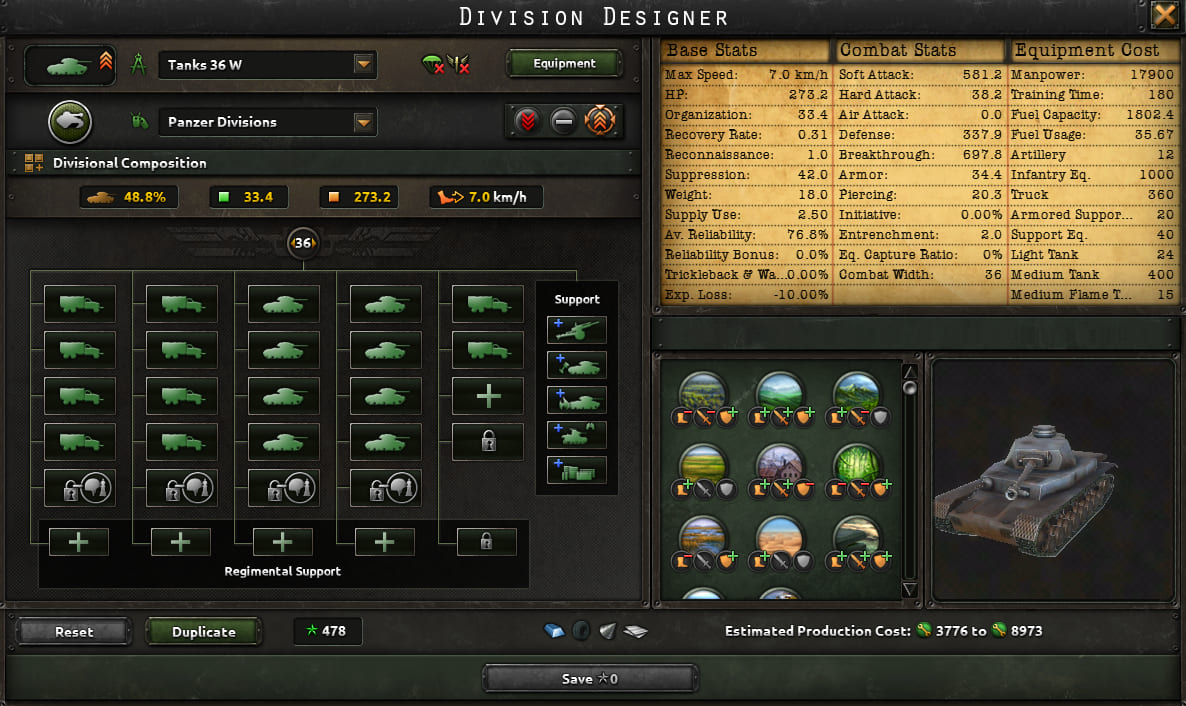


This is a major’s main template once the factories can keep up. Skip the Logistics Company and the column starves. A small country at the start of a game is years too early.
Verdict. Mid and late game, for a major. Thin industry — open the Tanks 20 tab.
Tanks, Combat Width 20
- Minor–major
- Breakthrough
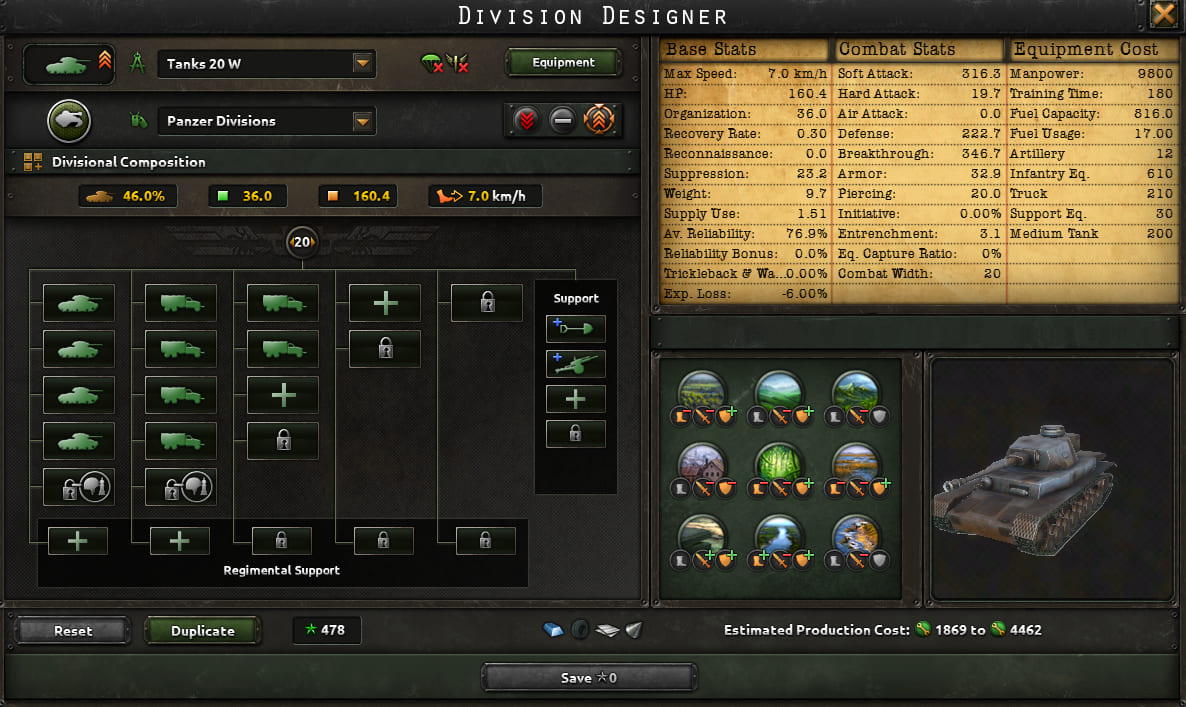
This is the main breakthrough template while width 36 is still too heavy. Stack 2–5 in one province. An Interwar hull can fight other small countries. The 1938 hull hits harder: armor, speed, reliability. Unlock it if you can. If you cannot, Interwar still works against a small neighbor. Bad terrain cuts the attack.
Verdict. Use this when tanks and supply cannot carry width 36. No rubber — leave this template unbuilt.
Motorized Infantry, Combat Width 20
- Exploitation
- Not a tank
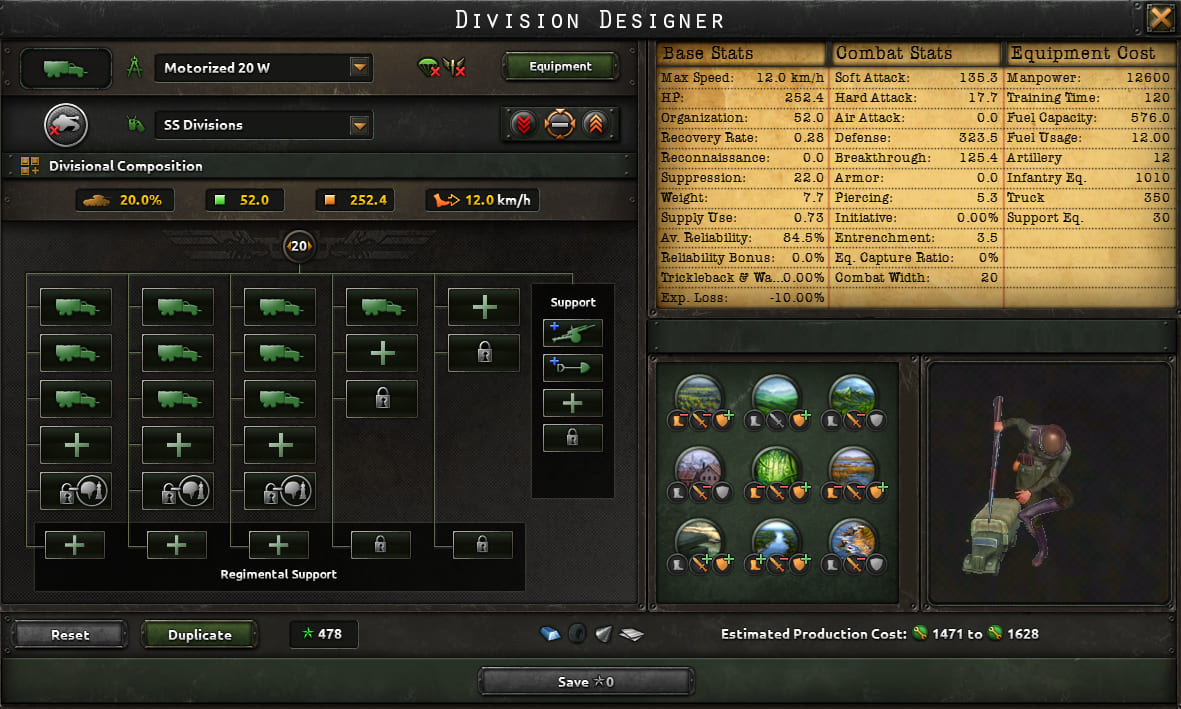
Once tanks have torn the line, these divisions race into the rear and close the pocket. Head-on into trenches without tanks they fold. Rubber and fuel both go.
Verdict. This is a pocket reserve. It does not replace a tank breakthrough.
Armored infantry, Combat Width 20
- Infantry breakthrough
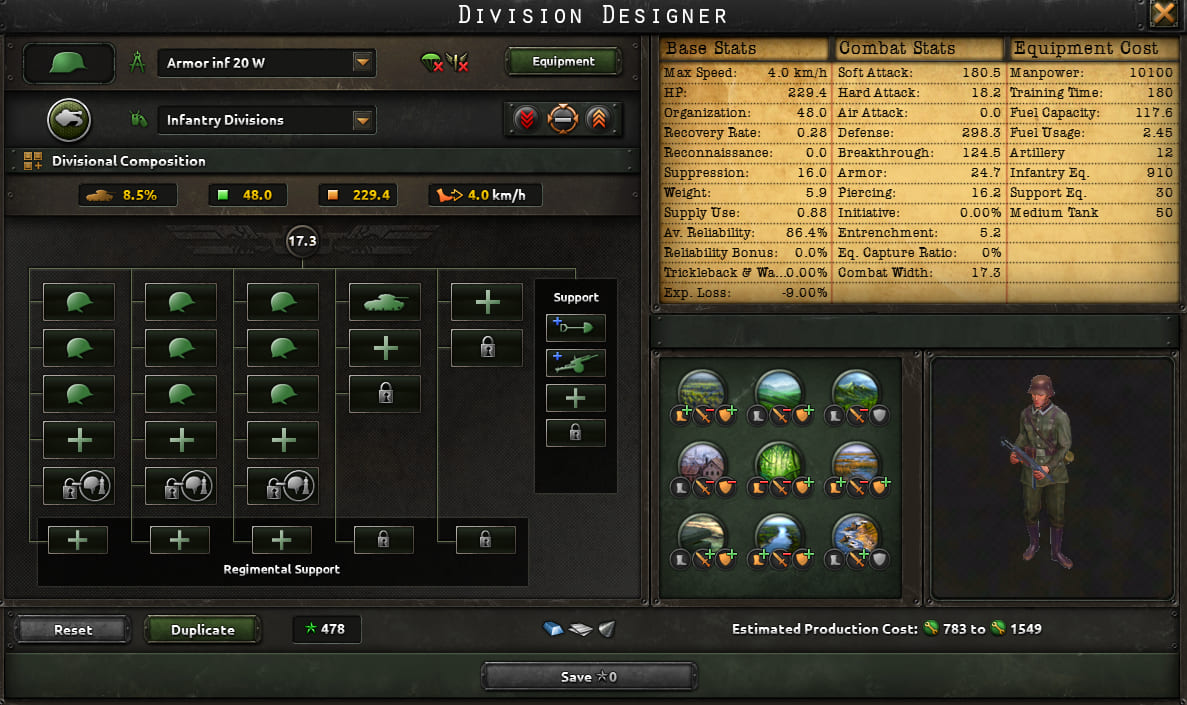
You don’t have enough tanks for a real breakthrough, and ordinary infantry already fails to shove the line. This is not a width 36 tank division.
Verdict. This is a compromise. Real breakthroughs still belong to the tank templates.
More in the article on templates for breakthrough.
Tank templates
Every lineup here sits on a medium chassis. A small country takes width 10 and 20. A major takes width 36, mixed, and SPG once the subdoctrine and the supply exist.
Tanks, Combat Width 10
- Weak minor
- Cheap
- Tank
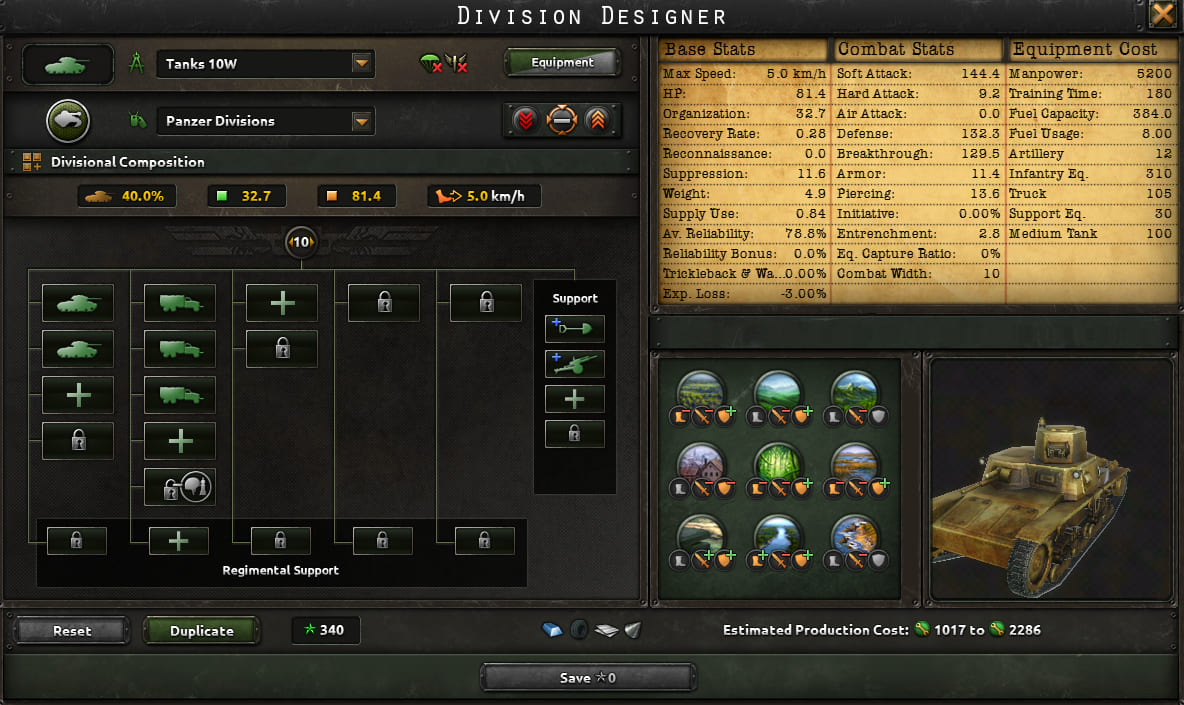
An Interwar hull is often enough. Stack 3–4 in one province and you can fight another small country. HP is low; against a major they wilt.
Verdict. This is for a weak small country. Add recon only if Organization can take it.
Tanks, Combat Width 20
- Strong minor
- Tank
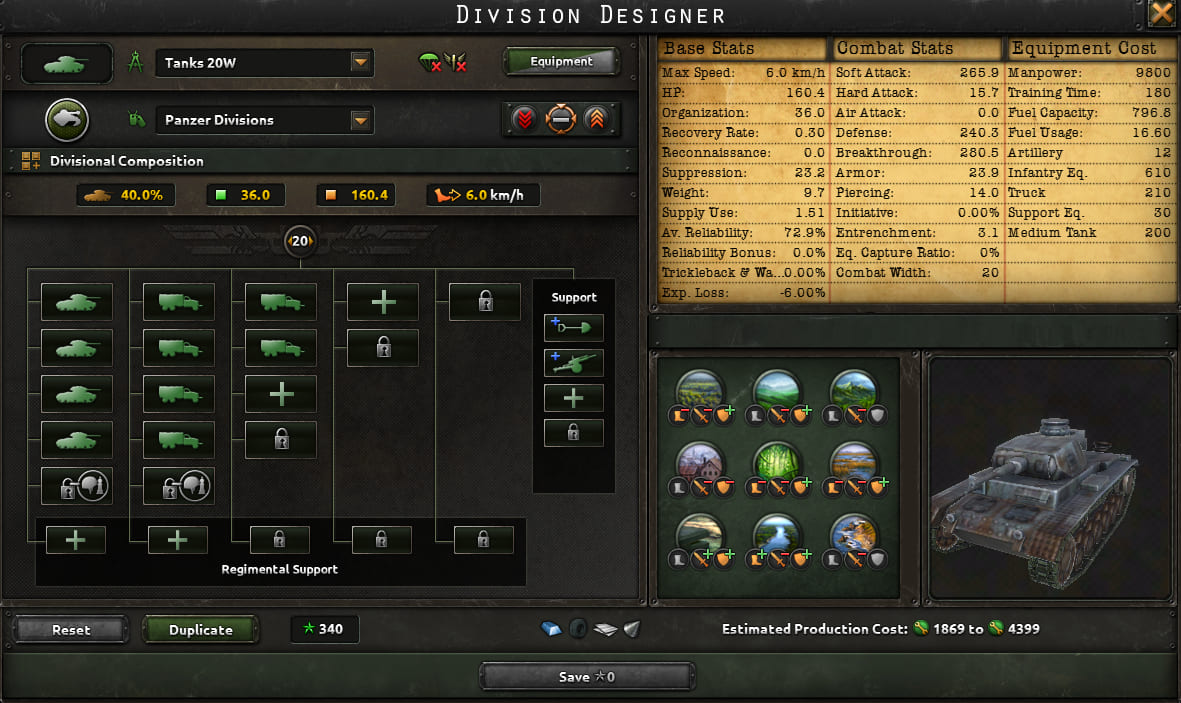
This is the attack template. Stack 2–5 in one province. Interwar hulls can fight other small countries. The 1938 hull is stronger: armor, speed, reliability. Unlock it if you can; if not, Interwar still works against a small neighbor. Special projects are not required. Supply sits in the middle: watch it, but this is not the hungriest lineup.
Verdict. This is for a strong small country against a weak or mid-tier major. Against a very large major this is already thin. No rubber — don’t build it.
Tanks, Combat Width 36
- Major
- Late-game
- Tank
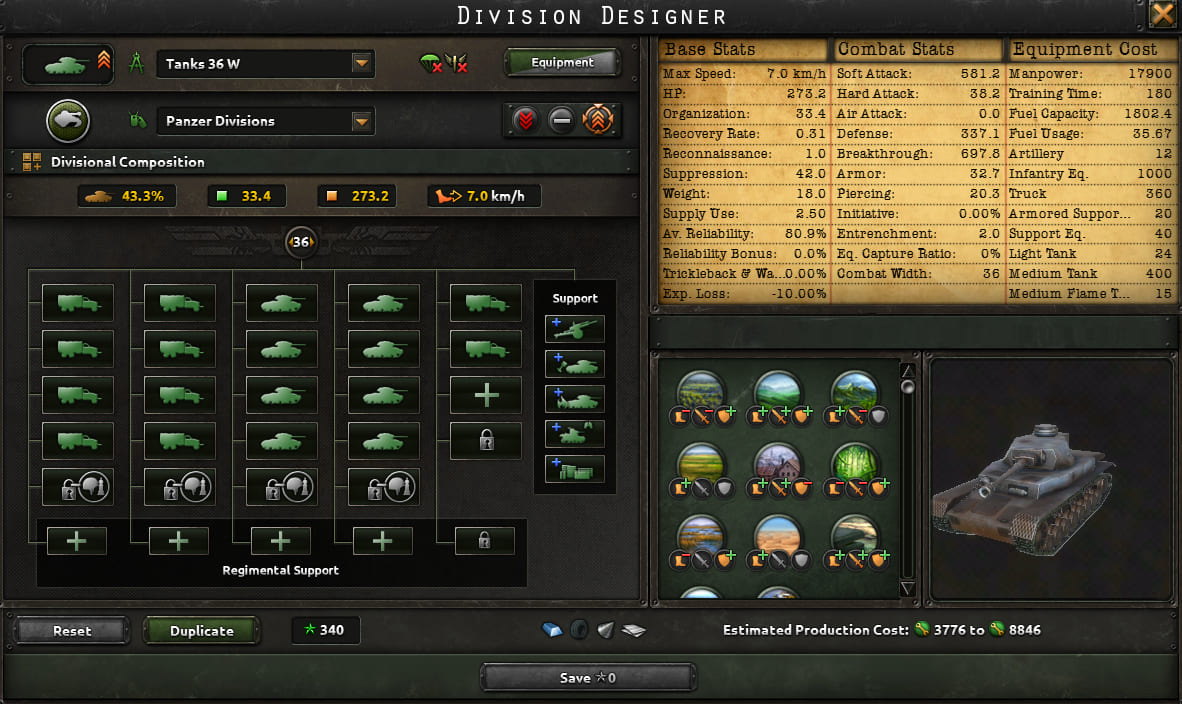

Park one or two of these in one province. The tank hull is 1940, with a howitzer on the turret. Without a Logistics Company and without air, the division dies fast. There is no AA in this lineup.
Verdict. This is for a strong major. Red air — slot an AA battery into the regiment.
Mix, Combat Width 36
- Major
- Late-game
- Mixed
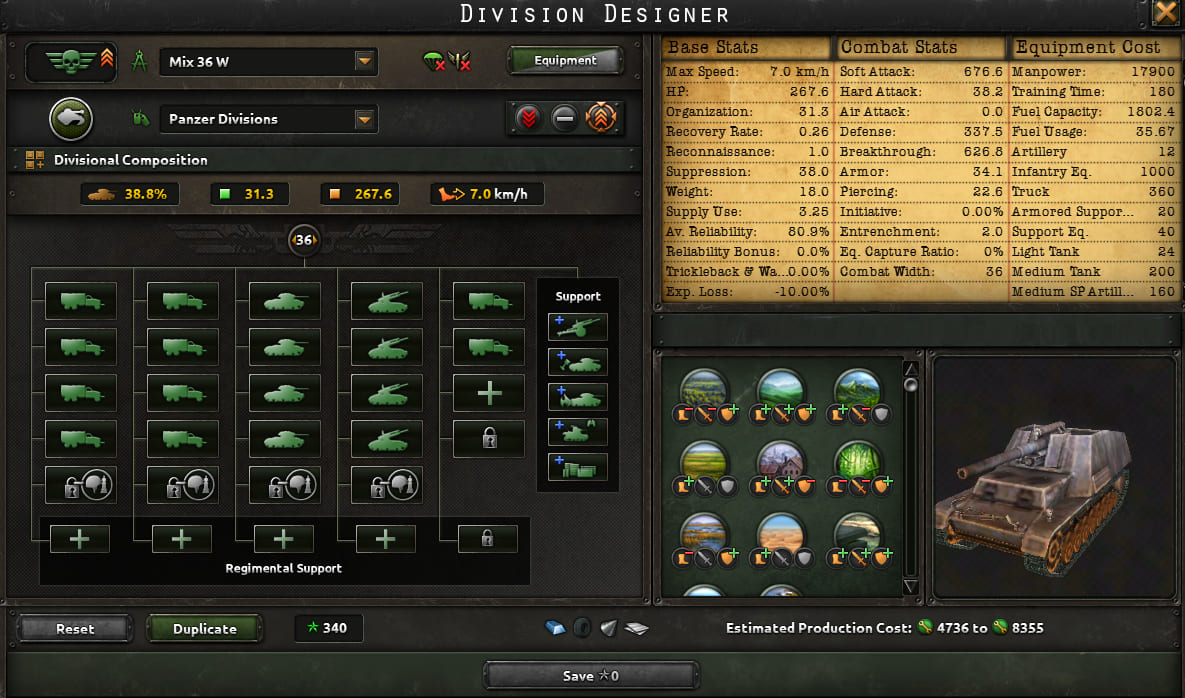
Tank breakthrough plus SPG Soft Attack. This needs the Self-Propelled Support subdoctrine. A Logistics Company is not optional.
Verdict. This is for a major versus the AI until late war. A small country is not ready.
SPG, Combat Width 36
- Major
- Late-game
- SPG
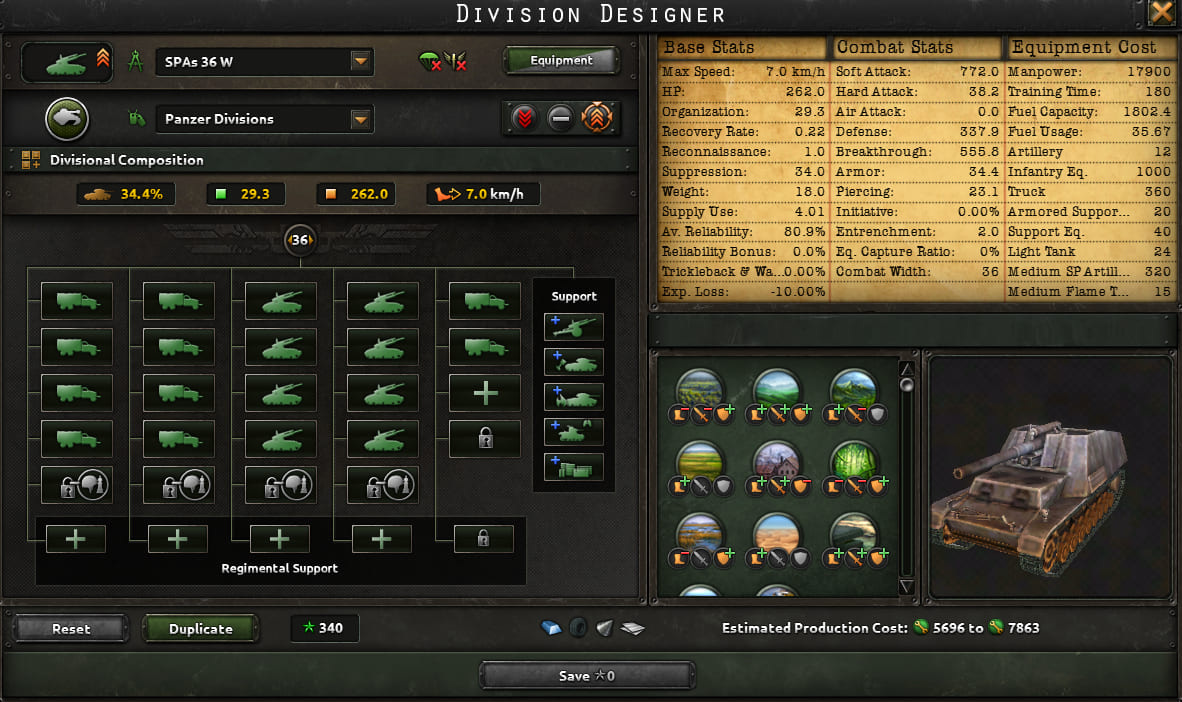
This hits infantry defense hard. Enemy tanks hold it worse than a clean Medium Tank lineup. Supply eats a lot.
Verdict. This is for a major with Self-Propelled Support. Against enemy tanks, clean Medium Tank is better.
More in the article on tank templates.
Motorized infantry templates
Without tanks, motorized infantry is weak. Speed and pockets are the point, not a frontal fight into forts.
Motorized Infantry, Combat Width 10
- Minor
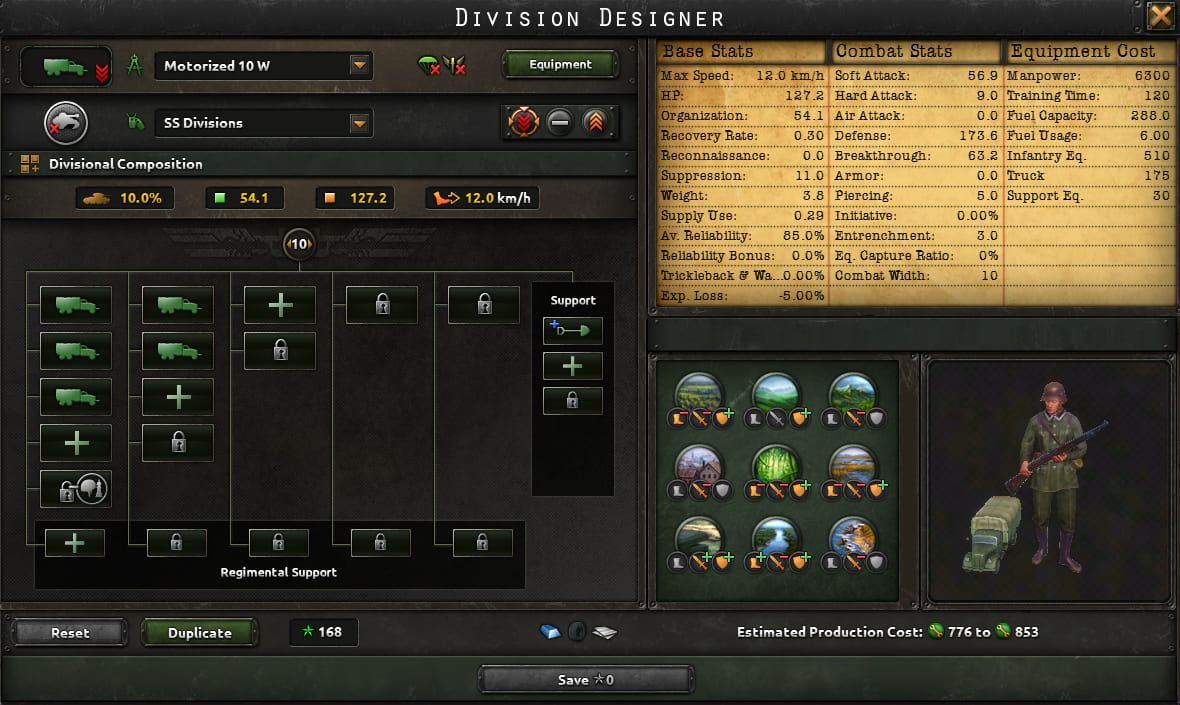
Tanks tear the line; these divisions follow in packs. They will not shove trenches head-on. I skip width 2–8 on purpose: a ten still holds a province if something pokes it.
Verdict. Build a lot of these and don’t cry if some get pocketed. I usually skip company artillery — the template gets expensive.
Motorized Infantry, Combat Width 20
- Major
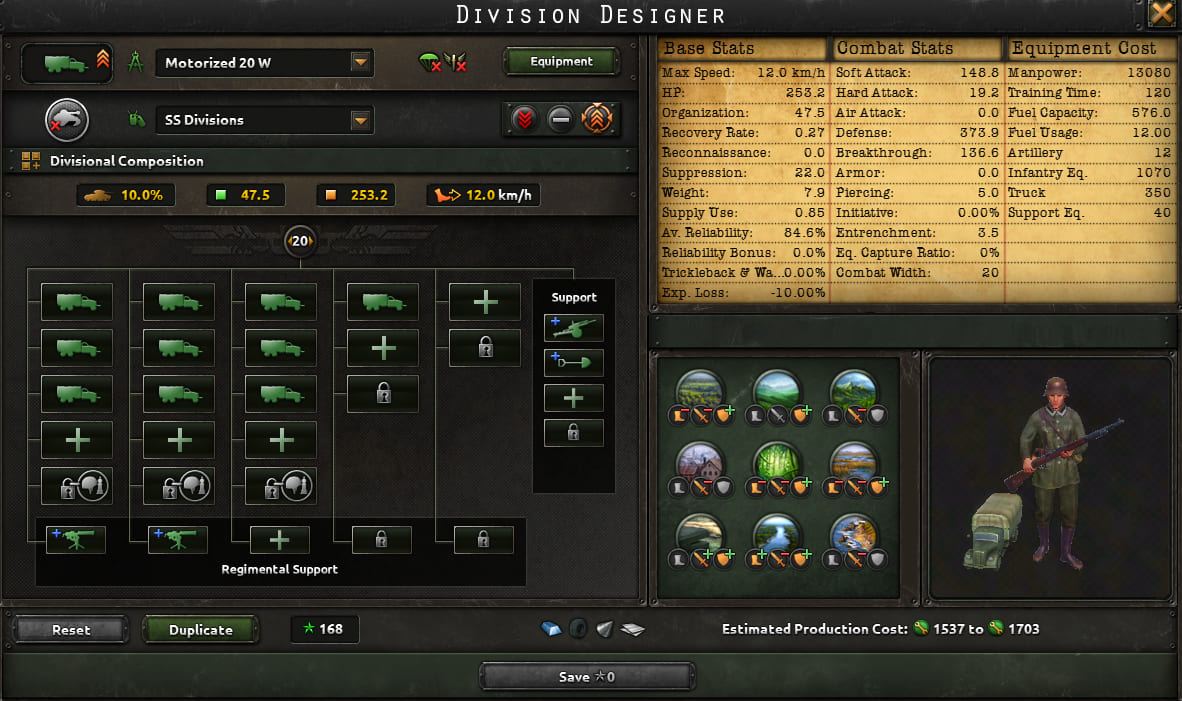
These already hurt to lose. Don’t send a lone column deep. A small country should drop the Heavy Weapons Companies. If you can afford this template, you can almost always afford width 20 tanks — and those usually win the fight.
Verdict. This is optional. A width 20 tank template usually hits harder in combat.
More in the article on motorized infantry templates.
Mountaineer templates
Hills and mountains. On plains this is expensive infantry that also eats the special-forces cap.
8 Mountaineers, Combat Width 16
- Minor
- Mountains
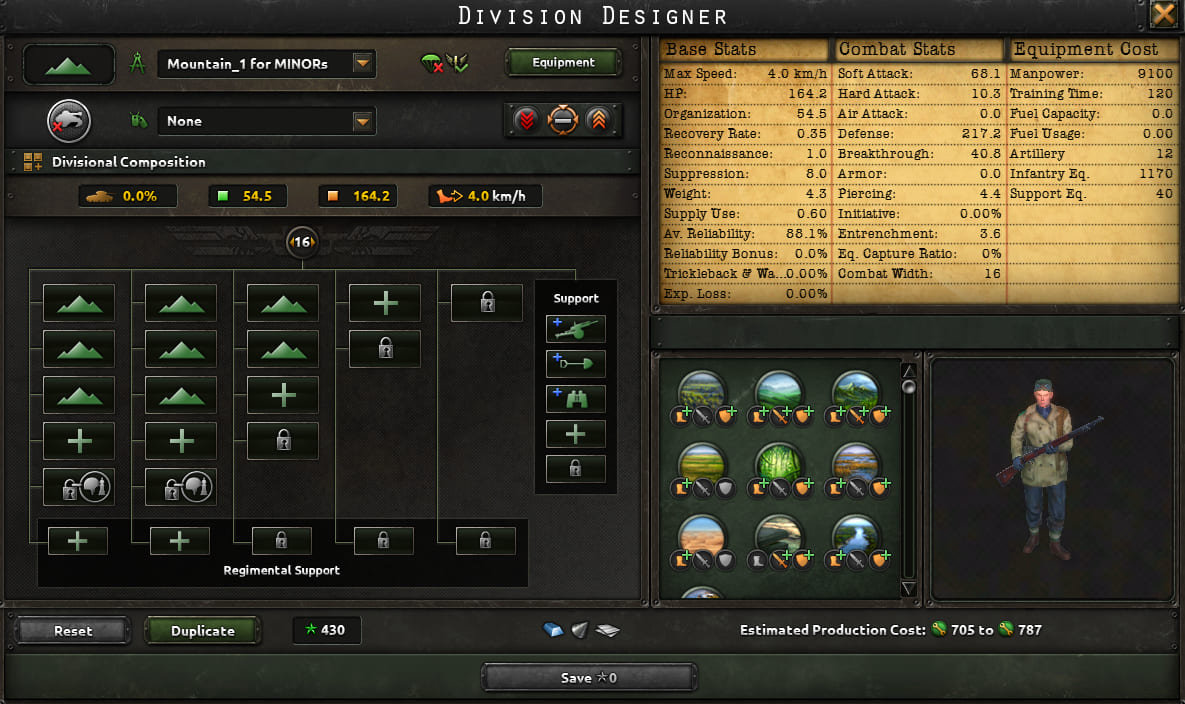
Even a poor start can field three of these. Each battalion wants 140 rifles instead of 100 on ordinary infantry. Count the special-forces cap first.
Verdict. This is for a small country and a weak major — into the mountains. Don’t park this on the whole Polish plain.
Mountaineers, Combat Width 25
- Major
- Mountains
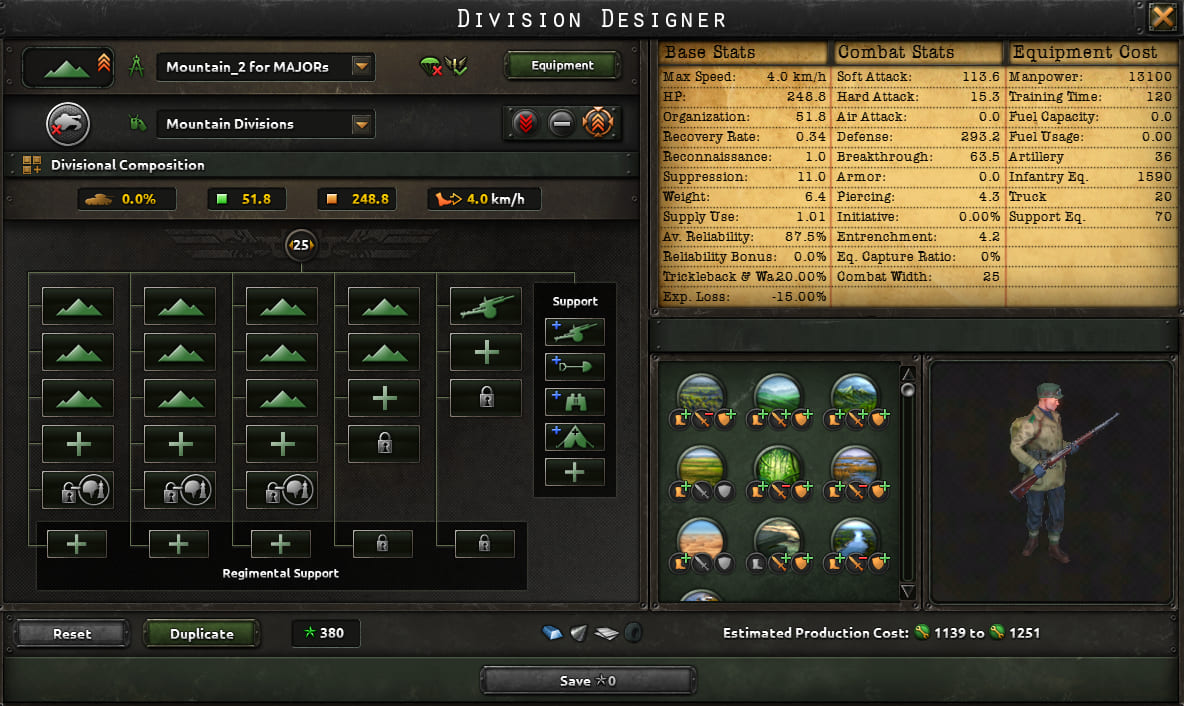
This is denser than the small-country template. A Field Hospital eats trucks. On plains it still doesn’t pay for itself.
Verdict. This is for a major with a mountain front. A handful of divisions, not the whole army.
More in the article on mountaineer templates.
Marine templates
Landings, rivers, marsh. Ordinary infantry attacking from water takes −50%, and in marsh −40%.
Marines, 15 CW
- Minor
- Landing
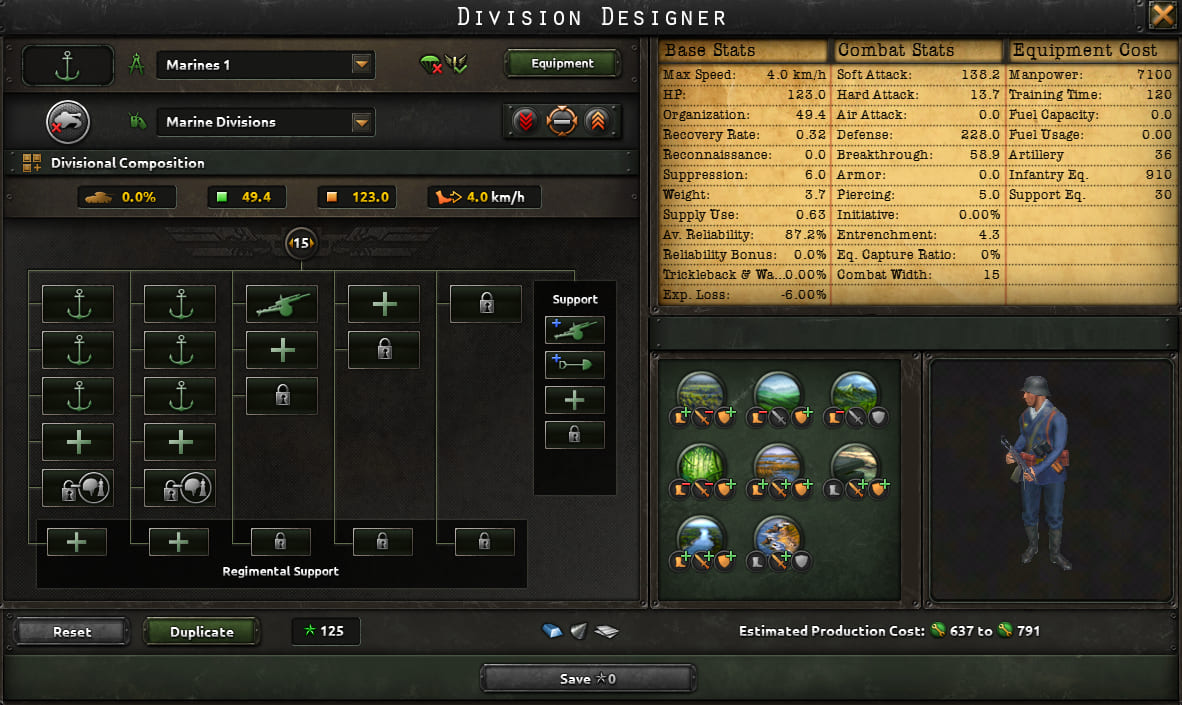
No vehicles. Four divisions usually fit the special-forces cap from any start. Hit several landing points at once.
Verdict. This is for a small country and a long coast. Don’t wrap sea to sea with this template.
Marines for marsh
- Major
- Marsh
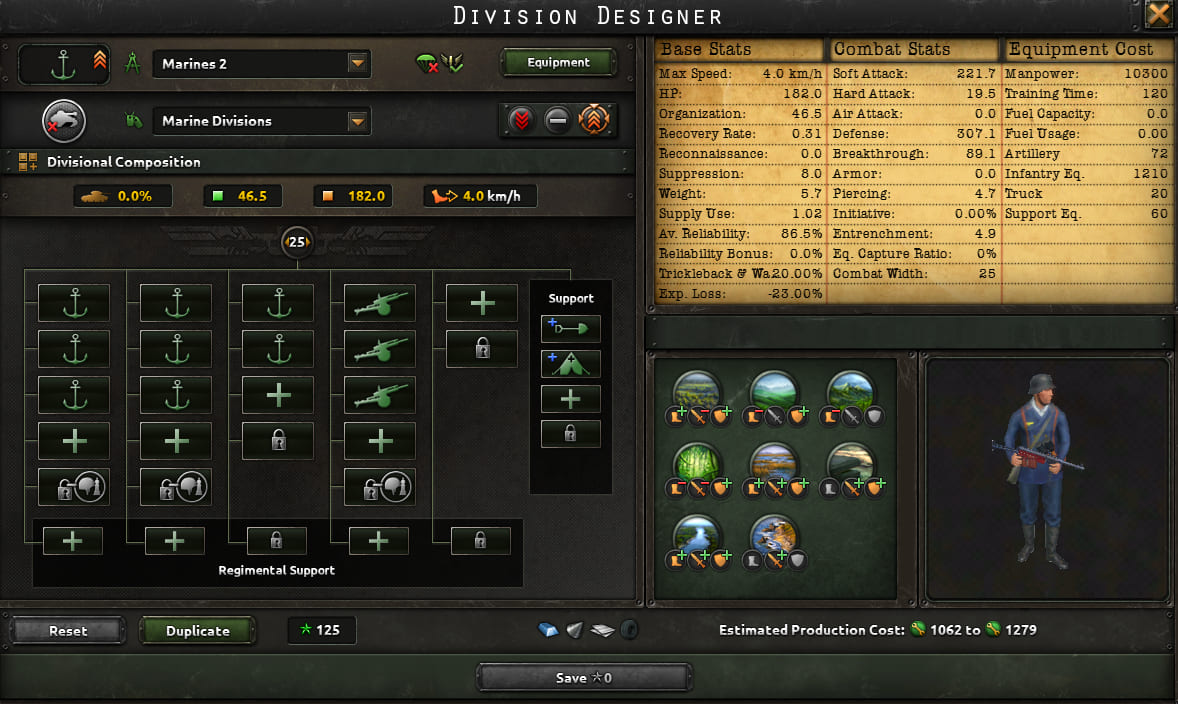
This needs trucks and the Marines research. A lot of Soft Attack. The special-forces cap is tighter than on the light template.
Verdict. This is for a major, or a narrow marsh front. A small country is often too early.
More in the article on marine templates.
Paratrooper templates
The template exists to jump from a plane, not to win a plains fight. You need transport planes and about 70% air superiority.
Light paratroopers
- Drop
- Cheap
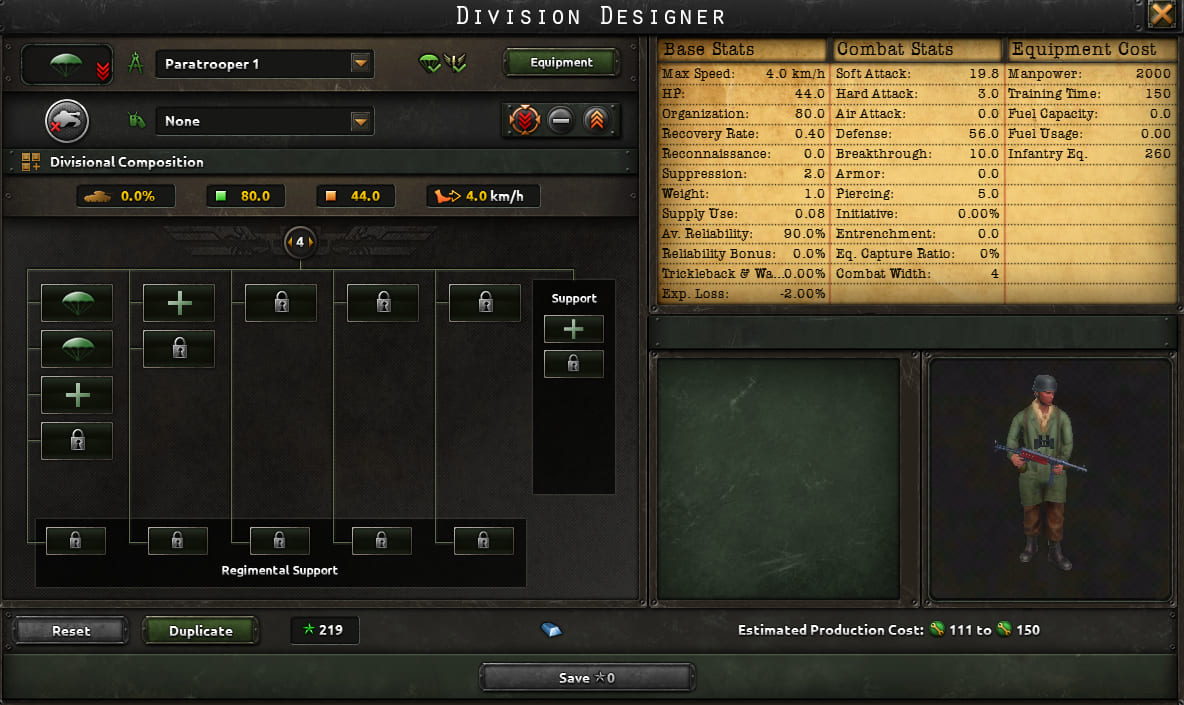

Deep rear, a capital, a supply dump. After the drop, link up with ordinary infantry. This template does not hold a front.
Verdict. This is for a small country and early war. No transport planes — don’t assemble this template.
Medium paratroopers
- Drop
- Tougher
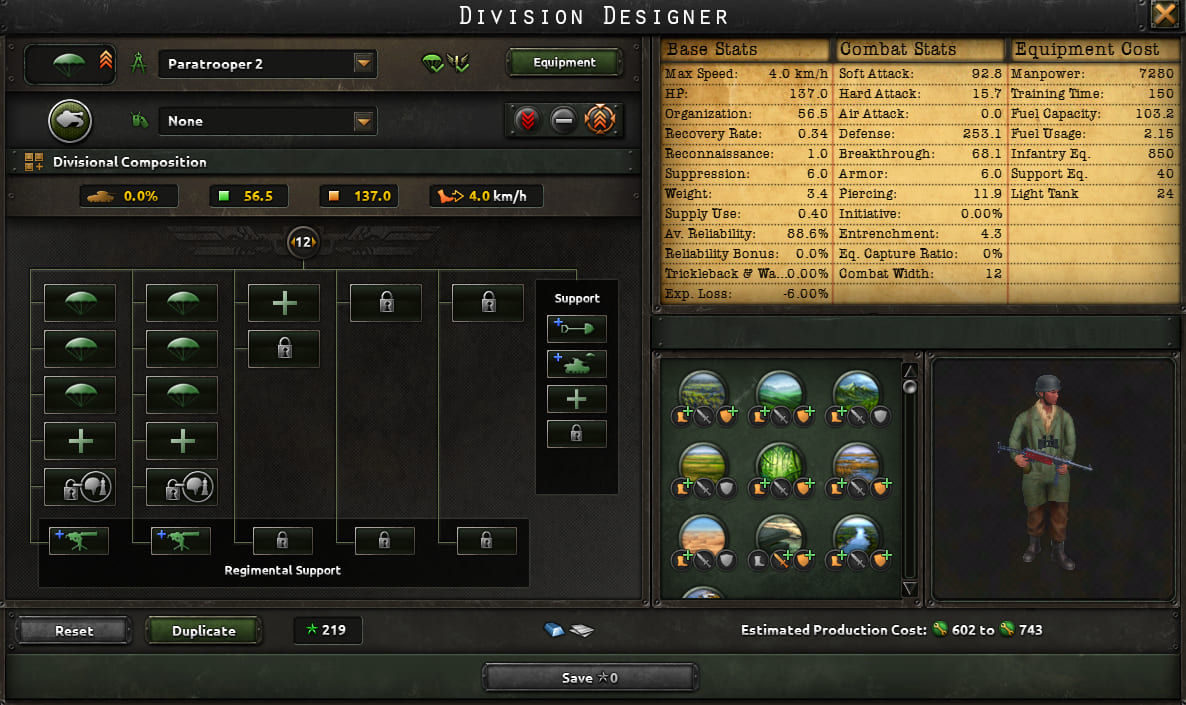

Closer to the front, a supply dump. Light tanks come from the paratrooper subdoctrine; a small country can skip them. This template eats more of the special-forces cap.
Verdict. Use this once you have army XP and air. Otherwise stay on the light template.
More in the article on paratrooper templates.
Ranger templates
Forest and jungle, province width 60. On open ground, spend the special-forces cap on someone else.
6 Rangers + artillery, Combat Width 15
- Minor
- Forest
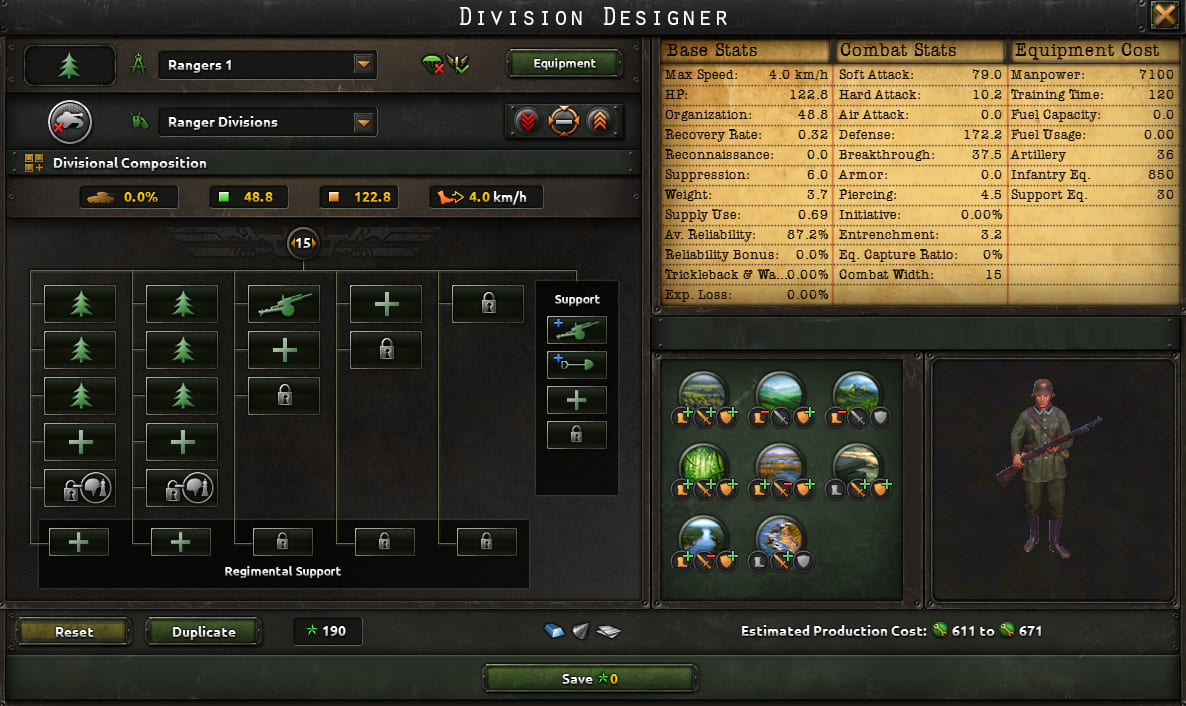
Four divisions usually fit the special-forces cap from any start.
Verdict. This is for a long forest front on a small country.
Rangers, Combat Width 20
- Major
- Forest
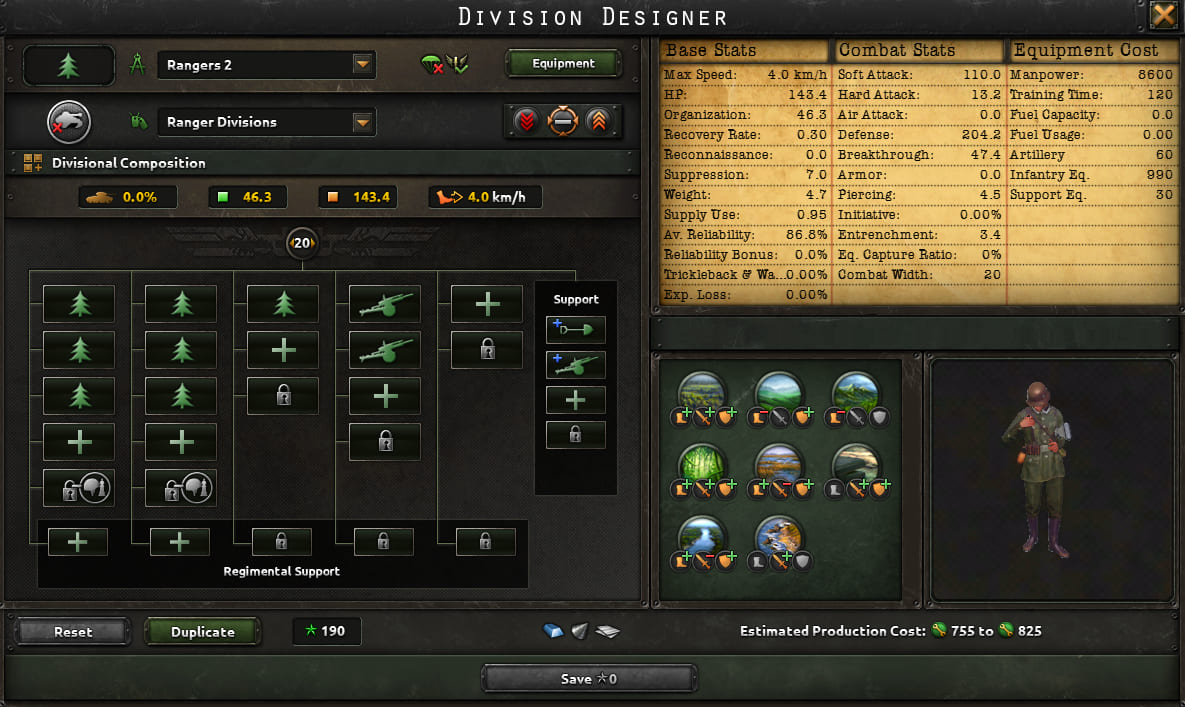
Denser per province, heavier on the special-forces cap. Don’t haul these onto plains.
Verdict. This is for a major with a forest front.
Rangers, Combat Width 30
- Mega-major
- Forest
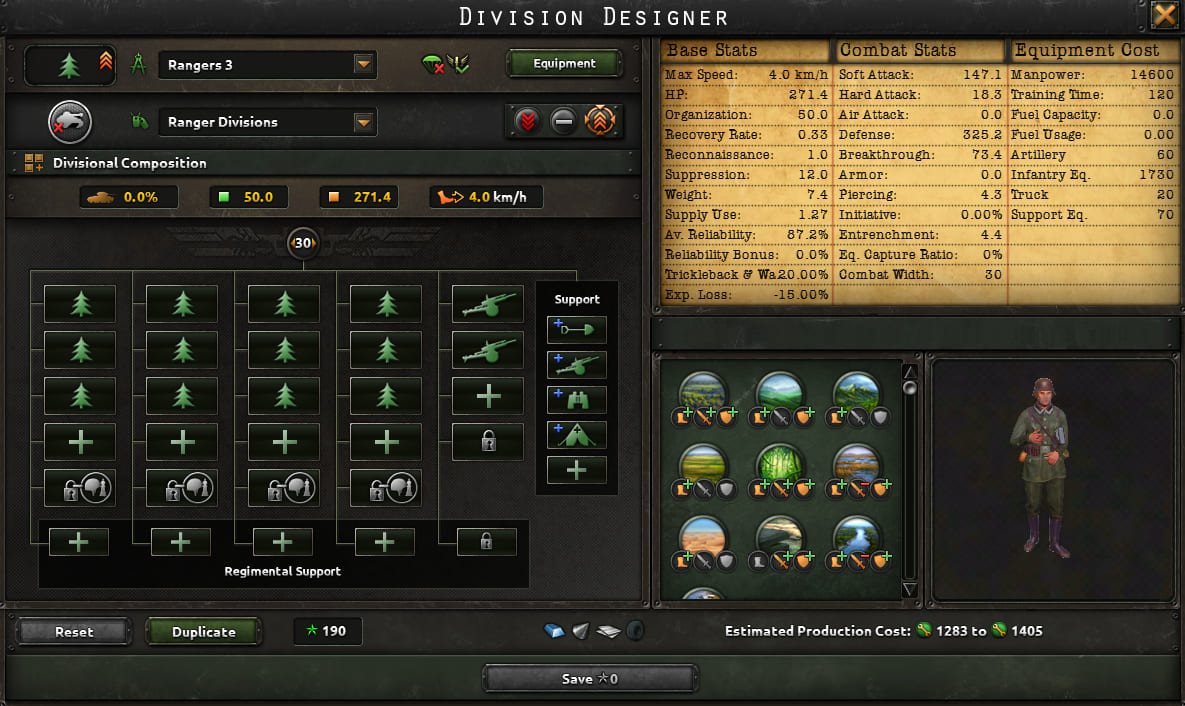
This eats a huge chunk of the special-forces cap. It is only worth it when forest is the main front of a very large country.
Verdict. A small country should not copy this just because it looks strong.
More in the article on Ranger templates.