Best Cheap Templates 2026
Article · Cheap templates
Best cheap division templates in Hearts of Iron IV
Five ready templates for a small country. Medium tanks, two kinds of regular infantry, infantry with Medium SP Anti-Air, and a tiny cavalry division you do not send into a real fight. A great power like Germany can usually field heavier, more expensive divisions. This is about what a minor can actually afford.
Which template you need
For attack
Tanks 20 CW
For pushing. Ready closer to the war if you have about 10–20 Military Factories and Rubber for trucks. Take 2–4 of these divisions and attack one tile together. Against a great power stacking 5–10 divisions per tile, this is not enough.
Infantry 14 CW
The main cheap template from 1936. It can hold and attack with artillery. Fine against another small country. Against a strong Germany in 1941 it is already thin, and it does almost nothing to tanks.
For defense
Infantry 12 CW
Defense only. Park it against a very weak neighbor or on ports so nobody lands. No artillery — do not attack with it. Almost any country can start building it on day one.
Armor 10 CW
Also mainly defense, but it holds better: Medium SP Anti-Air in the template gives the division Armor, and enemy planes hurt less. Weak on attack. You need at least an Inter-War Medium Tank chassis and a few factories on SPAA.
Which template to field
Five tabs below — all ready-made templates. First of all for a small country. If you are Germany, the USSR or the USA, you can usually build stronger, more expensive divisions. These five still help early or on a quiet stretch of front where the main war is not happening.
Tanks 20 CW
This template is for attacking. Cheap next to other tank divisions, still more expensive than regular infantry. A small country can field several by the time war starts if it is not trying to design the fanciest tank in the designer.
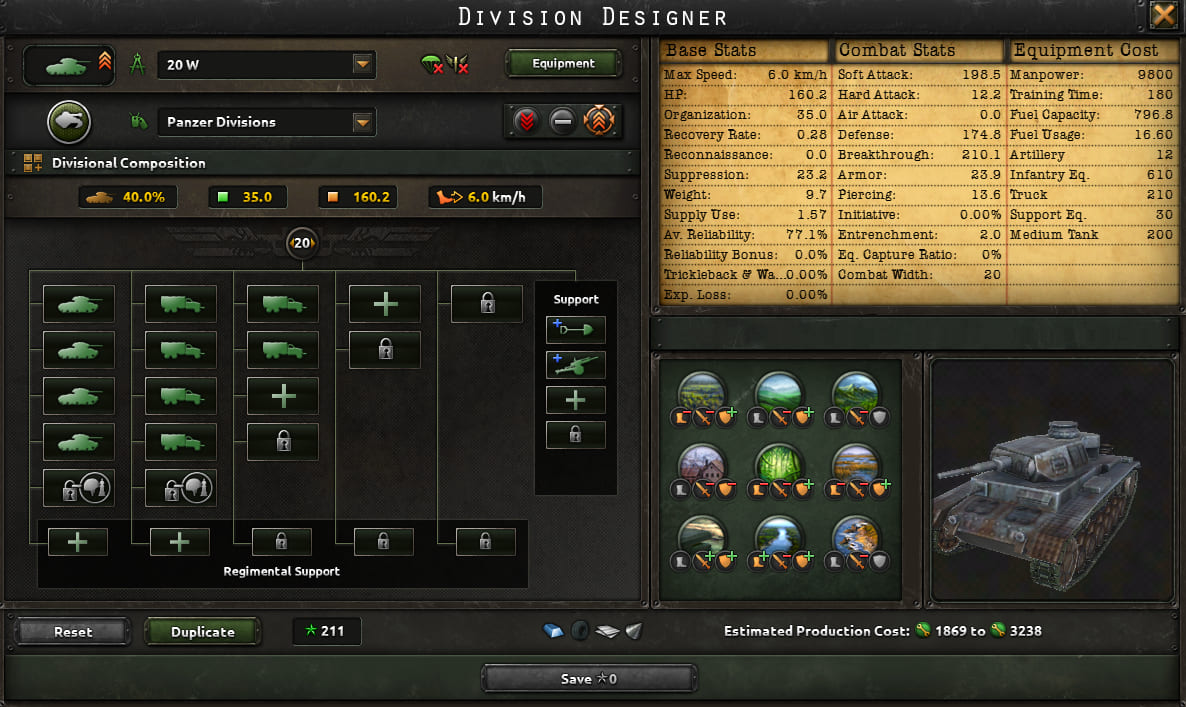


Four Medium Tank battalions are 200 chassis (50 per battalion). Six Motorized Infantry battalions are 210 Trucks (35 per battalion) plus 600 Infantry Equipment. Support: Support Artillery wants 12 Towed Artillery and 300 manpower, Engineer Company wants 10 Infantry Equipment, 30 Support Equipment and another 300 manpower. Total per division: 9800 Manpower. That is no longer a small infantry division. Tanks and trucks are usually the bottleneck.
How hard it hits depends on the tank you built in the designer, not only on battalion count. An Inter-War chassis and a 1940 chassis do not hit the same. A small country often lacks research slots and factories to unlock Improved Medium Tank (the 1940 chassis) and Improved Medium Howitzer. That does not mean no tanks. You can run Inter-War Medium Tank: many countries already have it researched at start. Weaker than late-war tanks, but 2–4 of these at 6–7 km/h punch through another small country just fine.
A wedge means 2–4 of these divisions attack one tile together, not one each along the whole front. Alone they do little. Tanks 20 CW does not break a line like a fat 36 CW tank template. Against a great power with 5–10 divisions on every tile, this template will not carry you. Against a small country — yes, if several divisions hit the same tile. Spread them out one-by-one and you get a pretty truck column that stalls on enemy infantry.
Optional: Cavalry Recon Detachment if the division is slower than 6.4 km/h — horses will not slow it and they add terrain bonuses. Armored Recon Company makes sense if Military Factories can still spare Light Tanks for recon. Another option: swap Medium Tanks for Medium SP Artillery. Same Combat Width (2 per battalion), more Soft Attack into infantry. Playstyle choice.
Truck production needs Rubber. No Rubber — almost no trucks, Motorized Infantry has no vehicles, tanks crawl without them. Before 1938–1939 a small country usually cannot field this: you need Military Factories (ballpark ten or more), tanks and trucks.
| Resource | Per division |
|---|---|
| Manpower | 9800 |
| Infantry Equipment | 610 |
| Support Equipment | 30 |
| Towed Artillery | 12 |
| Medium Tank | 200 |
| Truck | 210 |
| Combat Width | 20 |
Total for all divisions
Totals from the table above, for the chosen number of this template.
- Manpower
- 29,400
- Infantry Equipment
- 1,830
- Support Equipment
- 90
- Towed Artillery
- 36
- Medium Tank
- 600
- Truck
- 630
Pros
- Cheap for a tank division: 200 tanks and 210 trucks, not a huge 36 CW template
- Does not wait on a 1938 or 1940 chassis: Inter-War Medium Tank is enough
- Almost any small country with about 10+ Military Factories can field it by the war
Cons
- Will not break a front alone: you need 2–4 divisions on one tile
- Trucks need Rubber
- A small country usually cannot finish it before 1938–1939
Verdict. If they are fast and you hit one tile with several at once, you get a solid push against a country that is not a great power. One of these versus one enemy often does not wipe the tile. Recon and swapping tanks for Medium SP Artillery are optional.
Infantry 14 CW
The famous cheap infantry template. If you are a small country like Romania, it will not hold a 1941 front against a strong Germany. Against another small country — yes. It can defend and attack.
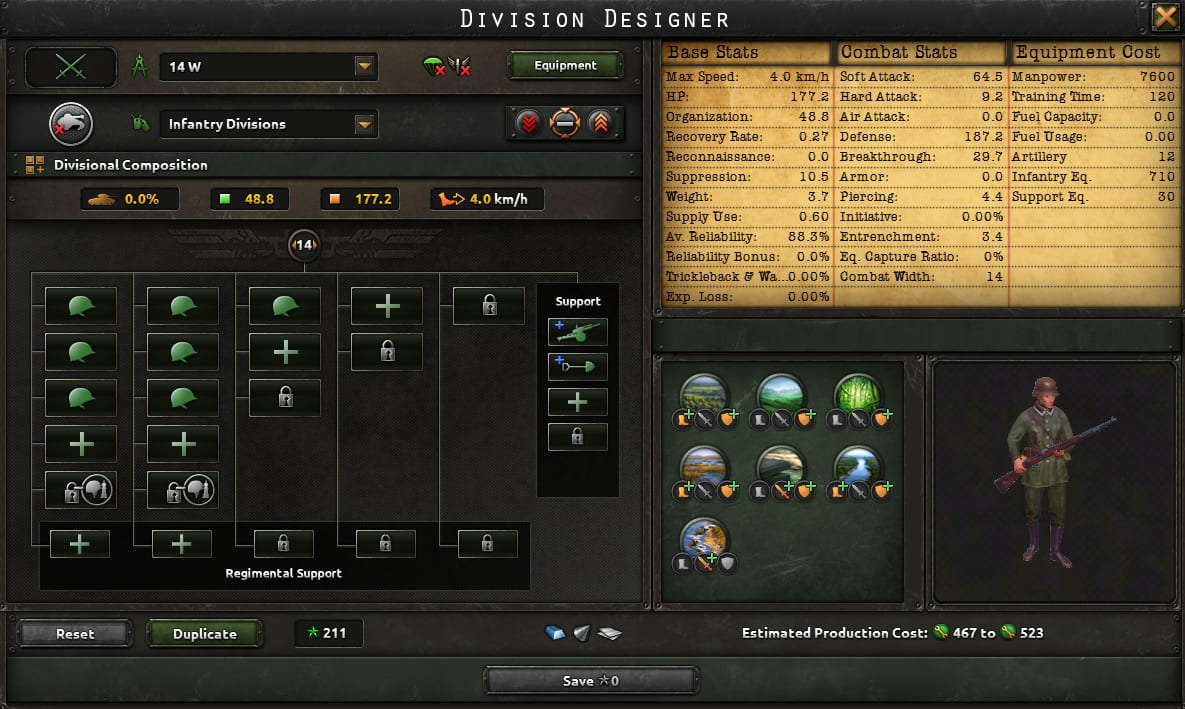
 7× Infantry
 Support Artillery
 Engineer Company
Seven Infantry battalions are 7000 manpower and 700 Infantry Equipment (1000 manpower and 100 rifles per battalion). Support Artillery adds Soft Attack (damage to regular infantry and unarmored targets) and does not increase Combat Width: companies add no CW. Engineers help you entrench, so the division holds better. Total: 7600 manpower, 710 Infantry Equipment, 30 Support Equipment, 12 artillery.
Simple idea. Infantry holds the tile. Support Artillery hits. So the division can defend and attack. As Germany I take Europe with this by 1941, including the Allies and Yugoslavia: it is cheap, you field a lot, and the artillery is enough to punch weak divisions. Still attack with numbers. One of these into a packed enemy tile is a bad idea. Against tanks it does almost nothing. Infantry Piercing is low: this is infantry with guns, not an anti-tank template.
You can build it in 1936: Infantry, Support Artillery and Engineers are on most starts or unlock immediately. Add Cavalry Recon Detachment if Organization still looks healthy and factories can spare Support Equipment. By 1941 it is thin if the main job is a great power. A small country fights with it until then, then changes the template when more factories exist. As Germany I add Super-Heavy Artillery in support when I go after the USSR.
| Resource | Per division |
|---|---|
| Manpower | 7600 |
| Infantry Equipment | 710 |
| Support Equipment | 30 |
| Towed Artillery | 12 |
| Combat Width | 14 |
| On Plains with no penalty | 5 divisions per tile (70 Combat Width) |
Total for all divisions
Totals from the table above, for the chosen number of this template.
- Manpower
- 76,000
- Infantry Equipment
- 7,100
- Support Equipment
- 300
- Towed Artillery
- 120
Pros
- Cheap infantry: 710 rifles per division, not special forces
- Buildable in 1936
- Defense and attack from Support Artillery
Cons
- Still loses head-on to a strong great power
- Attack with a numbers advantage
- Does almost nothing to tanks
Verdict. Strong for the start of the game. By 1941 it is a weak main answer to a great power. A small country can take other small neighbors with it, then change the template. Not the best template in the game and not trash — working infantry for the opening.
Infantry 12 CW
You do not conquer a neighbor with this. You cheaply cover weak spots: a stretch of front against a very weak enemy, or a port where someone might land. Almost any country can start building it on day one.
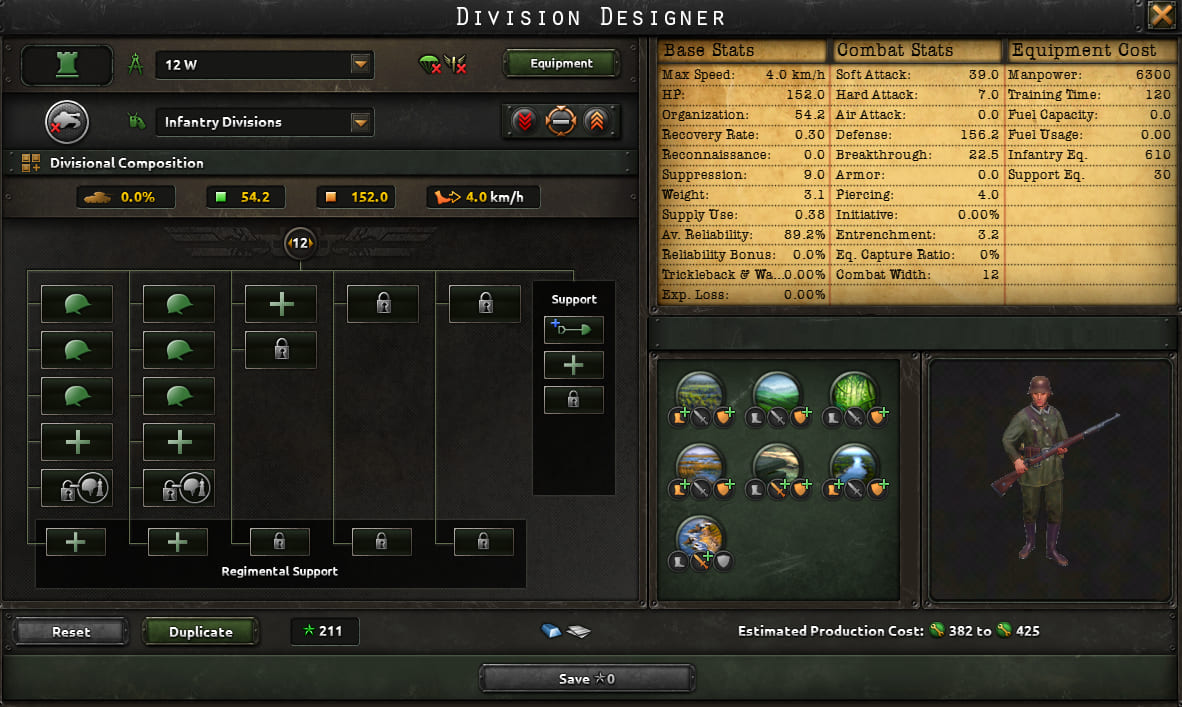 6× Infantry
Engineer Company
6× Infantry
Engineer Company
Six Infantry battalions: 6000 manpower and 600 rifles. Engineers: +300 manpower, +10 Infantry Equipment, +30 Support Equipment. Total 6300 manpower and 610 Infantry Equipment. No Towed Artillery. On purpose: a small country is short on artillery, so give it to Infantry 14 CW, the one that actually attacks.
Where to put it. On a border with a very weak country, so someone is standing there at all. And on ports (Naval Bases) where the enemy can launch a naval invasion. You can field a lot of these cheap divisions and cover many ports at once. Do not attack with this template: almost no Soft Attack, you just hand the enemy easy fights and experience. It will not hold a strong enemy for long either. Engineers help entrench, but six battalions are a thin line — they get pushed.
| Resource | Per division |
|---|---|
| Manpower | 6300 |
| Infantry Equipment | 610 |
| Support Equipment | 30 |
| Combat Width | 12 |
Total for all divisions
Totals from the table above, for the chosen number of this template.
- Manpower
- 75,600
- Infantry Equipment
- 7,320
- Support Equipment
- 360
Pros
- Very cheap: no artillery, no trucks, no tanks
- Fits almost any small country from day one
- Does not spend Towed Artillery — leave that for other divisions
Cons
- Holds poorly against a strong enemy
- Do not attack with it
Verdict. Cheap defense against weak countries and covering ports. More of these divisions means more closed ports and border tiles. Do not take it into a big offensive or “hold the USSR”. That is not saving industry — it is a thin line the enemy peels off on the first hit.
Armor 10 CW
An odd template. Little infantry, so on its own it attacks weakly and holds weakly. The point is a Medium SP Anti-Air battalion. It gives the whole division Armor. If the enemy lacks Piercing, they deal much less damage to this division.
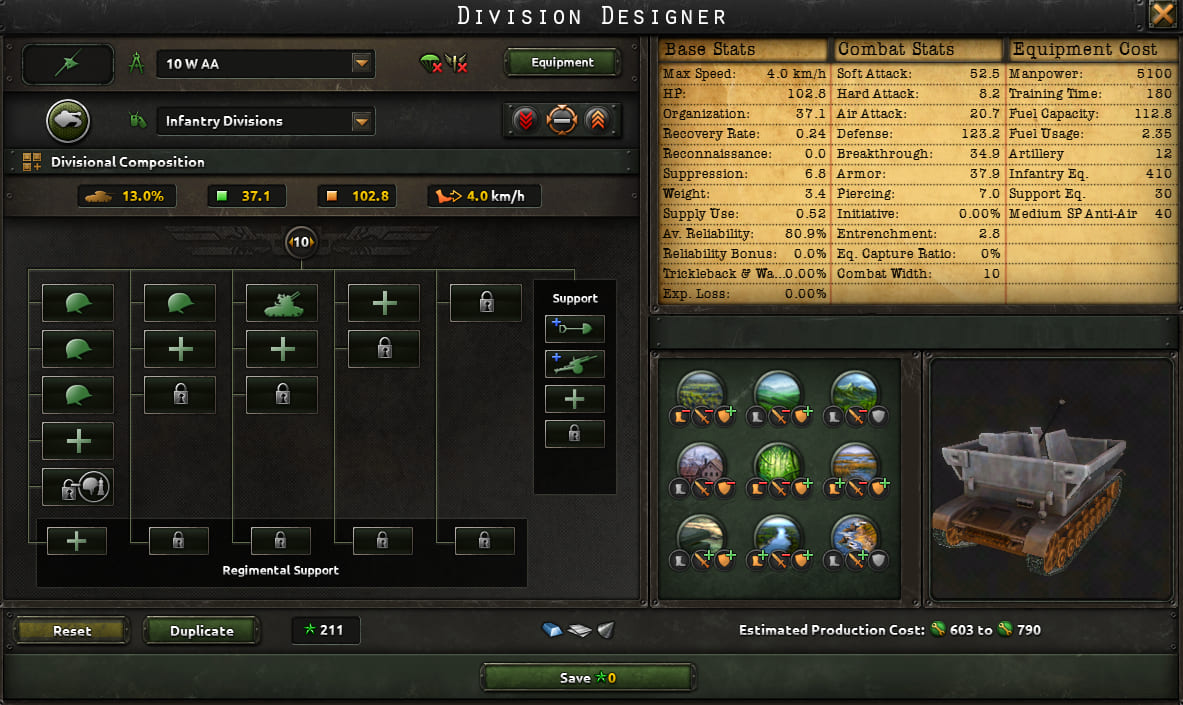 4× Infantry
 1× Medium SP Anti-Air
Support Artillery
Engineer Company
1× Medium SP Anti-Air
Support Artillery
Engineer Company
Four Infantry battalions: 4000 manpower and 400 rifles. The Medium SP Anti-Air battalion: another 500 manpower and 40 vehicles (not 50 like Medium Tank). Same companies as Infantry 14: Support Artillery and Engineers. Total: 5100 Manpower, 410 Infantry Equipment, 30 Support Equipment, 12 artillery and 40 SPAA. Little infantry means low Organization: SPAA barely gives Organization in combat. When I tested this in single player, low Organization hurt less than the designer numbers suggested. On defense this template lasted longer than any other infantry in this article.
Main job is defense. Attack only a weak enemy: little Soft Attack, little Breakthrough (the stat for pushing a defender), this is not a tank push with several divisions on one tile. Second job is aircraft. If the enemy has the Enemy air superiority penalty in the fight, the SPAA battalion cuts that penalty. The division holds better under enemy air, and it also shoots at planes. Optional extra companies, for example Cavalry Recon Detachment, if factories and Organization still allow it.
How can this be cheap with a whole SPAA battalion? Infantry itself is very cheap. The SPAA does not have to be expensive — you deliberately design it cheap in the tank designer.
Take any medium chassis, even Inter-War Medium Tank. Fit the cheapest turret (often One Man Turret), mount a Basic Anti-Air Gun, max the Armor, put it on the production line.
This vehicle is there for division Armor, not big damage. Ignore the gun and pretty attack numbers.
If you cannot make Medium SP Anti-Air, the same trick with a cheap Light Tank or Light SP Artillery: max Armor again, damage is secondary. The division needs Armor.
You still need a few Military Factories on that line. No interwar tank chassis, no template.
On Plains, seven of these fill exactly 70 Combat Width. Tight, but no Exceeding Combat Width penalty. Do not confuse this with real tanks: 40 cheap SPAA per division, not 200 Medium Tanks.
| Resource | Per division |
|---|---|
| Manpower | 5100 |
| Infantry Equipment | 410 |
| Support Equipment | 30 |
| Towed Artillery | 12 |
| Medium SP Anti-Air | 40 |
| Combat Width | 10 |
| On Plains with no penalty | 7 divisions per tile (70 Combat Width) |
Total for all divisions
Totals from the table above, for the chosen number of this template.
- Manpower
- 35,700
- Infantry Equipment
- 2,870
- Support Equipment
- 210
- Towed Artillery
- 84
- Medium SP Anti-Air
- 280
Pros
- Holds better on defense than the other infantry here — because of Armor
- Cuts the Enemy air superiority penalty
- Almost any country can afford it if the interwar tank chassis is unlocked and a few factories run SPAA
Cons
- Needs at least Inter-War Medium Tank
- A few Military Factories still go to SPAA
- Attacks weakly
Verdict. Fairly cheap defense on Medium SP Anti-Air. Damage drops because of Armor, and you can design the SPAA very cheap. Tweak the template to your factories: more infantry or more companies. Do not mix it up with Tanks 20 CW: those have tanks and trucks, this is infantry with one Medium SP Anti-Air.
Cavalry 2 CW
The template is a single Cavalry battalion. You do not put it in a real fight: any proper division shreds it instantly. You use it for jobs you do not want to waste real infantry on.
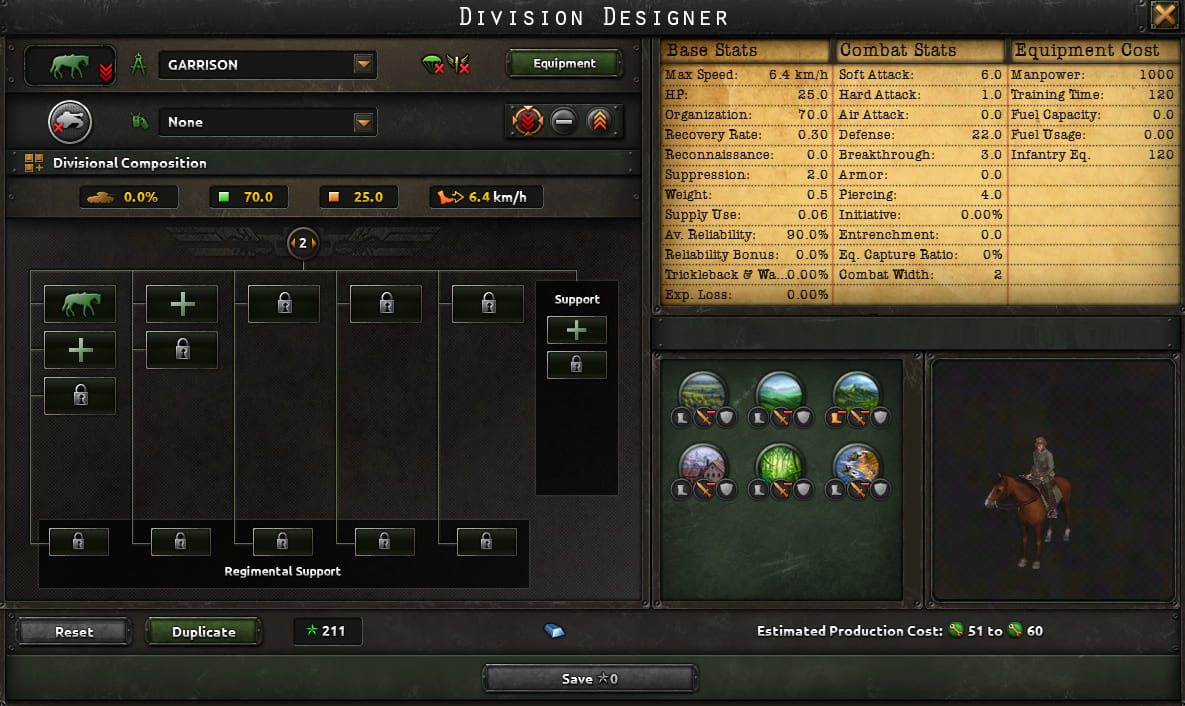
 1× Cavalry
Dirt cheap: 1000 Manpower and 120 Infantry Equipment per division. Regular infantry uses 100 rifles per battalion, cavalry uses 120, but you only have one battalion here, not six or seven. Few people in the template, so training is cheap: you can queue many divisions at once. On the map cavalry is also faster than infantry. That is for taking tiles with nobody on them. It does not train faster than infantry: infantry trains in 90 days, cavalry in 120.
Why bother if it cannot fight? First: garrison on land you already took. Resistance shows up; you need to suppress it or occupation suffers and the land rebels. Putting full infantry there burns a pile of Infantry Equipment. One cavalry is cheaper for “just stand there and suppress”. Downside: resistance damages garrison equipment. A one-battalion template has little gear, so it breaks fast. Keep spare rifles or the divisions sit almost unequipped.
Second: train many divisions, then change their template. In HoI you can switch an already trained division to another template: it pulls equipment and manpower from stockpiles. Train fifty cavalry, the army fills with divisions fast. Then switch them to Infantry 14 CW. Manpower is already there; you only need to ship rifles and artillery. Not a cheat. Just faster than training fat infantry from zero. You need stockpiles. Otherwise you get fifty divisions with almost no rifles.
Third: army size for decisions and national focuses. German Anschluss, for example, checks how much bigger your army is than Austria’s. It counts well-equipped units. Padding that with cavalry is easier than waiting on full divisions. Same for ultimata that require a large army.
Fourth: tiles with no enemy divisions. Cavalry runs those tiles and paints the land while the enemy’s main force fights somewhere else. As Turkey in the Axis in 1942 I ran a lot of cavalry through the Caucasus: the Germans held the main front, I took empty territory. As fascist Britain the same trick grabs US tiles before their army covers the coast. In a fight with a real division this cavalry dies instantly. Do not send it into a real battle. That is not a fast grab — it is a trip into gunfire.
| Resource | Per division |
|---|---|
| Manpower | 1000 |
| Infantry Equipment | 120 |
| Combat Width | 2 |
Total for all divisions
Totals from the table above, for the chosen number of this template.
- Manpower
- 24,000
- Infantry Equipment
- 2,880
Pros
- Ridiculously cheap: 1000 manpower and 120 rifles
- Cheap training: queue many divisions at once
- Any country in the game can afford it
Cons
- Useless against a real division
- Dies immediately in combat
- Resistance wrecks equipment on this thin garrison
Verdict. A template for jobs next to the war, not the war itself: garrison, train many then switch template, army size for a national focus, empty tiles. Do not send it into combat. Any country can afford it.
Do not mix these up
| Template | For what | When |
|---|---|---|
| Tanks 20 CW | Attack with several divisions on one tile, against a small country | By the war, about 10+ Military Factories, Rubber for trucks |
| Infantry 14 CW | Hold and attack | From 1936, main template until about 1941 |
| Infantry 12 CW | Cheap defense and covering ports | Day one, not for attacking |
| Armor 10 CW | Defense: Armor from Medium SP Anti-Air, easier under enemy aircraft | Interwar tank chassis and a few factories on SPAA |
| Cavalry 2 CW | Garrison, switch template after training, empty tiles, army size | Anytime, never a real fight |
Do not mix jobs. Do not cover ports with tanks just because they are fast. Do not attack a capital with cavalry just because it is cheap. Do not launch a big offensive with Infantry 12 CW just because you have a lot of them. Infantry with SPAA does not replace a tank push: it holds, it does not break a front. Each template has one job.
Bottom line
A small country needs five cheap templates. Not ten almost-identical infantry ones. Infantry 14 CW is the 1936 workhorse: holds and can attack with Support Artillery. Infantry 12 CW is ports and a very weak neighbor, no artillery. Armor 10 CW is defense: little infantry, less damage thanks to Armor, easier under enemy aircraft. Tanks 20 CW is several divisions hitting one tile on an interwar chassis if you have factories and Rubber. Not a fat 36 CW tank template. Cavalry 2 CW is garrison, train many then switch template, and empty tiles. Do not send it into combat.