How to Create a Division Template Properly?
Article · How to create a division template
How to create a division template the right way in Hearts of Iron IV
This is not the “train a division” button and not a tour of the designer grid. It is the order I think in when I build a template so it works on the front, not only looks strong in the stats on the right.
This article is how to build a division template in HoI the right way: in what order to think, and which numbers to watch in the designer. It is not where to click to train your first division, and not a button-by-button tour of “battalion / company / regiment”.
There is no “copy these ten templates” list here. Ready-made lineups live in the infantry, tank, marine articles and so on. Here it is the method: why the division exists, which type, which Combat Width, which Organization, whether you need armor.
I write for someone who installed the game yesterday and already opened the Division Designer.
Step 1. Pick the job and the division type
The most common template mistake is skipping the role and the job of that division. With no job, you cannot tell how much infantry to put in, whether you need artillery, whether you need tanks. The panel on the right can look strong, and on the map the division still does the wrong work.
Before the first battalion, decide one thing: what this division should do most of the time. Hold the front and not give tiles away? Attack and take ground? Sit in a port against a landing? Fight in mountains or marsh? Keep order on land you already occupy? Each job wants its own template. One template that “holds, pushes, and sits in a port” is usually weaker than two simple ones: cheap infantry for the line and a separate template for attack.
You pick the division type for that job. Infantry holds the front cheaply: rifles, manpower, a few companies and regiments. Tanks and motorized infantry hit hard and move fast, but they cost a lot and burn fuel. Mountaineers and marines are strong on their terrain and on landings, but you cannot field many because of the special forces cap. Cavalry and garrison suppress resistance on occupied land; in a straight fight against a real army they are weak.
If you stuff one division with infantry, a pile of artillery, and tanks “just in case”, you get a middle that holds worse than pure infantry, hits worse than real tanks, and wastes factories.
| Job | Which type | What to avoid |
|---|---|---|
| Hold the front | Regular infantry: cheap or medium size | Do not put every tank in the country on the whole line |
| Attack and take a tile | Tanks, motorized infantry, or large attack infantry | Do not spread this template across the entire front |
| Mountains, marsh, naval landing | Special forces if the cap allows | Do not expect regular infantry to walk that terrain easily |
| Guard a port and weak stretches | Very cheap infantry | Do not park medium tanks in a port |
| Occupation | Cavalry or garrison | Do not run combat infantry after partisans for the whole war |
Look at your country too. A small country with almost no factories does not have to copy a large Soviet template at Combat Width 36: you simply cannot produce it. A large country should not live the whole war on one cheapest width-10 infantry. The right template fits both the job and your industry.
Step 2. Pick Combat Width
Combat Width is how much space a division takes in one battle. Every map tile has a limit on that space. Plains 70, forest 60, mountains and marsh 50, urban 80. Only divisions whose total Combat Width fits the limit fight at full strength at once. The rest wait in reserve and do not shoot yet.
If the total width is still above the limit, divisions in the fight take a penalty. About −1% efficiency per 1% over, capped at −33%. Example: plains limit 70, you attack with three divisions of 30 — that is 90. The overflow is large, part of the strength burns in the penalty. It feels like “one more division will help”, and the fight actually gets weaker.
Only combat battalions in the center of the designer give Combat Width. Infantry and most tanks take about 2 per battalion. Line artillery takes 3. Support companies on the right and regimental support at the bottom do not add Combat Width. Adding engineers and adding another artillery battalion are different: a company buffs without extra width, line artillery both buffs and takes space in the fight.
There is no single correct width for the whole game. There are values that split common tile limits cleanly. For holding the front I usually take 10, 14, 18 or 20. For attack — 15, 20 or 36. 25 makes sense if you have to fight in mountains or marsh and you have no mountaineers or marines: two such divisions fill the 50 limit. Do not build 21 or 23 just because “it still fit”: then fewer divisions enter the tile without a penalty than you planned.
| Combat Width | When to take it |
|---|---|
| 10 | Cheap defense, ports, a small country with no factories. On plains, 7 of these fit the 70 limit. |
| 14–15 | Flexible infantry if the country can already hold the front and sometimes attack. 15 is nicer in forest: 4 divisions in the 60 limit. |
| 18–20 | Defense of important tiles for a large country. You do not need this template on every weak stretch of the map. |
| 25 | Mountains and marsh without special forces: two divisions fill the 50 limit. |
| 36 | A large attack when factories already cover the cost. On plains two divisions take 72 against a 70 limit — almost full, a third will not fit without a penalty. |
Choose Combat Width first, then fill battalions to hit it. If you keep adding “more infantry, more artillery” with no target, you easily land on 23 and get a template that sits badly on both plains and forest.
Step 3. Match Organization to the type
A division has two different pools. HP is men and equipment: how much the division can lose before it is wrecked. Organization is how long it can stay in the fight without breaking. When Organization hits zero, the division retreats even if it still has a lot of HP. High Soft Attack with low Organization gives a strong first punch, and a short time later the division is already leaving the battle.
Division Organization is the average of all combat battalions, not a sum. Infantry Organization is high, so it pulls the average up. Artillery, SP Artillery and tanks are lower, so they pull it down. Each new line artillery battalion almost always adds damage and also lowers Organization. Support companies matter too, but the line in the center of the designer sets Organization the most.
In single-player I check these targets. They are not a hard law, just a floor below which a template usually fights its role badly.
| Template type | Organization | If lower |
|---|---|---|
| Infantry holding the front | 45–50 and up | Divisions retreat fast, you have to pack even more of them on the front |
| Attack infantry | around 40 and up | The first hours of the fight go well, then they retreat without taking the tile |
| Tanks and mixed divisions | 30–40 | The attack dies halfway, the tile never falls |
If Organization is too low, you raise it with the lineup. Add infantry. In a tank template — motorized infantry or mechanized: they pull the average up. Drop extra line artillery and SP Artillery if you already have enough damage. Take off regimental “Heavy Weapons Company” and “Infantry Guns” if Organization drops hard after them and Support Equipment still is not produced in the numbers you need. On tanks you almost never fix Organization with another tank battalion — you fix it with infantry equipment next to the tanks.
Chasing Organization with no limit is also wrong. Infantry at Organization 70 with almost no Soft Attack will stand for a long time and barely push the enemy. Tanks do not need to aim for infantry 50: Breakthrough and attack matter more, and 30–40 Organization is usually enough if the division does not collapse at once.
Step 4. Armor is great if they cannot pierce it
Armor and Organization do different jobs. Organization is how long the division stays in the fight. Armor is how hard it is for the enemy to damage you. If your Armor is higher than the enemy’s Piercing, you take less damage and you hit harder. That is why armor is useful: the fight runs on different rules than a regular infantry fight.
In the armor formula the most armored battalion does a lot of the work; the rest is an average across the division. That is why infantry often gets one “Medium SP Anti-Air” battalion: cheap chassis, armor maxed — and armor already counts for the whole division. That is usually cheaper than dragging a medium tank only for armor. “Medium SP Artillery” in infantry is a different case: it gives a lot of Soft Attack in a large attack template, not cheap armor for the whole line.
If enemy Piercing is higher than your Armor, the bonus is almost gone. You spent factories on vehicles, and they still shoot you like regular infantry. On the other side, regular infantry with no armor and no anti-tank holds tank attacks badly. Armor is worth putting on when you can actually produce it and when the enemy does not yet pierce it in bulk.
When to add armor
- Factories already make SP Anti-Air or tanks in the numbers you need
- You must hold important tiles you cannot give away cheaply
- This is an attacking division that has to survive return fire
When not to add armor
- A small country copies a large armored template with no tank factories
- Ports and weak front stretches — cheaper to fill with infantry numbers
- The enemy already has a lot of anti-tank and tanks with high Piercing
Check the same thing on your attack. If your tanks do not pierce enemy armor, damage will be weak. Before an offensive, either the template has enough Piercing, or you should not send that template into those divisions.
Step 5. Companies, regiments, factories and Army Experience
When type, Combat Width, Organization and the armor call are set, you add the extras. Support companies sit on the right, five at most. They give bonuses and do not raise Combat Width. Regimental support appears under a battalion column if that column already has at least three battalions.
New columns and new company slots cost Army Experience. If you change the template on divisions that are already trained, that also costs Army Experience, plus manpower and equipment to fill the new lineup. Until the stockpile is there, divisions on the map run understrength: the designer shows a full template, and in combat they miss rifles or guns.
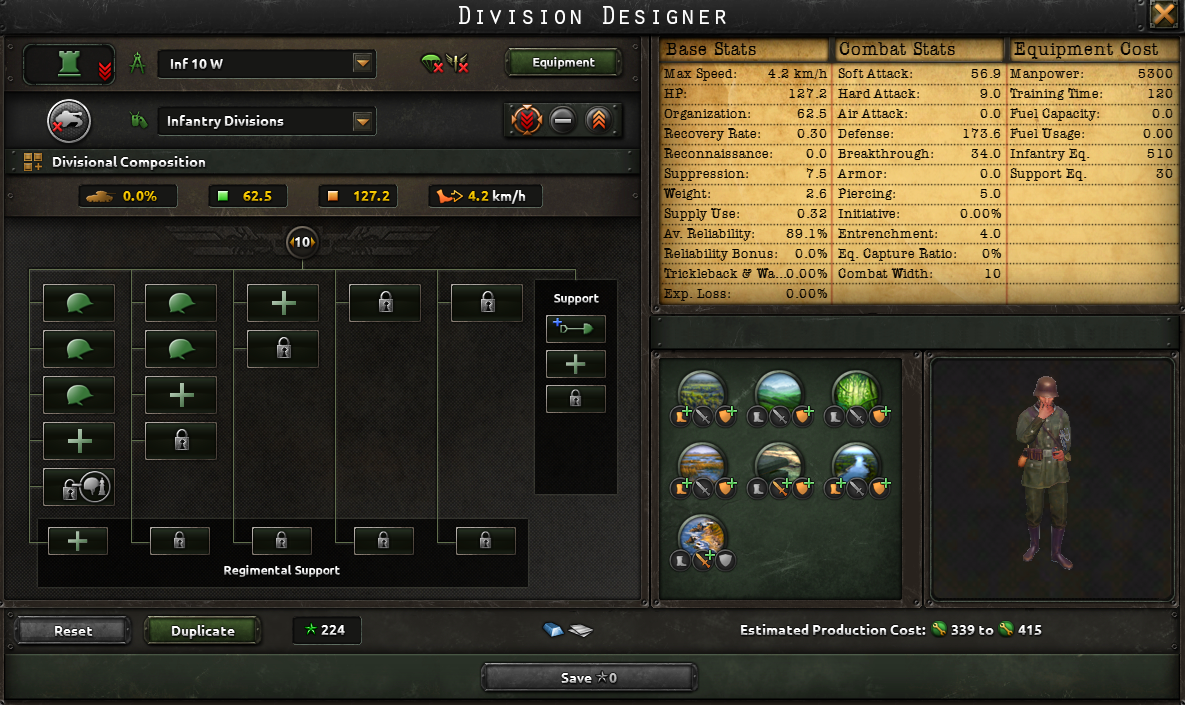
You do not have to fill all five company slots at once. “Engineer Company” is almost always first: better entrenchment on defense, easier attacks in forest and across rivers, a bit better against forts. Then look at the job. For the line, “Support Artillery” is often enough. If the enemy bombs hard — “Support Anti-Air”. If the enemy has many tanks — “Support Anti-Tank”, but only while Organization after that is still fine. “Field Hospital” spends trucks and Support Equipment: on the cheapest infantry of a small country it is often missing, on a large attacking division it is already useful. Put “Cavalry Recon Detachment” if Organization allows. Do not drop engineers just to fit recon.
Regimental “Heavy Weapons Company” and “Infantry Guns” make the division stronger, but they lower Organization and spend Infantry Equipment and Support Equipment. If Organization falls too low after them, or factories cannot keep up with Support Equipment — take the regiments off. A simple full division fights better than an expensive template that stays understrength on the map.
After every change, look at more than attack in the panel. Look at supply use, speed, and how much equipment one division needs. A large template without trucks and fuel on a long front is weaker than the paper stats. If military factories cannot even cover current rifles, a new more expensive template only grows the production queue.
Step 6. Check before you produce
Before I save the template I walk a short list. It takes a minute, and later you do not have to rebuild the whole army mid-war.
- The job is clear: defensive infantry holds the front, the attack template is not spread across the whole map.
- Combat Width fits the terrain where these divisions will stand most of the time.
- Organization is in the target range for this type.
- If there is armor — not everyone already pierces it. If there is no armor — that is a choice, not a forgotten battalion.
- Companies match the job, not the fact that there are five slots. Regiments can come off if Organization or equipment cannot keep up.
- Factories, manpower, trucks and Army Experience cover not one division, but the number you actually plan to produce.
If any point does not hold, fix the template now. Six months into the war, changing the lineup on a hundred divisions takes time, and until then they sit without the equipment they need.
Common mistakes
- One template for the whole war. Holding the front, attacking, guarding a port and fighting in mountains need different lineups. Two or three templates per campaign is usually enough. You do not need to copy ten at once.
- A lot of attack and too little Organization. The division hits hard at the start of the fight and retreats quickly. On an offensive that is especially visible: the tile does not fall.
- Ignoring Combat Width. Three divisions of 30 on plains with a 70 limit already take a penalty. More divisions in the fight does not automatically mean stronger.
- Armor without production. You put a tank or SP Anti-Air in the template, factories cannot keep up, divisions on the map lack vehicles, and the enemy still pierces the armor.
- All five companies on the very first template. Army Experience runs out, Support Equipment is not produced, divisions leave understrength.
- Changing the template with empty stockpiles. Every division on that template starts filling the new lineup. Without rifles and manpower they are weaker until they reinforce.
- Copying a large-country template as a small country. The USSR can field a large width-36 division. A small country often cannot. The right template is the one you can produce.
Bottom line
You build a good template in order. First the role and the job, then the type. Then Combat Width for the terrain it will fight on. Then Organization in the range for that type: higher on infantry, 30–40 on tanks is fine as long as the division does not retreat at once. Armor is a strong bonus if they cannot pierce it and if factories actually make it. Support companies buff without Combat Width. Drop regimental companies if Organization falls or equipment is short. If the division does its job and you can produce it — the template is built right, even when the numbers in the panel are not the biggest.