Best Infantry Template 2026
Article · Infantry Division Templates
Best Infantry Division Templates in Hearts of Iron IV
10 battle-tested meta infantry templates refined for single-player campaigns. Features budget frontline defense for minor nations, heavy defense for major powers, armored infantry, and dedicated offensive divisions.
Which template should you choose?
For minor nations:
- Infantry 10 CW. When you have almost no military factories: produce in bulk and cover the front line through sheer numbers.
- Armor 10 CW. Once you can produce budget «Medium SP Anti-Air».
- Infantry 14 CW. If you want both dependable defense and occasional counter-attacks. A developing major can also field it.
- Infantry 15 CW. If you need offensive punch rather than passive defense.
For major powers:
- Infantry 18 CW. Frontline defense for a developing or mid-tier major.
- Infantry 20 CW. Robust defense for holding vital sectors.
- Armor 20 CW. Extremely tough defense for a large major power on critical tiles.
- Infantry 25 CW. When special forces are unavailable and you need to fight in mountains or marshes.
- Infantry 36 CW. Offensive thrusts once military factories permit.
- Armor 36 CW. Heavy shock offensive template, strictly for massive industrial powers like the USSR: infantry and «Medium SP Artillery».
If you are a beginner and find it hard to choose, I recommend starting with 14 CW for defense, and 15 or 20 CW for offense. Personally, I prefer 14, 15, 25, and 36 CW for infantry. Now let us dive into the templates themselves.
10 battle-tested infantry templates
Infantry, Combat Width 10
- For weak minors
- Budget
- Defense


Template overview
Template composition and explanation
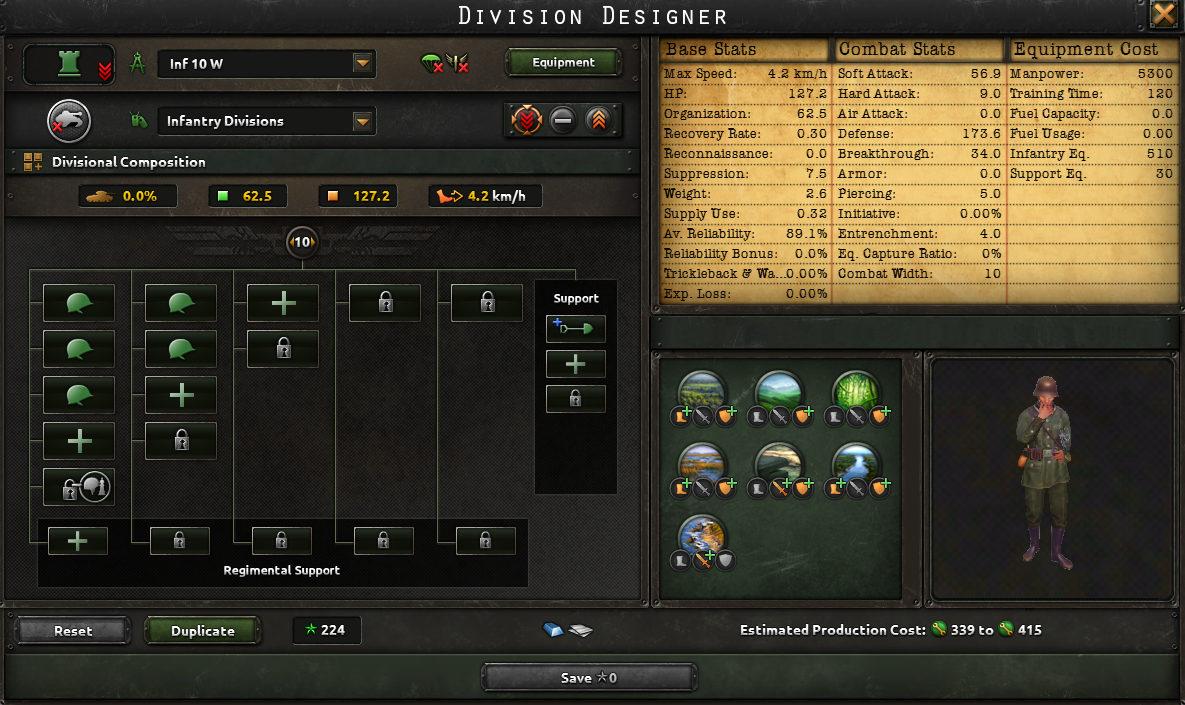
It is very straightforward: 5 «Infantry» battalions and an «Engineer Company» in support. Infantry provides organization and holds the line, while engineers boost entrenchment speed and grant defense bonuses across rough terrain. There are no tanks, artillery, or support regiments here: the template is available right from game start, requires almost no research, and costs merely 510 infantry equipment and 30 support equipment.
How to use this template
This is a low-cost defensive template for smaller nations. A single division will not hold out for long on its own, so defensive lines are held by numbers: place 3–4 divisions per tile. A combat width of 10 cleanly fills province limits and distributes incoming damage across multiple divisions. The template is unsuitable for offensive pushes due to negligible soft attack.
Template upgrades
Over time, as your industry grows and doctrines unlock, the template can be upgraded. If the enemy fields lots of tanks, add «Support Anti-Tank». If you lack firepower, slot in «Support Artillery». Adding support regiments («Heavy Weapons Company») is not recommended: they noticeably reduce the organization of a cheap division and demand scarce support equipment.
Template nuances
The primary advantage of this division is its low production cost, allowing a minor nation to build dozens of them. Its main drawback is a near-total absence of soft attack, meaning you cannot counter-attack with it. Furthermore, the division remains vulnerable to tanks and enemy air support until it receives the appropriate support companies.
Pros
- Minimal production cost.
- Available from game start without research.
- Cleanly fills province combat width.
Cons
- Relies strictly on numbers, not combat quality.
- Very low soft attack.
- Defenseless against tanks and enemy air support.
| Resource | Per division |
|---|---|
| Manpower | 5300 |
| Infantry Equipment | 510 |
| Support Equipment | 30 |
| Combat Width | 10 |
Total for all divisions
Total equipment based on the table above for the selected number of divisions.
- Manpower
- 63 600
- Infantry Equipment
- 6 120
- Support Equipment
- 360
Verdict. The ideal choice for a weak minor lacking military factories. Build in bulk and hold defense through numbers. Only add artillery or anti-tank once surplus military factories become available.
Armored Infantry, Combat Width 10
- For minors
- Armor
- Defense

Template overview
Template composition and explanation
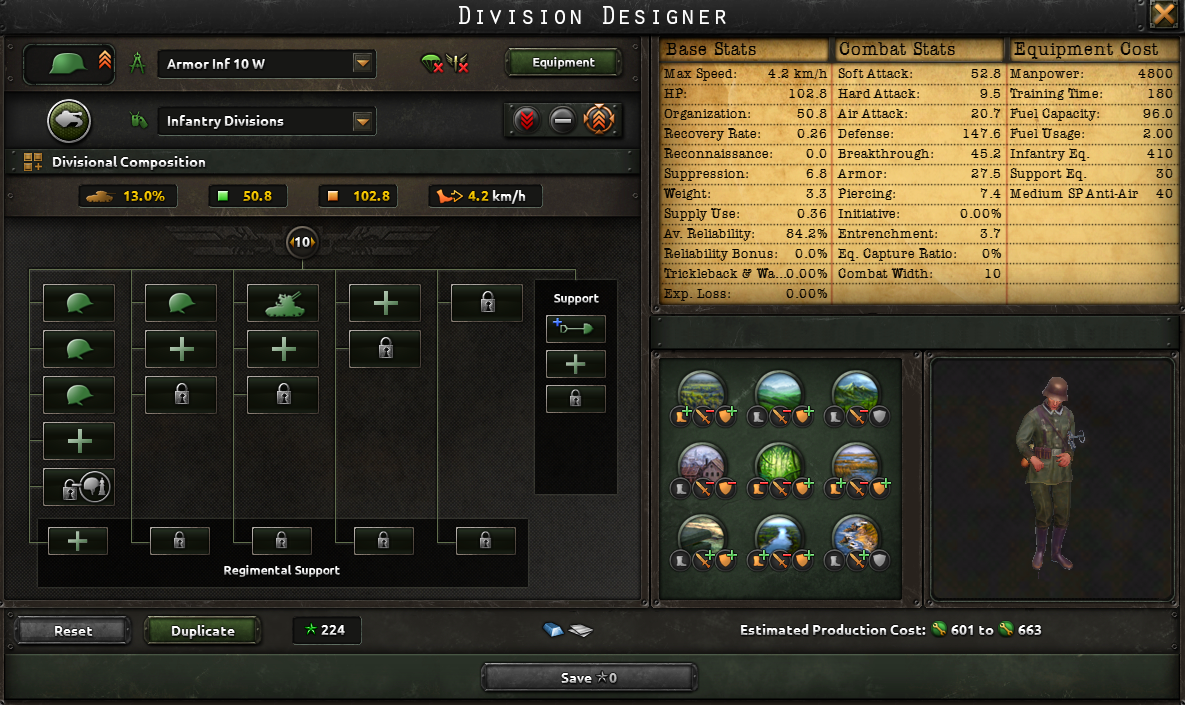
The template includes 4 «Infantry» battalions, 1 «Medium SP Anti-Air» battalion, and an «Engineer Company» in support. Infantry supplies manpower and organization, engineers handle entrenchment, and the anti-aircraft vehicle battalion provides the entire division with an armor rating while shooting down enemy CAS directly in combat.
How to use this template
The template is designed for reliable defense when playing a minor. Its defining feature is armor: if enemy infantry lacks piercing (no anti-tank or tanks), the division blocks up to 50% of incoming damage and holds firm. It is best to place 1–2 of these armored divisions per tile alongside regular 10 CW light infantry. Using the template for offense is not recommended, as it lacks artillery for breakthrough.
Template upgrades
Build the SP Anti-Air as cheaply as possible: even a basic interwar medium chassis with an entry-level anti-aircraft gun works, as long as you prioritize maximum armor. Do not attach support regiments here to avoid lowering organization. If military factories cannot keep up with vehicle production, it is better to revert to the standard 10 CW template without SP Anti-Air.
Template nuances
The division's high survivability hinges entirely on its armor. If the enemy deploys tanks or support anti-tank companies with sufficient piercing, the advantage disappears, and this template has lower organization than regular infantry. Additionally, production requires a dedicated military factory line and resources to produce 40 Medium SP Anti-Air vehicles.
Pros
- Blocks up to 50% of incoming damage from regular infantry.
- Medium SP Anti-Air battalion shoots down enemy CAS.
- Cheap build on an interwar medium chassis.
Cons
- Lower organization than standard 10 CW infantry.
- Requires military factories and resources for armor.
- Loses its advantage if the enemy has tanks or anti-tank.
| Resource | Per division |
|---|---|
| Manpower | 4800 |
| Infantry Equipment | 410 |
| Support Equipment | 30 |
| Medium SP Anti-Air | 40 |
| Combat Width | 10 |
Total for all divisions
Total equipment based on the table above for the selected number of divisions.
- Manpower
- 38 400
- Infantry Equipment
- 3 280
- Support Equipment
- 240
- Medium SP Anti-Air
- 320
Verdict. An excellent way for a minor to gain immunity against enemy rifle fire. Build your SP Anti-Air with maximum armor on a cheap chassis. If the enemy brings out tanks with piercing, switch back to standard infantry.
Infantry, Combat Width 14
- For minors
- Developing major
- Versatile


Template overview
Template composition and explanation
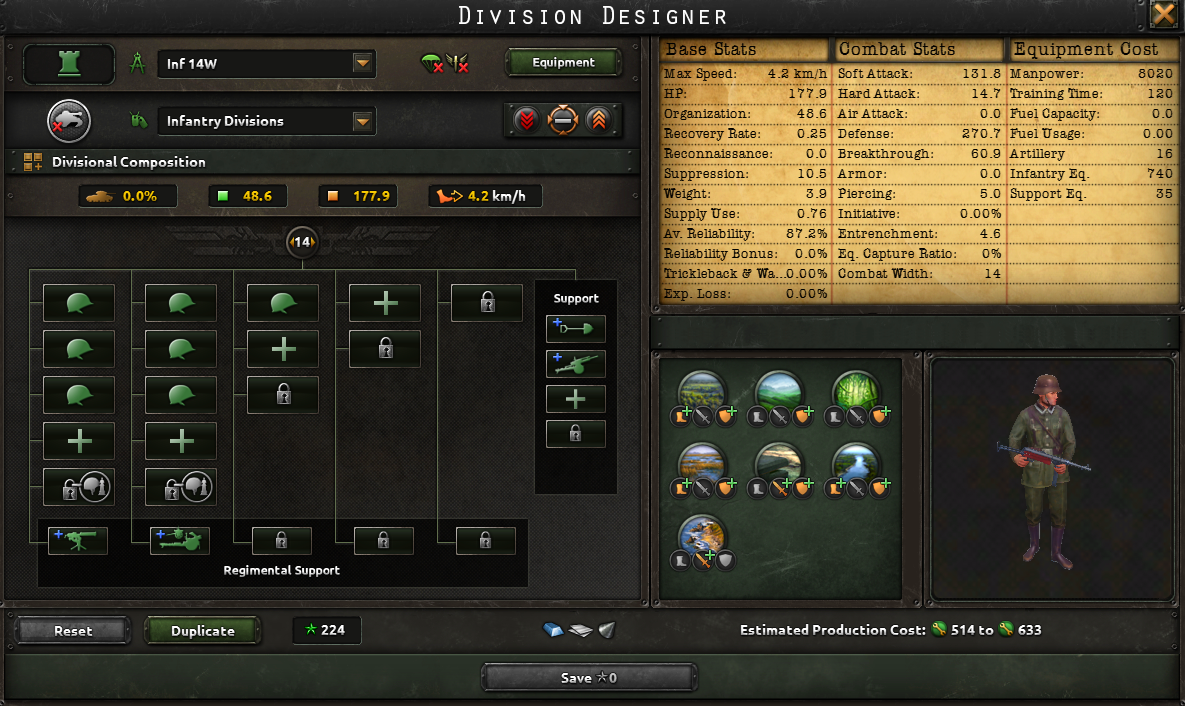
The composition includes 7 «Infantry» battalions, «Engineer Company» and «Support Artillery» in support, plus «Heavy Weapons Company» and «Infantry Guns» in regimental support slots. Seven infantry battalions provide good organization and HP, engineers aid defense, and support artillery combined with regimental guns delivers noticeable soft attack at 14 combat width. Top players frequently recommend this template.
How to use this template
This is a versatile, well-balanced template for a capable minor or secondary major. The division reliably holds defense across plains and forests, while remaining capable of attacking: concentrating several such divisions along a single sector allows you to successfully push through weak enemy positions.
Template upgrades
Support regiments («Heavy Weapons Company» and «Infantry Guns») noticeably increase firepower, but reduce organization and require substantial support equipment. If organization drops below 40–45 or military factories cannot keep up with losses, strip the support regiments. The division will hit slightly softer on attack, but will remain fully equipped.
Template nuances
A combat width of 14 fits most terrain types well, particularly forest regions. In mountains and marshes, the division struggles more due to higher supply consumption and movement penalties. Running this template smoothly requires steady domestic production of towed artillery and support equipment.
Pros
- Versatile: equally effective on defense and attack.
- Optimal combat width for forests and plains.
- Support regiments can be easily removed to save equipment.
Cons
- Support regiments reduce division organization.
- Requires steady production of artillery and support equipment.
- Suffers penalties in mountains and marshes.
| Resource | Per division |
|---|---|
| Manpower | 8020 |
| Infantry Equipment | 740 |
| Support Equipment | 35 |
| Towed Artillery | 16 |
| Combat Width | 14 |
Total for all divisions
Total equipment based on the table above for the selected number of divisions.
- Manpower
- 64 160
- Infantry Equipment
- 5 920
- Support Equipment
- 280
- Towed Artillery
- 128
Verdict. A versatile workhorse for a solid minor or developing major. Reliably holds defense and can counter-attack. If military factories cannot sustain support regiments or organization drops, remove them immediately.
Infantry, Combat Width 15
- For minors
- Offense

Template overview
Template composition and explanation
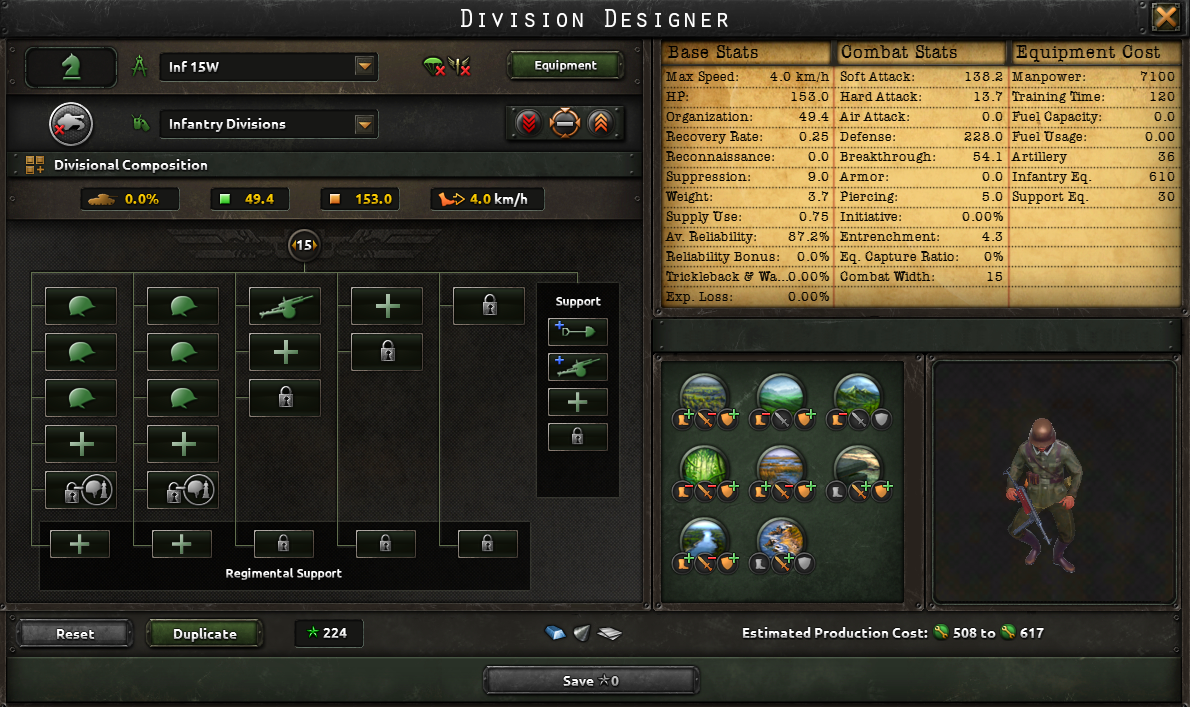
The division fields 6 «Infantry» battalions and 1 full «Artillery» battalion, supported by an «Engineer Company» and «Support Artillery». Having a full artillery battalion paired with a support company gives this 15 CW division high burst soft attack, effectively shredding enemy infantry.
How to use this template
The template is tailored for localized offensive operations when playing minor nations. Spreading it across the entire border is too expensive. It is better to hold the main front line with budget infantry, gather several 15 CW divisions together, and strike a vulnerable spot in the enemy defense. On defense, this division also holds firmly.
Template upgrades
No support regiments are used here. If organization permits and surplus military factories are available, you can add «Cavalry Recon Detachment» to speed up movement through hills and forests. If artillery stockpiles run low, the artillery battalion can be temporarily replaced with regular infantry.
Template nuances
Battalion-level line artillery consumes supplies noticeably faster than foot infantry and requires 36 guns per division. In low-infrastructure regions or far from supply hubs, the division quickly loses offensive momentum due to supply shortages.
Pros
- High soft attack from line artillery.
- Affordable offensive tool for minor nations.
- Easily reinforced with cavalry recon without losing momentum.
Cons
- Requires 36 artillery pieces per division.
- Higher combat supply consumption.
- No armor: takes heavy casualties when facing tanks.
| Resource | Per division |
|---|---|
| Manpower | 7100 |
| Infantry Equipment | 610 |
| Support Equipment | 30 |
| Towed Artillery | 36 |
| Combat Width | 15 |
Total for all divisions
Total equipment based on the table above for the selected number of divisions.
- Manpower
- 42 600
- Infantry Equipment
- 3 660
- Support Equipment
- 180
- Towed Artillery
- 216
Verdict. An accessible assault tool for minors. Gather 4–6 divisions into a spearhead and punch through enemy weak points. Avoid fielding this across the entire front line, or artillery stockpiles will drain fast.
Infantry, Combat Width 18
- For mid-tier majors
- Defense
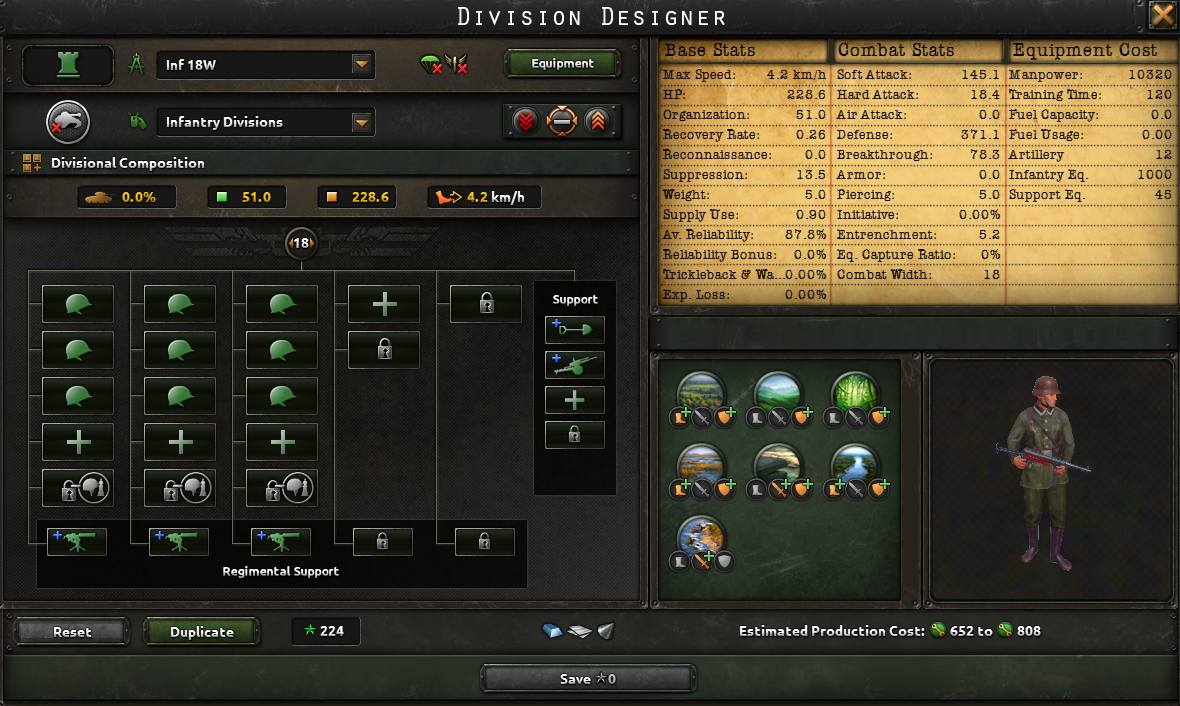
Template overview
Template composition and explanation
The core consists of 9 «Infantry» battalions, with «Engineer Company» and «Support Artillery» in support, plus 3× «Heavy Weapons Company» in support regiments. Nine infantry battalions provide an immense HP pool and high organization, engineers speed up entrenchment, and the heavy companies greet attackers with a dense wall of fire.
How to use this template
This is a dense defensive template of 18 combat width for a developing or mid-tier major. The division is designed to hold the primary front line and reliably repulse enemy assaults. You should not attack with it: soft attack is insufficient for a breakthrough, and manpower losses will be unjustifiably high.
Template upgrades
The three heavy companies drain organization and support equipment most heavily. If organization feels too low after deployment or military factories cannot keep up with losses, feel free to remove one or all three companies. Without them, the 9 infantry battalions with support companies still remain a rock-solid defensive shield.
Template nuances
Each division requires exactly 1,000 rifles and over 10,000 men, so it significantly drains manpower. A combat width of 18 fits plains and forests well, but in areas with poor logistics the division may face supply issues.
Pros
- Massive hit points pool and high organization.
- Dense barrage fire from three heavy companies.
- Excellent for defending plains and forests.
Cons
- Heavy organization hit and support equipment drain.
- Requires over 10,000 manpower per division.
- Ineffective when attempting offensive pushes.
| Resource | Per division |
|---|---|
| Manpower | 10320 |
| Infantry Equipment | 1000 |
| Support Equipment | 45 |
| Towed Artillery | 12 |
| Combat Width | 18 |
Total for all divisions
Total equipment based on the table above for the selected number of divisions.
- Manpower
- 82 560
- Infantry Equipment
- 8 000
- Support Equipment
- 360
- Towed Artillery
- 96
Verdict. A classic defensive standard for plains and forests when playing mid-tier majors. Holds ground stubbornly, but should never be tasked with attacking. If equipment runs low, simply drop the heavy support regiments.
Infantry, Combat Width 20
- For mid-tier majors
- Defense
- Key sectors
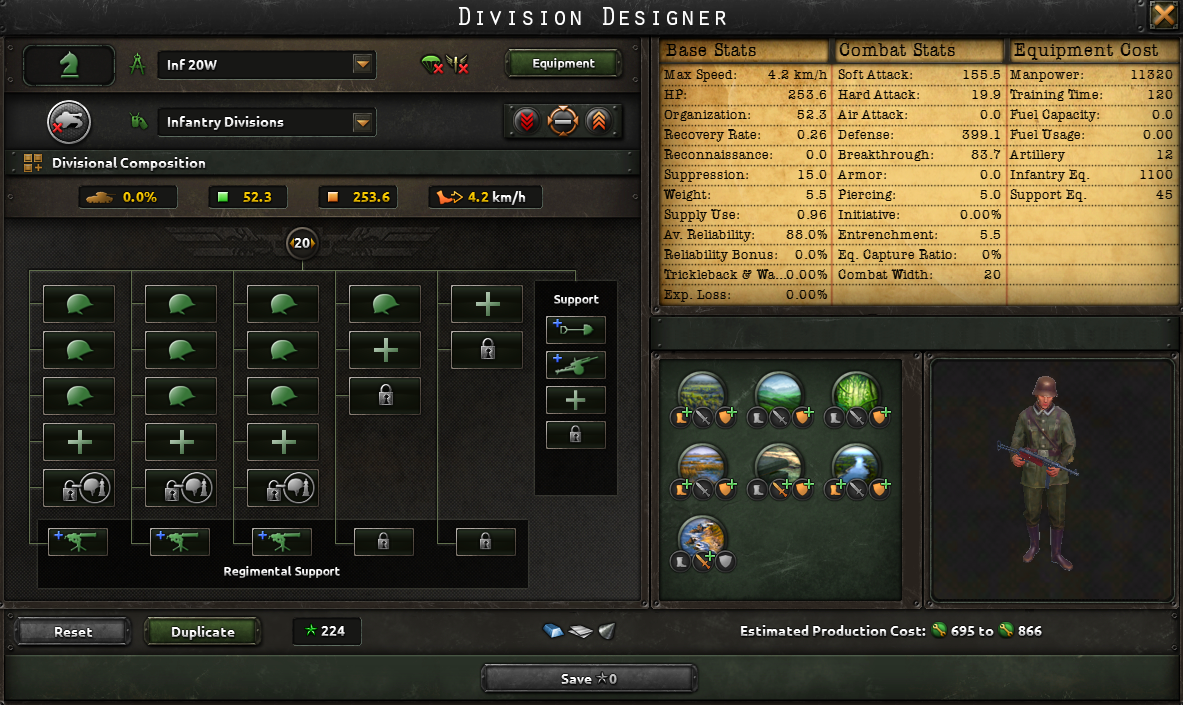
Template overview
Template composition and explanation
The template includes 10 «Infantry» battalions, «Engineer Company» and «Support Artillery», plus 3× «Heavy Weapons Company» in support regiments. Ten infantry battalions provide massive HP and high organization, allowing the division to hold defense for a very long time under continuous enemy pressure.
How to use this template
This is a reinforced defensive template on 20 CW for a mid-tier major. Do not garrison your entire border with it: producing that much equipment will overwhelm your industry. Use these divisions on critical sectors: narrow chokepoints, land bridges, major cities, and expected main enemy attack corridors. Secondary lines are cheaper to hold with 10 or 18 CW divisions.
Template upgrades
If you lack military factories for support equipment or need higher raw organization, strip the heavy companies from support regiments first. When an armored threat appears, adding «Support Anti-Tank» to the support companies is recommended.
Template nuances
Maintaining the division is expensive: 11,320 manpower and 1,100 rifles. In addition, at 20 CW it is important to monitor province combat widths to avoid penalties for exceeding frontline limits.
Pros
- Maximum staying power on critical frontline sectors.
- Ideal for narrow land bridges, cities, and mountain passes.
- Regiments can be removed without altering the 20 CW profile.
Cons
- Too expensive to hold the entire front line.
- High infrastructure and supply demands.
- Risk of exceeding province combat width limits.
| Resource | Per division |
|---|---|
| Manpower | 11320 |
| Infantry Equipment | 1100 |
| Support Equipment | 45 |
| Towed Artillery | 12 |
| Combat Width | 20 |
Total for all divisions
Total equipment based on the table above for the selected number of divisions.
- Manpower
- 67 920
- Infantry Equipment
- 6 600
- Support Equipment
- 270
- Towed Artillery
- 72
Verdict. An unyielding «wall» for critical sectors: narrow land bridges, cities, and mountain passes. Too expensive to deploy along the entire border. In times of deficit, support regiments can be stripped without losing the 20 combat width profile.
Armored Infantry, Combat Width 20
- For majors
- Armor
- Defense
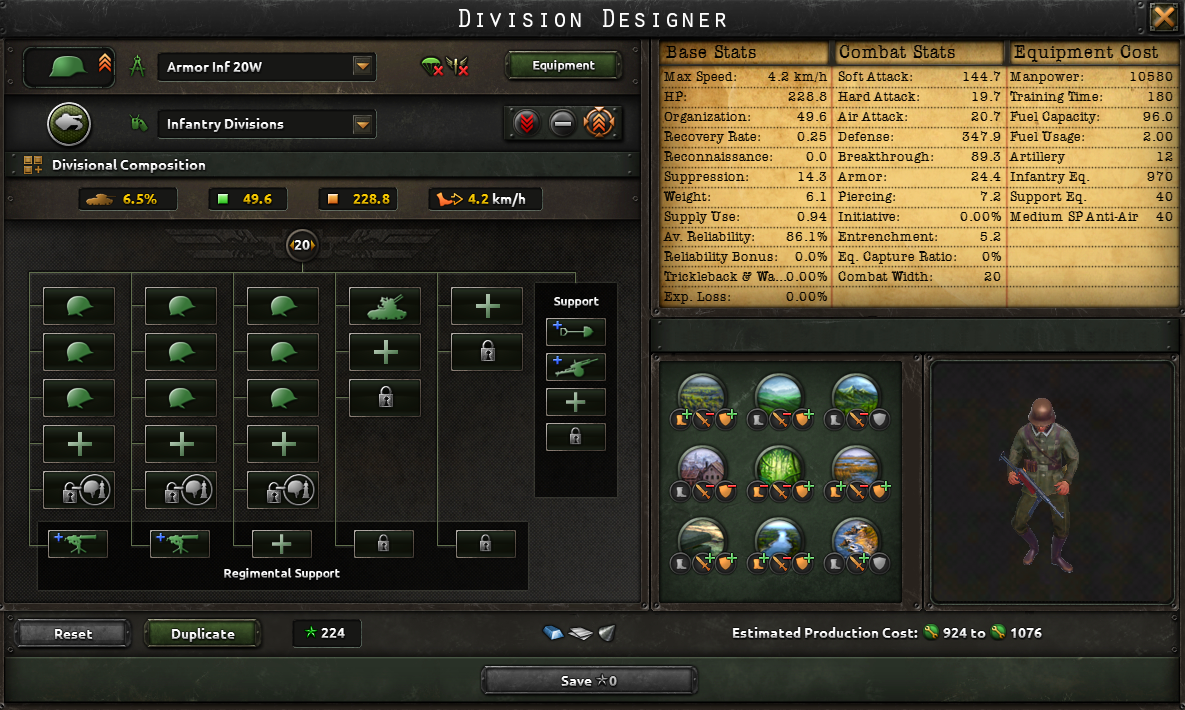
Template overview
Template composition and explanation
The division includes 9 «Infantry» battalions, 1 «Medium SP Anti-Air» battalion, «Engineer Company» and «Support Artillery», plus 2× «Heavy Weapons Company» in support regiments. Infantry forms a solid core, artillery and regimental weapons deliver solid damage, and the SP Anti-Air battalion provides division armor along with protection against air strikes.
How to use this template
A high-quality armored defensive template for developed major powers. Thanks to armor, the division cuts damage taken from enemy infantry in half and reliably holds the line on plains and hills where regular units suffer heavy casualties. An excellent choice for holding back massive enemy forces.
Template upgrades
The SP Anti-Air is built on a 1938 or 1940 medium tank chassis: mount a basic anti-aircraft gun and prioritize maximum armor. The support regiments («Heavy Weapons Company») can be stripped if support equipment runs short or organization is low. The SP Anti-Air battalion must never be removed — without it, the division loses its main advantage.
Template nuances
The division requires a dedicated armor production line (40 Medium SP Anti-Air per division). If the enemy fields units with sufficient piercing, the armor bonus ceases to apply, and the division fights like regular infantry with reduced organization.
Pros
- Heavy armor cuts incoming damage from enemy infantry in half.
- Reliable organic protection against enemy CAS.
- High counter-attack damage from artillery and regimental guns.
Cons
- Requires 40 Medium SP Anti-Air per division.
- Armor bonus is lost against tanks and anti-tank.
- Expensive to produce: not suitable as a mass frontline force.
| Resource | Per division |
|---|---|
| Manpower | 10580 |
| Infantry Equipment | 970 |
| Support Equipment | 40 |
| Towed Artillery | 12 |
| Medium SP Anti-Air | 40 |
| Combat Width | 20 |
Total for all divisions
Total equipment based on the table above for the selected number of divisions.
- Manpower
- 63 480
- Infantry Equipment
- 5 820
- Support Equipment
- 240
- Towed Artillery
- 72
- Medium SP Anti-Air
- 240
Verdict. An impenetrable shield for major powers along decisive axes. Build your SP Anti-Air with maximum armor. Field selectively — even an industrial giant cannot afford to equip an entire frontline army with this setup.
Infantry, Combat Width 25
- No special forces
- Mountains & marshes
- Versatile
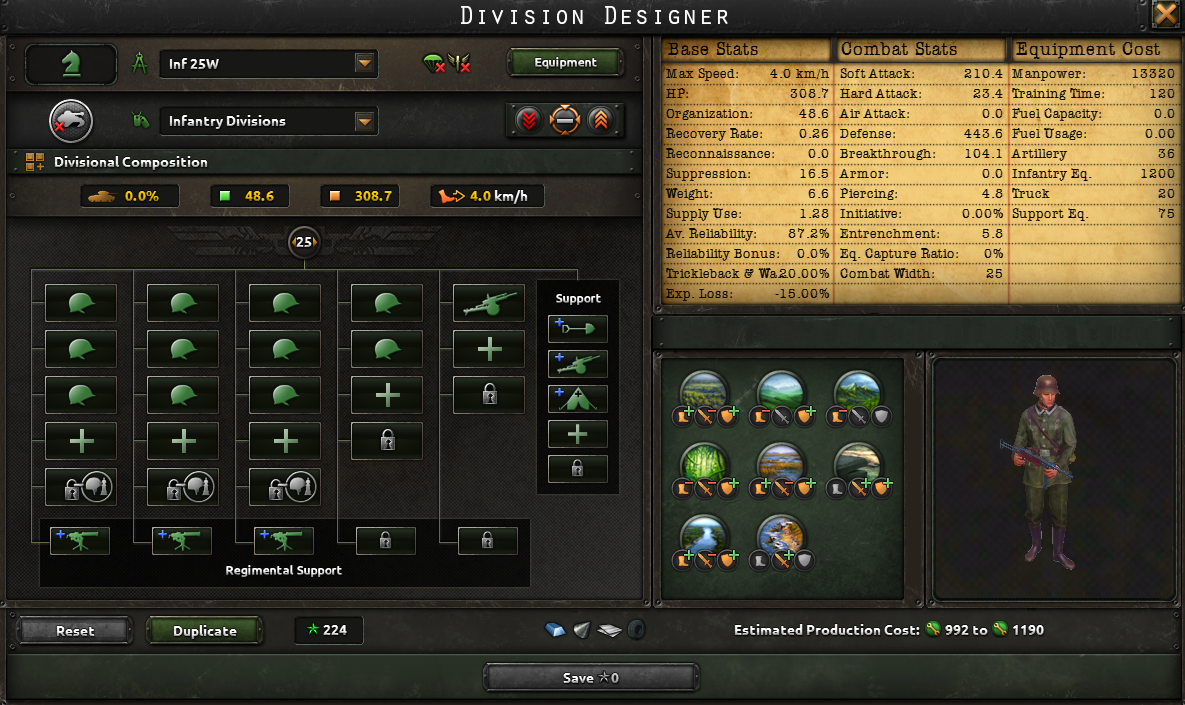

Template overview
Template composition and explanation
The template consists of 11 «Infantry» battalions, 1 line «Artillery» battalion, three support companies («Engineer Company», «Support Artillery», «Field Hospital»), and 3× «Heavy Weapons Company» in support regiments. Massed infantry provides immense staying power, artillery delivers excellent anti-infantry firepower, engineers strengthen defenses, and the hospital helps preserve manpower and soldier veterancy.
How to use this template
This is a specialized template designed for difficult terrain: mountains and marshes. It is used when mountaineers are not yet researched or the special forces cap has been reached. A combat width of 25 fits the combat width limits of marshes and mountains cleanly. The division reliably holds defense in rugged regions and can push enemy positions.
Template upgrades
If military factories cannot keep up with support equipment production or organization drops, remove the three heavy companies from support regiments first. «Field Hospital» requires trucks: if they run short, it can also be temporarily removed. Do not remove line or support artillery — without them, the division loses its soft attack.
Template nuances
The division turns out quite massive: 13,320 manpower, plus artillery guns and motorized trucks. Fighting on open plains with it is uneconomical — standard 18–20 CW templates perform better and more efficiently there. Additionally, regular infantry in mountains lacks the unique movement and attack bonuses innate to mountaineers.
Pros
- Optimal combat width for mountains and marshes.
- Field hospital preserves manpower pools and soldier veterancy.
- Full substitute for special forces without consuming the cap.
Cons
- Lacks the unique terrain combat buffs of special forces.
- Uneconomical and overly wide for open plains.
- Consumes trucks and support equipment for hospital and regiments.
| Resource | Per division |
|---|---|
| Manpower | 13320 |
| Infantry Equipment | 1200 |
| Support Equipment | 75 |
| Towed Artillery | 36 |
| Truck | 20 |
| Combat Width | 25 |
Total for all divisions
Total equipment based on the table above for the selected number of divisions.
- Manpower
- 53 280
- Infantry Equipment
- 4 800
- Support Equipment
- 300
- Towed Artillery
- 144
- Truck
- 80
Verdict. A lifesaver for battles in mountains and marshes when your special forces cap is exhausted. The hospital preserves division veterancy and manpower exceptionally well. Do not deploy on open plains — standard 18–20 CW templates are far more economical there.
Infantry, Combat Width 36
- For majors
- Offense
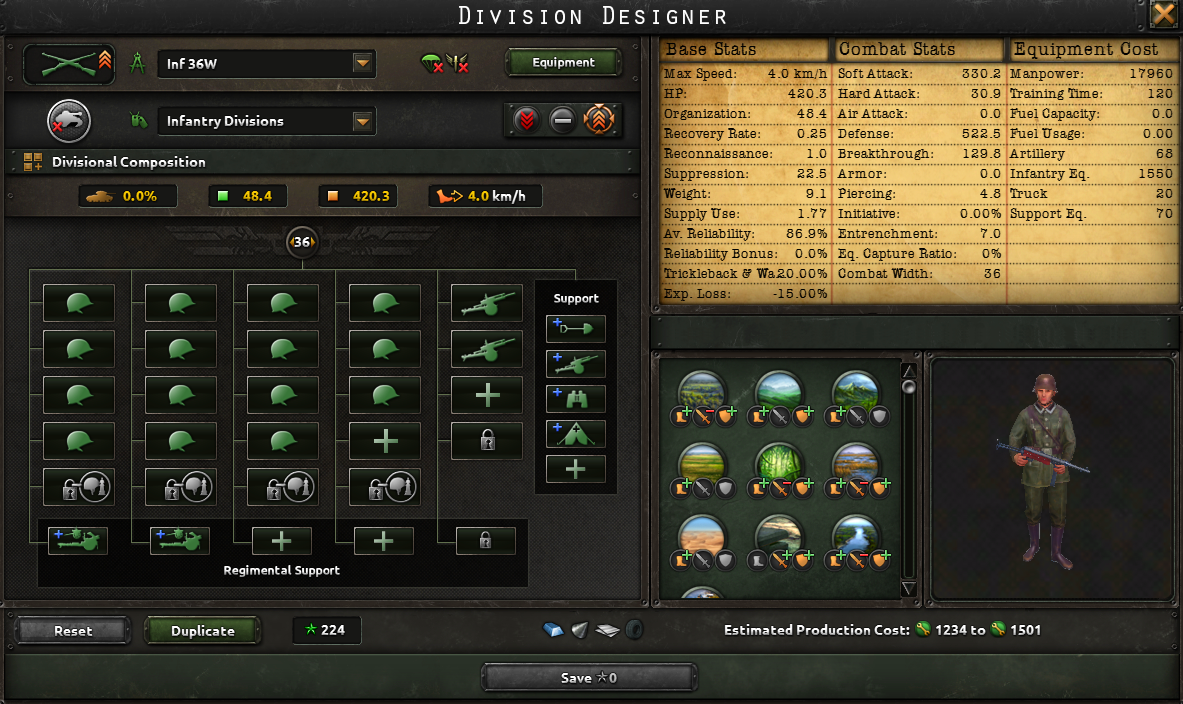

Template overview
Template composition and explanation
A shock assault setup: 15 «Infantry» battalions, 2 line «Artillery» battalions, and four support companies («Engineer Company», «Support Artillery», «Cavalry Recon Detachment», and «Field Hospital»). Fifteen infantry battalions provide a massive HP buffer, two artillery battalions deliver punishing anti-infantry damage, recon speeds up movement, and the hospital reduces casualties in prolonged battles. One of the most popular templates among experienced players who prefer pushing with infantry.
How to use this template
This is a powerful offensive template for developed major powers. There is no need to stretch these divisions along the entire front line: concentrate 2–3 divisions on a decisive breakthrough sector, focus your firepower, and shatter the enemy defense along the chosen axis.
Template upgrades
The fifth support slot is left open for situational needs: against heavy enemy aviation add «Support Anti-Air», and against tank formations add «Support Anti-Tank». If you lack military factories or organization drops, you can temporarily drop the hospital or recon, but do not remove the two artillery battalions — without them, the division loses its offensive punch.
Template nuances
The division is demanding on your economy: nearly 18,000 manpower and 68 artillery pieces per unit. Due to the 36 combat width, usually only two such divisions fit into combat simultaneously. The template critically depends on supply: under poor logistics or lacking air support, the division quickly loses offensive momentum.
Pros
- Devastating soft attack to shatter infantry defenses.
- Giant HP buffer backed by 15 infantry battalions.
- Open support slot for Anti-Air or Anti-Tank depending on threats.
Cons
- Colossal cost: 18,000 manpower and 68 artillery pieces.
- Critically dependent on rail logistics and supply.
- Narrow specialization: strictly meant for local breakthroughs.
| Resource | Per division |
|---|---|
| Manpower | 17960 |
| Infantry Equipment | 1550 |
| Support Equipment | 70 |
| Towed Artillery | 68 |
| Truck | 20 |
| Combat Width | 36 |
Total for all divisions
Total equipment based on the table above for the selected number of divisions.
- Manpower
- 71 840
- Infantry Equipment
- 6 200
- Support Equipment
- 280
- Towed Artillery
- 272
- Truck
- 80
Verdict. The primary offensive spearhead for large powers lacking a dedicated tank corps. Slot anti-air or anti-tank into the fifth support slot depending on the battlefield. Always verify railway throughput before attacking — supply consumption is immense.
Armored Infantry, Combat Width 36
- For superpowers
- Offense
- Armor
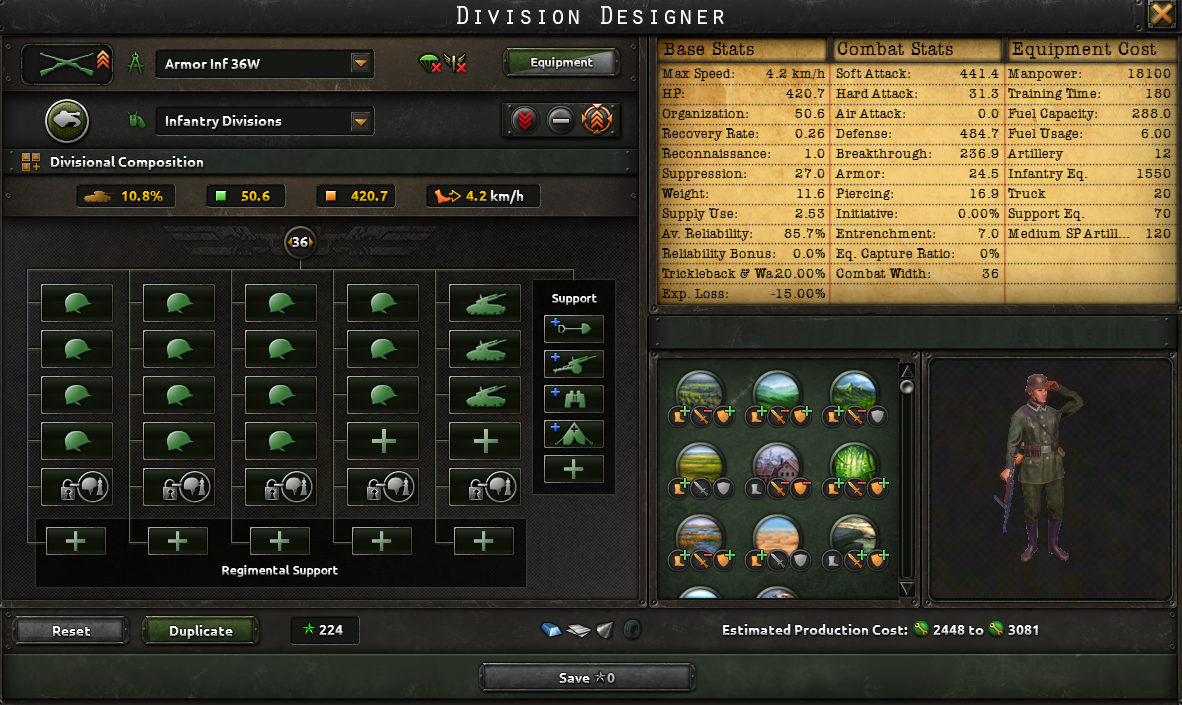

Template overview
Template composition and explanation
A heavy armored template: 15 «Infantry» battalions, 3 «Medium SP Artillery» battalions, and four support companies («Engineer Company», «Support Artillery», «Cavalry Recon Detachment», and «Field Hospital»). Infantry provides mass and organization, while three SP Artillery battalions deliver colossal soft attack and blanket the division in armor, avoiding heavy casualties under enemy fire.
How to use this template
A powerful offensive tool for major industrial powers (such as the USSR, Germany, or the USA). Designed to smash through heavily fortified defensive sectors on plains and hills. Thanks to armor, the division advances with minimal losses against infantry without anti-tank, and the immense SP Artillery damage quickly overruns enemy units.
Template upgrades
The fifth support slot is used situationally: slot in «Support Anti-Air» against CAS or «Support Anti-Tank» against armor. If equipment runs short, you can remove the hospital or recon, but the SP Artillery battalions should not be touched. If needed, SP Artillery can be replaced with medium tanks — this reduces soft attack, but significantly increases division breakthrough.
Template nuances
The division demands heavy investment: 120 Medium SP Artillery, substantial fuel consumption, and dependable supply. The template shines best when researching the «Self-Propelled Support» sub-doctrine. Without a robust tank industry and a solid railway network leading to the front line, deploying such a division is not recommended.
Pros
- Record-breaking soft attack from three SP Artillery battalions.
- Armor enables offensive pushes with minimal casualties.
- Top-tier synergy with the «Self-Propelled Support» sub-doctrine.
Cons
- Extremely expensive: requires 120 Medium SP Artillery per division.
- Heavy fuel consumption and high logistical strain.
- Requires advanced technology and dedicated research slots.
| Resource | Per division |
|---|---|
| Manpower | 18100 |
| Infantry Equipment | 1550 |
| Support Equipment | 70 |
| Towed Artillery | 12 |
| Truck | 20 |
| Medium SP Artillery | 120 |
| Combat Width | 36 |
Total for all divisions
Total equipment based on the table above for the selected number of divisions.
- Manpower
- 54 300
- Infantry Equipment
- 4 650
- Support Equipment
- 210
- Towed Artillery
- 36
- Truck
- 60
- Medium SP Artillery
- 360
Verdict. The ultimate armored battering ram for industrial juggernauts like the Soviet Union. Requires the «Self-Propelled Support» sub-doctrine and hundreds of SP Artillery vehicles in stockpiles. If you lack a dominant tank industry, fuel, and rail logistics, do not attempt to build it.
How I Selected These Templates
I set out to assemble several distinct templates tailored to different combat situations and different nations. I categorized nations by industrial capacity. A struggling minor can get by with 10 CW. A confident minor can field 14 CW, or 15 CW if taking the offensive. A developing or mid-tier major uses 18 and 20 CW to secure vital sectors. The heavy shock 36 CW division is for when military factories are producing in volume. I kept 25 CW separate: it is an option when mountaineers and marines are unavailable, but combat takes place in mountains or marshes. Special forces are superior, but if you do not have them, a 25 CW infantry template will do the job.
I added regimental support («Heavy Weapons Company» and «Infantry Guns») where they genuinely reinforce the division. As noted throughout: strip them if organization drops or military factories cannot keep up. The open support company slot on both 36 CW templates is intentional. Whether you slot Anti-Air or Anti-Tank depends on enemy air superiority and whether the enemy fields armor. In single-player, I evaluated whether industry could sustain production, whether the template held defense, and whether it could attack. In multiplayer, you should not copy all ten templates at once: players design divisions for specific scenarios and optimize them more aggressively.
Bottom Line
If you are playing a minor nation, hold the front line with 10 and 14 CW divisions. Attack with 15 CW, or try 20 CW if your industry allows.
If you are playing a major power, hold the front line with 18 and 20 CW divisions, and you can also try 16 CW. For offensive pushes, take 25 and 36 CW.
Strip support regiments when organization is low or military factories fall behind. You can also upgrade or adapt division templates by adding support companies or regiments based on the situation.