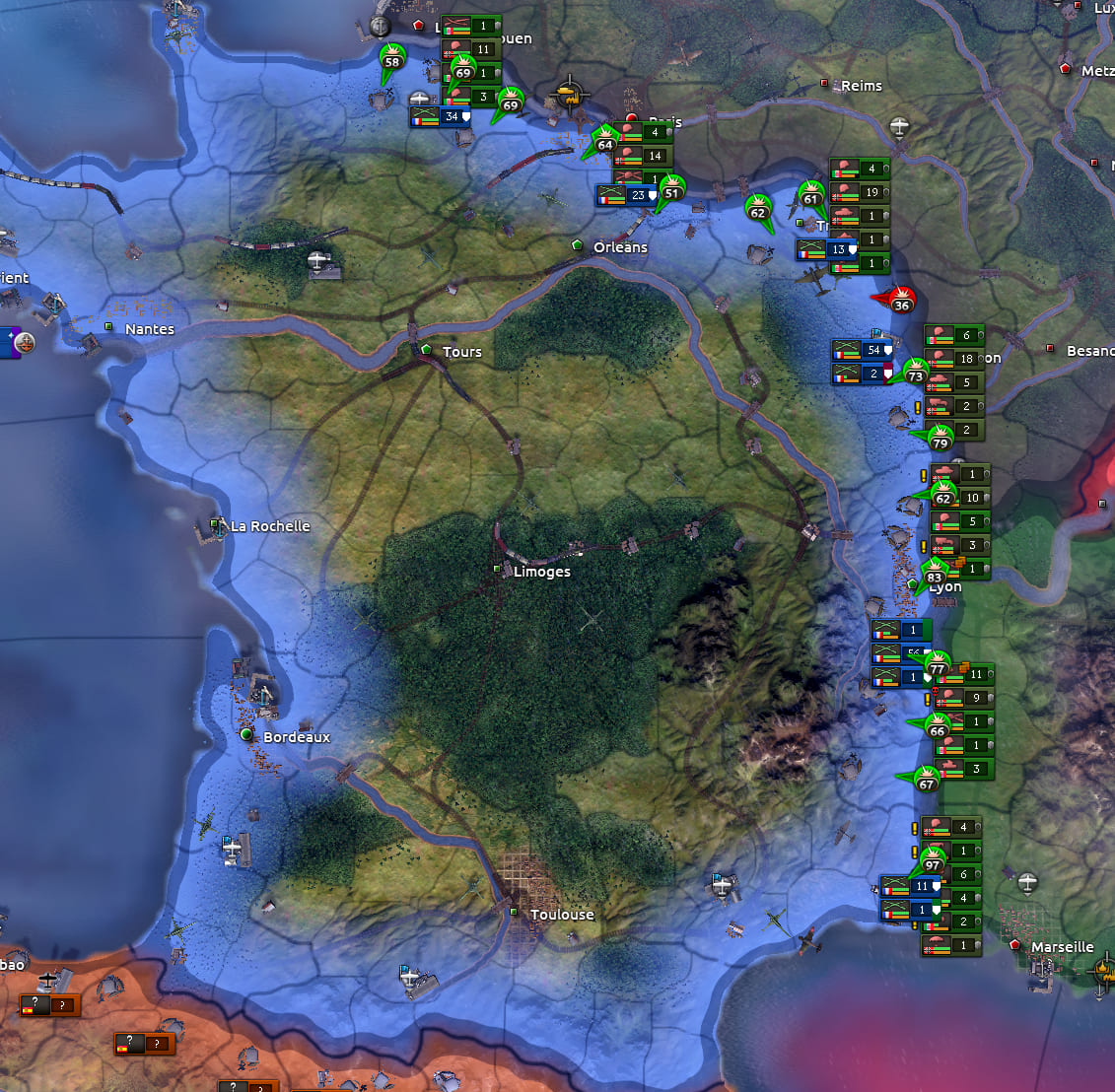
Supply Guide
How to Maintain Top-Tier Logistics in War?
Supply in Hearts of Iron 4
Without supply, your tanks are just scrap metal. Learn how to feed your army and starve the enemy.
In Brief
Without supply, divisions lose up to 80% combat effectiveness: penalties to attack, defense, organization, and speed. Supply depends on hubs, railways, infrastructure, motorization, terrain, and weather. It is improved by building hubs/ports, upgrading railways, enabling truck delivery, air supply, and reducing division count. Cut enemy supply by capturing their hubs, ports, and railways — the effect takes hold after 72 hours.
What Is Supply?
Supply is the logistical network that delivers provisions from your capital to divisions at the front. It determines how well your troops are equipped with ammunition, fuel, food, and spare parts. Without a working supply system, even the most powerful army becomes a helpless mob.
Why Is It Important?
Supply defines combat effectiveness: without it, divisions become easy prey. Managing supply is more important than division templates — even the best division without provisions will lose to the weakest one.
What Affects Supply?
- 1) Province supply capacity — how many supplies a province can receive. Increased by infrastructure level (+0.3 per level), victory points, regional population, and proximity to a hub/port. Also depends on whether the entire region is controlled.
- 2) Hub throughput — how many supplies a hub can receive from the capital. Determined by railway level (base 10 + 5 per level) and the number of trains in the country (if there are no trains, supply drops to 50%).
- 3) Delivery from hub to province — decreases with each step (0.5 for the first province, +0.7 for each subsequent one). Heavily dependent on terrain, rivers, and infrastructure along the route. Hub motorization with trucks extends delivery range.
- 4) Trains, trucks, and convoys — without trains, railways do not work; without trucks, hub motorization is impossible; without convoys, there is no naval supply.
- 5) Weather and terrain — impose penalties on supply efficiency and increase equipment wear.
How to Improve It?
- 1. Build more supply hubs / naval bases.
- 2. Upgrade railways from the capital to the required hub.
- 3. Build infrastructure.
- 4. Use air supply.
- 5. Connect nearby hubs and ports with railways.
- 6. Remove some divisions from an oversaturated area.
Frequently Asked Questions
The issue is not the hub but the province capacity. Each province can only accept a limited amount of supplies — this depends on infrastructure, victory points, and population. If there are too many divisions in the province, they simply don't fit. Spread your troops across neighboring provinces and build infrastructure.
Motorization switches the hub from horses to trucks. It increases the range over which the hub can distribute supplies and boosts the overall supply flow. Activate it in F4 mode via Shift+LMB on the hub or in the army interface. Use partial for infantry (30 trucks) and full for tanks (60 trucks).
You need to upgrade the weakest section along the entire route from the capital to the hub. Hub capacity is determined by the lowest railway level on the path. If there is a level 1 section on the route, the entire line operates as level 1, even if the rest is level 5. Find and sequentially improve all weak points.
Each division has 72 hours of supply reserves. If you cut off the enemy from supply, they will not die instantly — they have 3 days to try to break out or receive help. The effect of supply disruption takes 3-4 days to manifest. Hold the captured point for at least that long.
Infrastructure provides only +0.3 supplies per level (maximum +1.5 at level 5). It is expensive and inefficient as a primary method to improve supply. However, it speeds up troops, increases resource extraction, and accelerates construction. Build it in key regions where province capacity is insufficient, but not as the main solution.
This is attrition. Tanks break down due to poor terrain, weather, supply shortages, or training. For example, in mountains, truck wear is +100%, and in marshes — +400%. Counter it through high equipment reliability (maintenance companies, upgrades) and by avoiding hazardous terrain.
Press F4 (supply mode), hold Ctrl, and click on the desired hub or port. Allied supply will be cut off, and they will stop stealing your provisions. Useful when an ally brings a swarm of divisions and your troops start starving.
Yes, but only as a temporary solution. 200–400 transport planes on a supply mission provide approximately +1.5 infrastructure levels. They require air superiority (70%+) and 5–20 command power. They do not replace full logistics but help in critical situations.
It is when one weak railway section limits the entire supply chain. For example, if on the route from the capital to the hub there is a level 1 railway, the hub will receive supplies as for level 1, even if everything else is level 5. Find and upgrade that section — and the entire supply flow will increase.
Marshes are the worst: -16% supply and +400% truck wear. Jungles are almost as bad: -16% and +300%. Mountains are also poor: -12% and +100%. The best are cities (+20% supply) and plains (no penalties). Try to advance through plains and cities, bypassing marshes and jungles.
Stat Comparison
How critical the difference is between a well-fed and a starving division.
| Stat | At 100% supply | At 10% supply |
|---|---|---|
| Soft attack | 28 | 10 |
| Breakthrough | 14 | 5 |
| Organization | 63 | 14 |
Supply Hubs
Supply hubs are the main points where provisions arrive from the capital via railways. From there, they are distributed to surrounding provinces using motorization (horses or trucks).
They cost 20,000 construction points — the most expensive building in the game. I do not recommend building them in Europe, where there are already plenty of hubs. But I strongly recommend them in regions with low hub density (Siberia, Africa) — without your own hub, an offensive there is almost impossible.
Naval Bases
An alternative hub type: supplies are delivered by sea using convoys. The port must have a naval route to the capital or to a port connected by railway to the capital.
They are cheaper: level 1 — 5,000, each subsequent level costs +1,000 more. They can only be built on coastal provinces.
Advantages: low cost, supply for regions without railways.
Disadvantages: convoys and naval superiority are required; the enemy can cut the sea route. If you lack superiority, connect the base by railway to a functioning hub.
Railways
The cheapest building in the game, but one of the most useful. They connect hubs to the capital. They have 5 levels. Level 1 is built by default. Each level increases hub throughput by +5 supplies (base 10, level 1 — 15, maximum 35).
Important: hub capacity is determined by the weakest section along the entire route from the capital. Upgrade not everything indiscriminately, but specific bottlenecks — find the lowest value and raise it until the entire route matches.
Infrastructure
Increases the amount of supplies that can fit in a province. Cost: 6,000. Each level adds +0.3 supplies to every province in the region (at level 5: +1.5).
Not the most efficient method in terms of cost/benefit, but it has bonuses: it speeds up troop movement, increases resource extraction, and accelerates construction. Build it in key regions where combat is ongoing or province capacity is insufficient — infrastructure expands the "bucket" into which the hub pours supplies.
Efficiency Comparison
| Name | Description | Efficiency | When to build | Cost |
|---|---|---|---|---|
| Supply hub | Receives supplies via railway and distributes them to troops in range | 10/10 | During a long lull, 1-2 provinces from the front | 20,000 |
| Naval base | Receives supplies via convoys and distributes them to troops | 7/10 | During a short lull, by the water, 1-2 provinces from the front | 5,000 |
| Railway | Connects supply hubs, increases throughput | 6/10 | Before or during an offensive | 170 |
| Infrastructure | Increases province capacity in the region | 5/10 | In key regions before a major offensive | 6,000 |
Division Supply Consumption
This is how much food a division consumes. The higher the consumption, the harder it is to supply. Armored divisions (tanks, SPGs) consume a great deal. Try to keep consumption as low as possible.
It can be reduced through field marshal traits, division command spirit (officer corps), doctrines, and focuses.
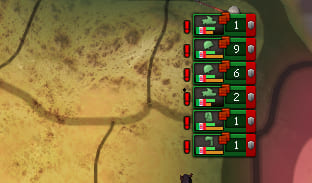
Division Penalties
Without supply, penalties reach 50–70% of a division's potential. Infantry will be unable to hold the line, and tanks will have no fuel. Penalties are applied gradually:
- Movement speed: -80%
- Organization: -80%
- Combat effectiveness (soft/hard attack, breakthrough, defense): -33%
- Organization recovery: -30%
- Attrition losses: up to 30%
Divisions have a grace period: by default, 72 hours (3 days) without penalties after losing supply. This gives a chance to escape an encirclement or restore the line.
Motorization Levels
A mechanic many overlook. Motorization levels can be set both for a hub and for an army. There are three types:
- Horse supply — slow, cheap, requires no trucks. Enabled by default.
- Partial motorization — for infantry divisions. Requires 30 trucks per used hub.
- Full motorization — for tank and expensive divisions. Requires 60 trucks per hub.
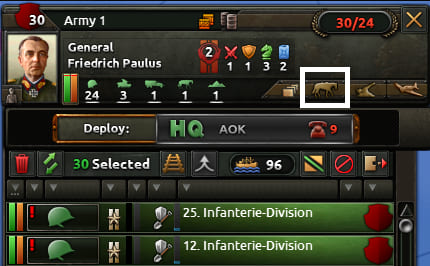
Trucks do not consume fuel when used for supply. To set the level for a hub: switch to the supply map (F4), hold Shift, and click on the hub. For an army: select the army, in the left army management menu click on the horse/truck icon in the upper right corner.
Partial for infantry, full for tanks.
Province Capacity
Each province has its own supply capacity — not a physical warehouse, but an abstract limit. It depends on:
- 1) Infrastructure level (+0.3 per level).
- 2) Victory points in the province — a hidden but powerful mechanic. Capital (50 points), major city (20), villages (1), empty provinces (0). The more points, the higher the passive supply from the population.
- 3) Population in the region — the more people, the more help for the soldiers.
- 4) Proximity to a hub/port — the hub projects a portion of its throughput onto the province. Even with a good population, without a hub, divisions will starve.
- 5) Control percentage over the region — supply from the population only works in the controlled part.
- 6) Hub bonuses in the region — each hub you build gives a small permanent bonus to all provinces in the region, regardless of distance.
- 7) Weather — precipitation, blizzards, and floods temporarily reduce capacity and increase supply consumption.
Battalion Supply Consumption Table
| Name | Consumption |
|---|---|
| Infantry | 0.06 |
| Paratroopers | 0.05 |
| Marines | 0.05 |
| Mountaineers | 0.05 |
| Rangers | 0.05 |
| Name | Consumption |
|---|---|
| AA | 0.1 |
| AT | 0.1 |
| Artillery | 0.21 |
| Rocket Artillery | 0.22 |
| Name | Consumption |
|---|---|
| Motorized AA | 0.15 |
| Motorized AT | 0.15 |
| Motorized Artillery | 0.25 |
| Towed Rocket Artillery | 0.25 |
| Motorized Rocket Artillery | 0.25 |
| Name | Consumption |
|---|---|
| Amphibious Battalion | 0.18 |
| Armored Car | 0.14 |
| Cavalry | 0.06 |
| Mechanized Infantry | 0.14 |
| Motorized Infantry | 0.06 |
| Name | Consumption |
|---|---|
| Light SPAA | 0.1 |
| Medium SPAA | 0.1 |
| Heavy SPAA | 0.1 |
| Modern SPAA | 0.1 |
| Light SPG | 0.42 |
| Medium SPG | 0.46 |
| Heavy SPG | 0.6 |
| Modern SPG | 0.5 |
| Light TD | 0.2 |
| Medium TD | 0.22 |
| Heavy TD | 0.3 |
| Modern TD | 0.25 |
| Name | Consumption |
|---|---|
| Amphibious Tank Battalion | 0.2 |
| Heavy Tank | 0.32 |
| Light Tank | 0.22 |
| Medium Tank | 0.25 |
| Modern Tank | 0.25 |
Plains and Cities
Cities: supply works best. The terrain gives +20% supply efficiency, plus passive supply from population and victory points. When creating encirclements, always capture cities first to deny the enemy this advantage.
Plains: neutral terrain — no buffs or debuffs. You can leave them for quickly mopping up the enemy after cutting supply.
Hills and Forests
Hills: -10% supply, +20% truck wear. Your trucks break down faster and provisions arrive worse. Not critical for short operations, but begins to noticeably hurt logistics during prolonged offensives.
Forests: slightly better — -8% supply, truck wear +20%. Forests do not hinder supply as much as hills but still slow delivery. When moving through large forested areas, allow extra time for bringing up supplies.
Mountains and Marshes
Mountains: -12% supply, truck wear +100%. Equipment breaks very quickly, offensives are extremely difficult. Every unit of supply is worth its weight in gold, and trucks become expendable. If possible, bypass mountains or use specialized mountain divisions.
Marshes: worst terrain — -16% supply, wear +400%. Practically unbearable. Trucks bog down, supplies barely arrive. An offensive through marshes is a guaranteed logistical collapse. The only sensible solution is to bypass marshes or attack only with absolute superiority.
Jungles and Deserts
Jungles: -16% supply, wear +300%. Marginally better than marshes but still terrible. Jungles consume trucks and supplies at a frightening rate. In such conditions, it is better to use infantry divisions with minimal dependence on motor transport.
Deserts: -14% supply, wear +50%. Trucks suffer moderately, but overall supply drops noticeably. The desert is not as fearsome as jungles or marshes, but still requires more careful logistics planning and fuel reserves.
Terrain Table
| Terrain | Supply Efficiency | Truck Wear |
|---|---|---|
| City | +20% | — |
| Plains | 0% | — |
| Hills | -10% | +20% |
| Forest | -8% | +20% |
| Mountains | -12% | +100% |
| Marsh | -16% | +400% |
| Jungle | -16% | +300% |
| Desert | -14% | +50% |
Winter
Snow, cold, sometimes mud. Supply vehicles bog down, provisions arrive worse, truck wear is significantly increased. In winter, supply efficiency drops by 10-25% depending on specific weather (snowfall or blizzard), and truck wear can reach +100%.
Attack in winter only against a clearly weak opponent or in a critical situation. Ideally, postpone all major offensive operations to spring-summer, and in winter focus on reinforcing positions and stockpiling resources. Exception — wars in southern regions where winter is milder.
Spring
Melting snow leads to mud and impassable roads. Supply conditions are poor — efficiency drops by 15-20%, truck wear increases to +300-500% depending on the region. Vehicles wear out quickly, supplies get stuck in the mud.
Debuffs are not as severe as in winter, but offensives are still hampered. The best use of spring is preparing for a summer strike: regrouping troops, building infrastructure, stockpiling supplies. Active combat should be limited to local operations.
Summer
Ideal time for offensives. Roads are dry, mud is minimal, temperature rarely causes serious problems. Almost complete absence of supply debuffs — efficiency is at maximum, truck wear is minimal.
The prime time for major operations: breakthroughs, encirclements, and deep raids. Exception — extreme heat in deserts, where supply consumption can rise by 50%, but these are local cases. Plan your main offensives for the summer months.
Autumn
The situation resembles spring: mud and cooling begin, supply and offensives suffer severe debuffs. Supply efficiency drops by 15-20%, truck wear increases, provisions arrive worse.
It is best to finish active operations before the autumn mud season arrives. If you delay, troops will bog down, and logistics will collapse. Autumn is a time to consolidate on achieved lines and prepare for winter defense or a spring offensive.
Weather for Supply
| Name | Debuff | Frequent Season |
|---|---|---|
| Rain | Organization recovery -5% | Spring, Autumn |
| Storm | Supply consumption +10% Supply efficiency -5% | Autumn, Winter |
| Snowfall | Supply efficiency -10% Truck wear +30% | Winter |
| Blizzard | Supply consumption +15% Supply efficiency -25% Truck wear +100% | Winter |
| Sandstorm | Supply efficiency -15% Truck wear +300% | Summer (deserts) |
| Mud | Supply efficiency -15% Truck wear +500% | Spring, Autumn |
| Extreme cold | Supply efficiency -15% Truck wear +100% | Winter |
| Very cold | — | Winter |
| Very hot | Supply efficiency -5% | Summer |
| Extreme heat | Supply consumption +50% Truck wear +10% | Summer |
| Medium snow cover | Supply efficiency -20% Truck wear +50% | Winter |
| Deep snow cover | Supply efficiency -40% Truck wear +100% | Winter |
| Flood | Supply efficiency -40% Truck wear +300% | Spring |
Why Cut Enemy Supply?
One of the key offensive objectives is to cut enemy supply. Without supply, the enemy suffers such severe debuffs that even cheap infantry templates can break through their defense. Tanks will destroy enemy divisions even without encirclements, thanks to their speed. Cutting enemy supply is one of the laws of a successful offensive.
How to Cut Enemy Supply?
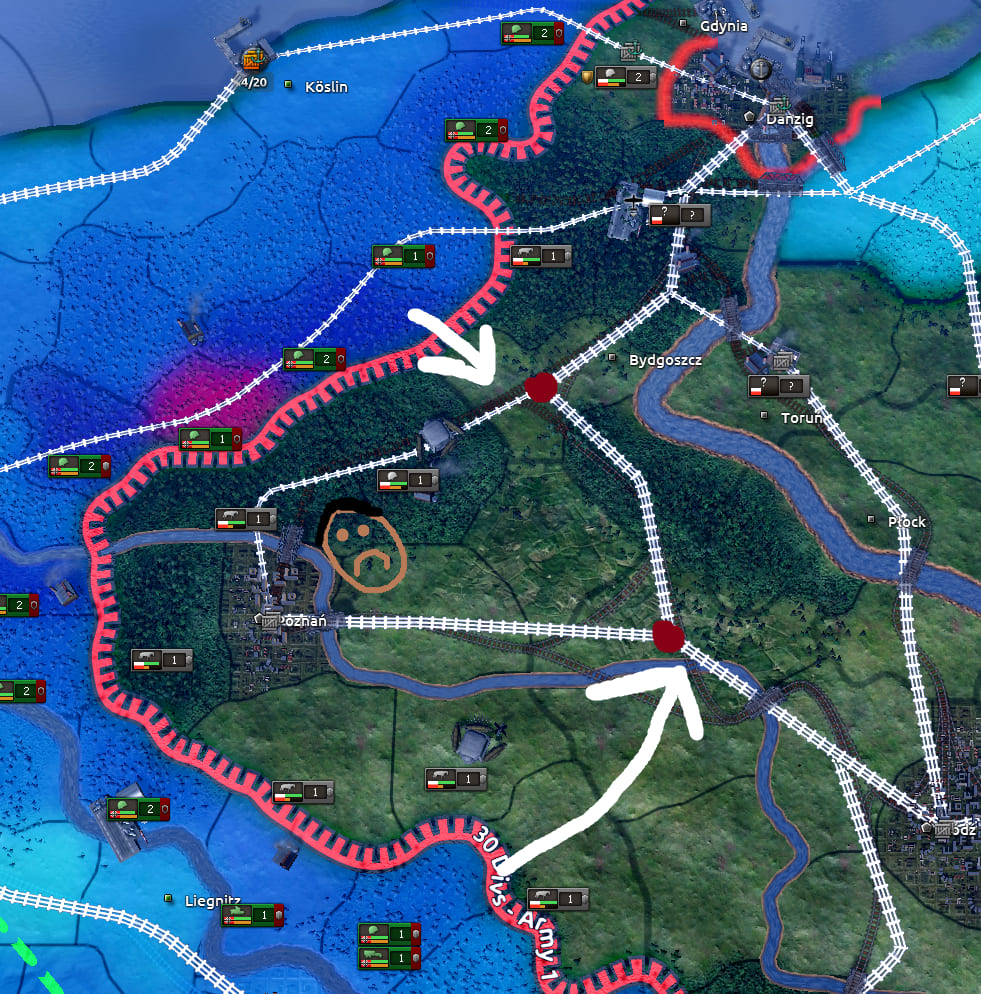
The essence of successful supply disruption is speed. Use fast divisions: armored, motorized, mechanized. The task is to quickly cut or capture key points:
- 1) Supply hubs — begin working for you if you have a railway from the capital.
- 2) Naval bases — block the maritime supply channel.
- 3) Railways — cutting the railway to a hub denies the enemy supplies in that direction.
- 4) Cities and towns — provide passive regional supply. Deprive the enemy of this source.
Important nuance: divisions have 72 hours of supply reserves. The effect of disruption does not occur immediately, but after 3 days. Hold the captured point for at least 3-4 days, otherwise the enemy will restore supply and your attack will be futile.
How to View Enemy Supply?
Press F4 (Supply map mode). You will see supply hubs, naval bases, and railways. You can hover over any province and see supply details — both yours and the enemy's, if you have intelligence.
Enemy Debuffs
The enemy suffers the same supply shortage penalties as you. But in practice, it is worse for them:
- AI templates are worse than yours — standard suboptimal divisions become completely helpless.
- AI manages logistics poorly — rarely switches hubs to trucks, does not always build roads and trains.
- AI cannot concentrate efforts — reacts slowly to supply disruption.
Conclusion: by cutting off enemy supply, you turn their divisions into easy prey. Even infantry can push, and tanks can destroy starving units without encirclements.
Strategic Bombing
Theoretically, you can destroy enemy supply from the air using CAS, tactical, and strategic bombers. In practice — this is one of the worst ways to harm the enemy. Logistics bombing is barely felt by the enemy, and that air power could be used elsewhere.
Strategic bombers targeting strategic structures can, over several months, undermine the enemy's industry. But even this is often pointless, because you could have captured that industry yourself. Bombing logistics with aircraft is a bad idea.
Blocking Naval Supply
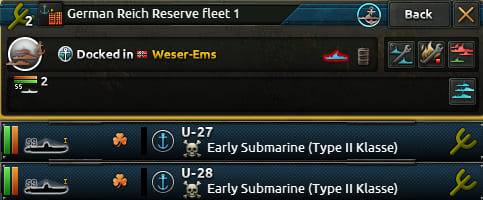
You can deprive the enemy of naval supply by sending submarines to the required sea regions (splitting them into groups of 3–4). They are fairly good at sinking convoys. However, if the enemy has land hubs, losing a naval base is unlikely to be catastrophic. Moreover, the enemy can deploy naval bombers to intercept your submarines. Sinking convoys is an enjoyable and not entirely useless activity, but it is not applicable everywhere.
Air Supply
Many players overlook this feature, but it is quite decent. Every 100 transport planes on an air supply mission require 5 command power. For a medium-sized front, 200–400 planes are enough (10–20 command power).
Effectiveness depends on many factors, but on average it is about 1.5 times better than one infrastructure level. Air superiority is important. This luxury is more often affordable for majors who have enough factories for fighters, a couple of factories for transport planes, and everything else.
Supply Grace Period
Each division carries a supply reserve, by default 72 hours (3 days). If supply was just perfect and the division gets encircled, it will hold out without debuffs for another three days. Then the penalties start to grow.
This provides a chance to rescue encircled troops or hold a captured point while the enemy starves. Some countries and doctrines can extend the grace period.
Attrition
Attrition is the loss of equipment by land divisions outside of combat. Tanks break down, trucks stall, weapons fail simply from moving through poor terrain or standing in mud. Manpower does not suffer, but equipment is lost.
Attrition is affected by: terrain, weather, supply shortages, troop training, and resistance in captured regions. The key parameter in equipment design is "Reliability". The higher it is, the fewer losses. With high attrition and low reliability, losses can reach ~12% per day, which will quickly empty stockpiles.
Scorched Earth
This mechanic allows you to destroy all supply structures in a selected region. LMB on the region, and in the menu there will be a scorched earth icon. It is rarely needed against bots, but during a total defense or retreat behind a major river, it can be useful: fall back, then destroy the infrastructure so the enemy cannot supply advancing troops. Do this after your divisions have withdrawn, otherwise they will also be left without roads and retreat slowly.
Supply for Allies
If you are in an alliance, allies on your territory use your supply. Sometimes a clueless ally arrives, and your troops start starving.
You can disable this: press F4, find the required hub or naval base, hold Ctrl, and LMB click on the hub. Allied supply will be cut off.
Why and How?
Supply is the foundation of combat effectiveness. Without it, even the best divisions lose up to 80% organization and half their attack. To keep troops fed, build hubs and railways, upgrade infrastructure, and do not forget motorization. Always monitor the supply map (F4) — it will show weak points faster than any advisor.
Best Terrain and Weather?
For offensives, cities and plains in summer are ideal: cities give +20% supply, plains are neutral, and summer imposes almost no penalties. The worst scenario — marshes or jungles in a blizzard: supply penalties reach 40%, and truck wear exceeds 300%. Plan operations so you are not fighting nature and the enemy simultaneously.
Why and How to Cut Enemy Supply?
Disrupted supply turns enemy divisions into easy targets: attack drops, organization melts, equipment breaks. Strike fast using tanks and motorized infantry, capture hubs, ports, and key cities. Remember the 72-hour reserve — hold critical points for at least 3-4 days so the enemy is guaranteed to weaken.
Useful Console Commands
Cheat Sheet
- Press F4 — supply mode will show all hubs, railways, and problem areas (red/yellow zones). This is the first step to solving any issue.
- Find the bottleneck — hub capacity is determined by the weakest railway section on the route from the capital. Upgrade not everything, but that specific lowest-level section.
- Enable motorization — trucks on a hub (Shift+LMB on hub in F4 mode) or on a general (icon in army interface) extend supply delivery range. Partial for infantry, full for tanks.
- Don't forget trains and convoys — without trains, railways are useless (supply drops to 50%); without convoys, naval supply does not work. Keep a reserve.
- 72 hours to rescue — divisions have 3 days of supply reserves after losing supply. If you cut off the enemy, hold the point for at least 3-4 days, otherwise there will be no effect.
- Use transport planes as a temporary solution — 200–400 planes on a supply mission. 5 command power per 100 planes.
- Disconnect allies from your supply — if an ally is using your provisions, hold Ctrl and click on the hub in F4 mode.
Checklist: What to Do If There Is No Supply
Common Mistakes
Many upgrade roads from the capital to the hub entirely. In reality, hub capacity is determined by the lowest level along the entire route. Find and upgrade only the bottleneck — this gives the maximum effect for minimal cost.
Each province has a supply limit. Even if a hub is nearby and the railway is level 5 — the province simply cannot hold more. Spread troops across neighboring provinces within the hub's range.
Divisions have 72 hours of supply reserves. If you cut supply — hold the point for at least 3-4 days, otherwise the enemy will restore logistics and your attack will be useless.
Trucks increase supply delivery range by 2-3 times. Use partial for infantry (30 trucks), full for tanks (60). Activate in F4 mode via Shift+LMB on a hub or in the army interface.
Without trains, railways are useless — supply drops to 50%. Without convoys, naval supply does not work. Always keep a reserve and ensure they are not bombed.
Equipment breaks down from terrain, weather, and training. For example, in marshes, truck wear is +400%. Counter it through maintenance companies and high equipment reliability.
Press F4 — you will see their hubs and railways (if you have intelligence). Cut the weakest points — an enemy without supply becomes helpless.
If an ally has brought a horde of divisions and is eating your provisions — hold Ctrl and click on the hub in F4 mode. Allied supply will be cut off.
Europe already has plenty of hubs — spending 20,000 points on a new one is pointless. Build them only in low-density regions: Siberia, Africa, Canada, Scandinavia.
Transport planes are a temporary solution. They provide roughly +1.5 infrastructure levels but do not replace full-fledged hubs and railways. Use them only in extreme cases.