Meta Defense
How to Build the Strongest Frontline Defense?
Ultimate Defense in Hearts of Iron 4: How to Hold Against Any Enemy
Turn your country into an impregnable fortress, grinding down superior forces while waiting for the perfect moment to counterattack.
In a Nutshell
Total defense is a strategy that lets you hold the line even against an enemy with twice or three times your strength.
You bet on trained divisions (level 2–3+), a smart template designed for your specific enemy, air superiority with fighters, and the right use of terrain and bunkers.
The result: the enemy bleeds out, loses millions of men, and you build up strength for the turning point.
The golden rules of success:
- Division level "Regular (level 3)"
- Infantry division organization of 45–50
- The right division template
- Air superiority
- Smart defense in depth along rivers and mountains
- pumped-up sub-doctrines
When You Need Total Defense
When you're clearly the underdog and can't attack. Here are the telltale signs:
- You're playing a country that is far behind in army size and industry compared to the aggressor (France, Poland, Austria, etc.).
- The enemy has more than double your divisions.
- The enemy steamrolls your standard defense, and you have no resources for offensive actions.
In this situation, your goal is not to win quickly, but to exhaust the enemy, inflict maximum losses while keeping yours to a minimum, and retain control over key territory.
The Core of Defense
The essence of total defense is to inflict maximum losses on the enemy army, sustain minimal losses on your own, and hold as much vital territory as possible. You aren't chasing a quick win; you're grinding the enemy down by forcing them to attack in unfavorable conditions.
- Hold the front along a favorable line (rivers, mountains, bunkers).
- Exhaust the enemy with constant battles on terrain they hate.
- Preserve your industry and key regions.
- Stockpile experience for divisions and generals Doctrines guide.
- Wait until the enemy is so weakened you can counterattack.
- Buy time for allies to join or reserves to build up. Offensive guide.
Useful Console Commands
Frequently Asked Questions
7-10 infantry battalions, support AA and AT if the enemy has tanks, artillery and engineers are mandatory. Organization should be 45-50.
Defense is your toughness when your division is under attack. Breakthrough is your toughness when your division is attacking.
45-50 for an infantry division. If lower, add infantry or drop support companies. If higher, add more support companies and regimental support.
If the enemy has tanks: AA and AT. If no tanks: engineers and artillery.
Nope, too expensive. If your industry can handle it, build tank divisions instead.
The sweet spot for an infantry division is 14-20.
For defense — no. For offense — absolutely yes.
Switch to motorized supply if your divisions are starving. You'll need trucks in your stockpile for that.
For defense, only infantry battalions.
That's your division's current organization level. It directly affects how long a division can fight before retreating. Running out of organization is the main reason troops fall back.
Build 2-3 defense lines in depth, and keep a reserve quick-reaction force.
Garrison the coastline with divisions, and have a reserve quick-reaction force ready for when they land.
"Grand Battleplan" is optimal for total defense.
Bunkers are one of the main reasons you win with total defense. Build them to the max on your future front line.
It's affected by the enemy's soft/hard attack and breakthrough, and heavily influenced by enemy air superiority. Add AA and AT to your support companies.
Attack the enemy divisions trying to push deep. When you engage them in combat, they can't move — they're pinned. This buys time for your reserves to arrive.
Mountains. They have the lowest combat width and attack percentage.
Yes, depending on the front sectors. For example, France doesn't need 3+ divisions on the Maginot Line, but needs 10+ near Belgium.
At least double the enemy's count. If the enemy has 300 divisions, you'd better have at least 150.
Close air support gives huge buffs to the attacker if they have air superiority. That's why you need lots of fighters — to deny the enemy those buffs.
The best move is to let them land and push a bit inland. Then you cut them off from the port with decisive strikes and encircle the entire force, wiping it out.
It matters a lot. Usually it's -20-50% to combat stats, plus an organization drop of 20-80%.
Check the division card on the map — it's right where the organization bar is. A yellow supply icon means moderate supply. Red means terrible supply.
Yes, if you're defending in a region with poor infrastructure (Siberia, Africa). Building railways and supply hubs is critical for keeping your troops combat-ready.
If the enemy is relentlessly bombing your industry, then yes, definitely. But bunkers and supply come first.
Build bunkers on terrain that favors defense: along rivers, in mountains, jungles, and forests.
In that case, build a secondary defense line. If the enemy prevents repairs by constantly attacking the same tile, pull your troops back to pre-prepared positions after the line breaks.
Regular infantry has less defense in mountains and hills but more HP. Mountaineers get bigger bonuses in mountains and hills. I'd recommend regular infantry if your defense line has no mountains or hills.
Add AT to all your infantry divisions as a support company. That's more than enough.
Assign some fighters to the region being bombed. Also, put all factories on repair — railways will be fixed almost instantly.
Industry
Start early, around 1938, building military factories and producing only what's absolutely critical for combat.
Build bunkers along a favorable line: rivers, mountains, forests. Fort level — max it out.
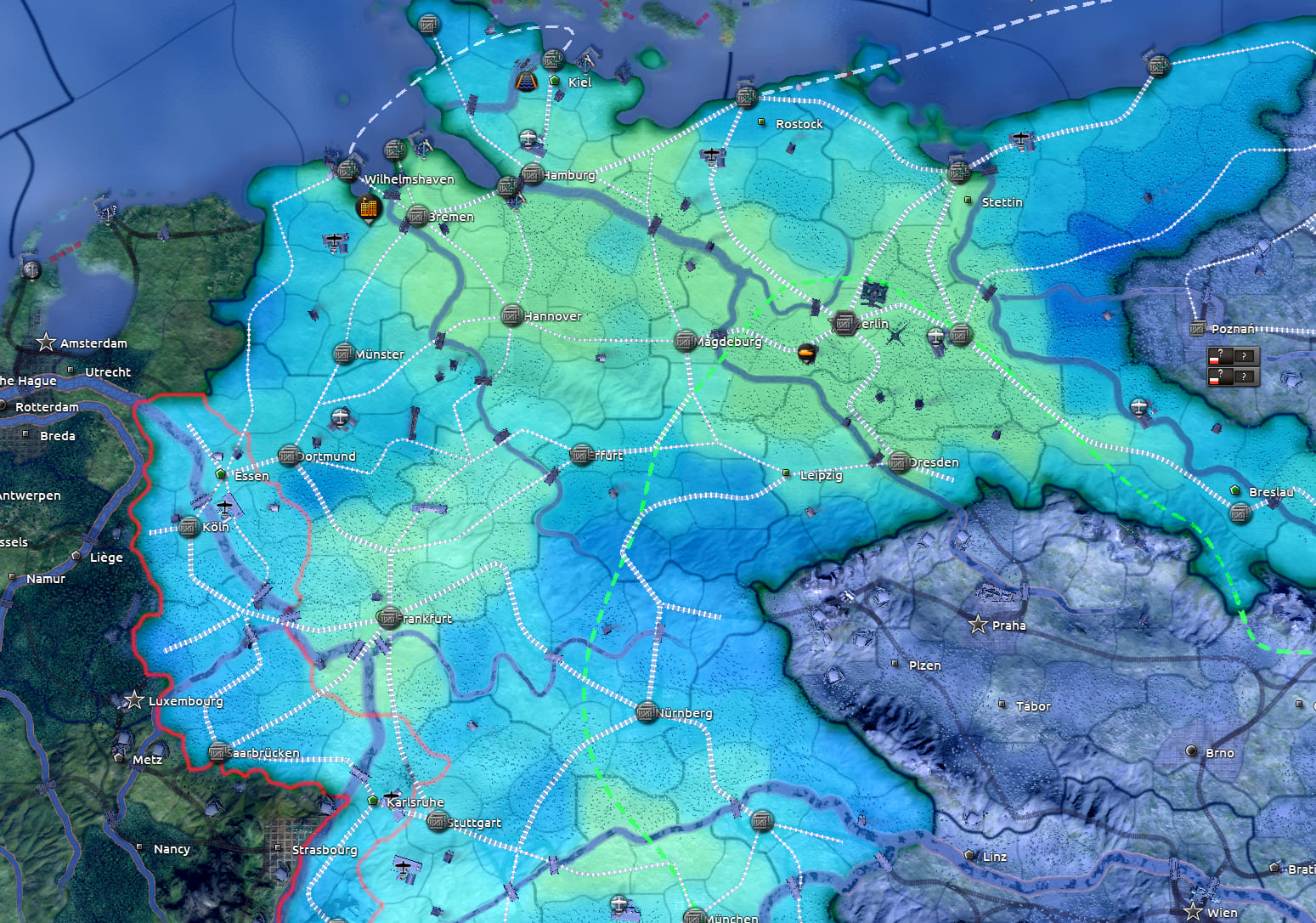
- Factories go in safe regions, far from the front.
- Infrastructure, railways, supply hubs — supply and speed decide everything.
Advisors
Pick those who buff your defense or debuff the enemy. For example, boosting resistance in your occupied territories. No offensive advisors when playing defense — go all-in on maximum protection.
- Army chief focused on defense.
- High command focused on defense and air superiority.
- A theorist who reduces doctrine cost or speeds up research.
Research
Absolutely essential:
- Support Weapons 3 (1940) — a massive buff to regimental support.
- Infantry Equipment 3 (1939) — defense buffs, but the gear is expensive.
- AT and AA — up to 1939 level.
- Artillery — up to 1940 level.
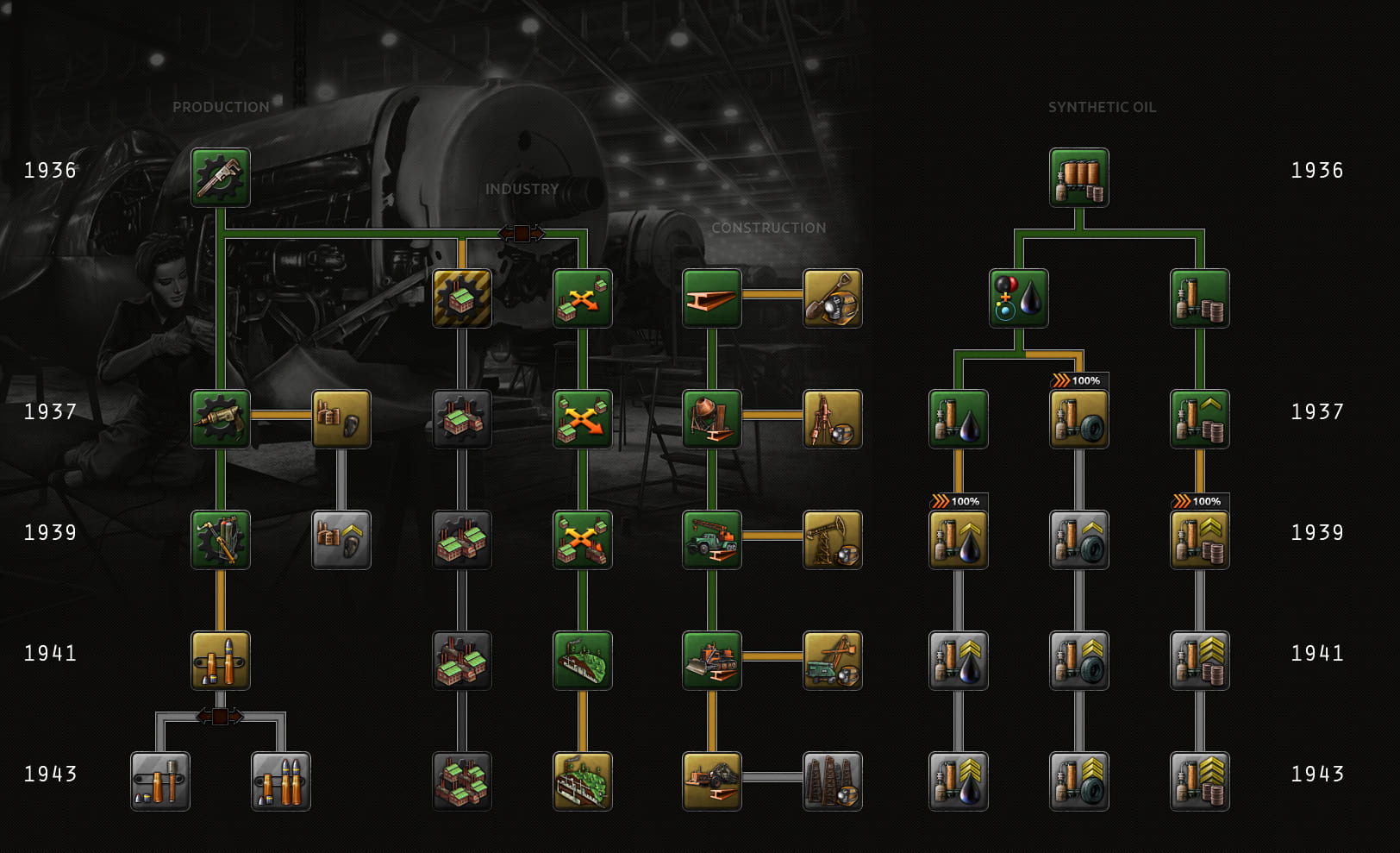
Industry — strictly dispersed, so bombing takes out fewer factories.
This is the ideal setup for 1939-1940.
How to Max Out Your Bonuses
The right focuses, advisors, research, and template.
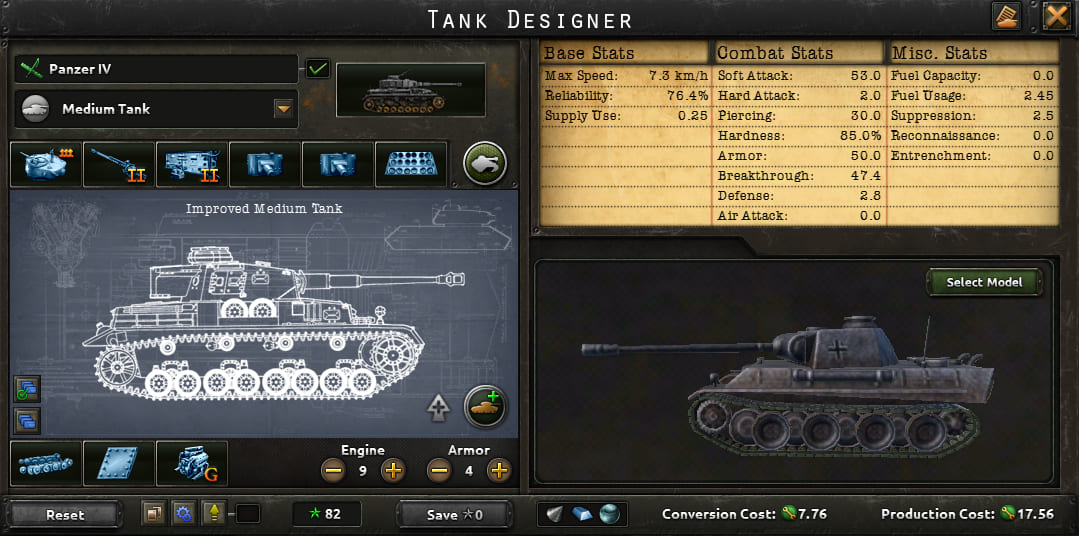
Example infantry division for Germany:
| Stat | Base Template | After Improvements |
|---|---|---|
| Width | 18 | 14 |
| Defense | 228 | 303 |
| Hard Attack | 11 | 32 |
| Soft Attack | 72 | 117 |
| Organization | 50 | 50 |
Stats skyrocket, width shrinks — exactly what you need to be unbreakable. And that's without even half the bonuses accounted for.
Interface Guide
Intel & Spy Network
Build an intel network with 5 factories. Send an agent to the enemy capital.
At 100% network strength, you get: +100% defense against invasion, +50% planning speed.
The enemy loses −100% max planning and −5 entrenchment.
This flips the war on its head — don't sleep on it!
More Divisions
- You need at least double the enemy's divisions. If you have 20-25+ divisions on a single tile — build echelons, deep defense, and reserves. Too many means supply penalties and width overstacking; too few means a breakthrough.
- Organization: 45–50. Below 45 — drop some support companies or add infantry (ideally no more than 20 width). Above 50 — add a heavy regimental support company, it boosts defense significantly.
- Divisions trained to veteran level also perform very well. You can train them, for example, in the Spanish Civil War. Guide to the Spanish Civil War and Volunteers
Defensive Division Templates
Against Tanks (e.g. vs Germany)
- Engineer company is mandatory
- Add artillery, AT, and AA as support companies
- Infantry battalions — 7-10 per division
- Division organization — 45–50
Against Infantry (no tanks)
- Engineer company is mandatory
- Artillery as a support company
- Infantry battalions — 7-10 per division
- Division organization — 45–50
Golden rule: If your organization is above 50, go ahead and add a heavy regimental support company — just don't let organization drop below 45.
Air Force
In total defense, forget about close air support — put everything into fighters. Without them, your organization will melt faster from enemy ground attacks than from land battles. The sky must be green-yellow, not red.
Fighters alone are enough; you don't need any other aircraft for total defense.
Navy
The fleet plays a supporting role: shell coastal tiles to debuff the enemy (just assign a fleet to the region via right-click), and use subs to strangle their supply lines.
For example, as France, cut off Germany's tungsten and rubber imports.
Defensive Echelons
When there are too many divisions on the front line, supply debuffs start to kick in.
Solution: pull some back into reserve. As soon as the enemy breaks through and commits motorized/tank divisions, the reserve must instantly plug the gap.
With proper execution, you can even encircle the breakthrough force.
Force Distribution
- Place more divisions on plains and hills — they’re less defensible. On forts, mountains, and forests — fewer.
- Ideal defensive line: river + difficult terrain (mountains, forests, jungle). The river-crossing penalty can reach up to ~80%. Build maximum fortifications there and hold the line.
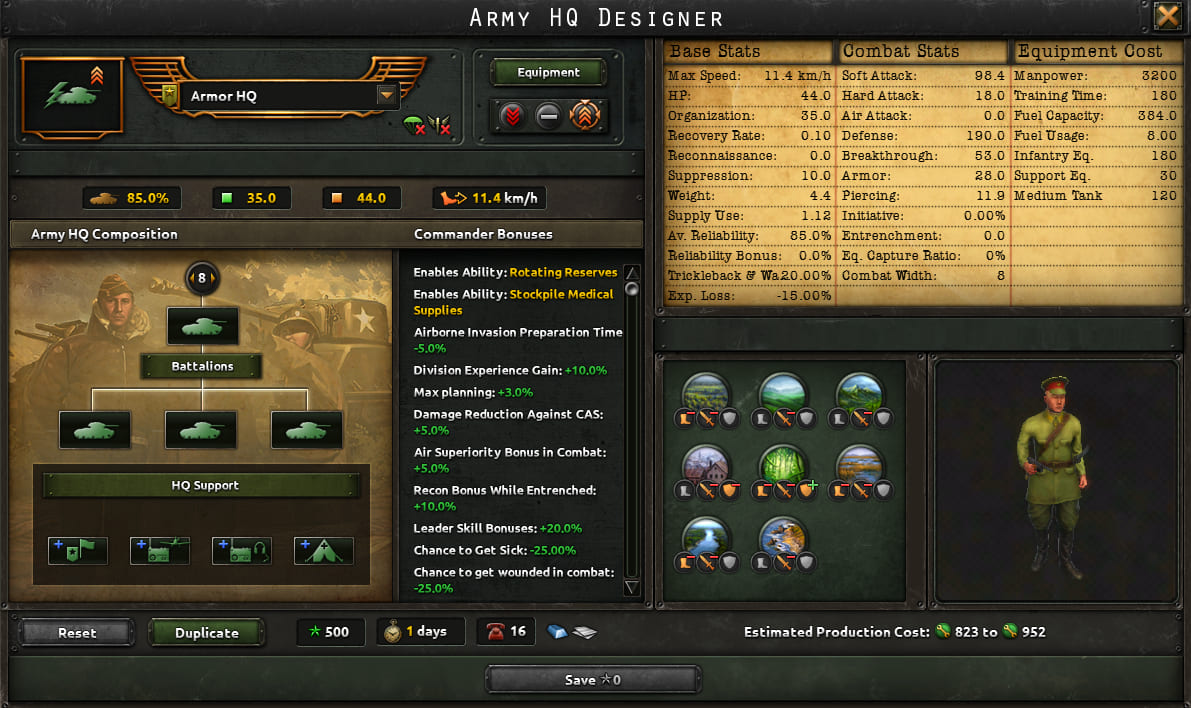
- Also, don’t forget to set up an HQ for the army. In total defense, I recommend keeping it 1–2 tiles behind the front.
Guide here
Holding Tactics
The enemy attacks nonstop — micro-management is essential.
Rotate divisions from adjacent tiles: battered ones pull back, fresh ones move in. If a tile becomes empty — attack the enemy to prevent them from occupying it first. Hold like this until the recovered troops return.
This is the holding tactic.
What to Expect from the Enemy
The enemy will throw everything at you:
- Bombardments
- Tanks
- Motorized infantry
- Cavalry
- Infantry — without pause.
As soon as one wave exhausts itself, the next one joins in. Watch where the front is cracking and rotate in fresh troops.
If a breakthrough does happen, without a reserve strike force, a blitzkrieg will begin — your divisions on the move will lose organization and won’t stop the tanks.
Keep a strong reserve strike force — it will save the day.