Division Speed
Division Speed in Hearts of Iron IV: Full Mechanics, Numbers, and How Not to Kill Your Breakthrough
In simple terms: how speed is calculated, why the slowest battalion dictates the pace, and how not to turn a fast strike force into a walking column.
📌 At a Glance
- Division speed = the speed of the slowest battalion in the template.
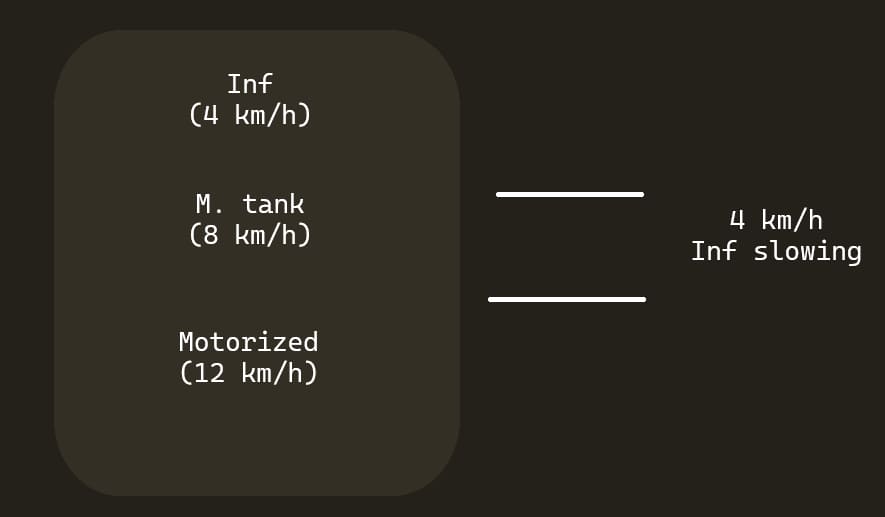
- Infantry / towed artillery / AT / AA = 4 km/h.
- Motorized infantry = 12 km/h, mechanized = 8–12 km/h, cavalry ≈ 6.4 km/h.
- During combat, movement is roughly ×0.33 of normal speed.
- Without supply, speed can drop by up to −80%; without fuel, roughly to ×0.4.
- For tanks and motorized, speed isn’t a «nice bonus» — it’s the condition for encirclements and operational tempo.
🧠 What Division Speed Is
Speed (maximum speed) in HoI4 is how fast a division moves across the map in km/h.
In the division designer it’s a single number. On the frontline it decides:
- whether you’ll close the pocket in time;
- whether the infantry can pull up a second line;
- whether your tanks outrun the motorized infantry;
- whether the enemy escapes or you run them down.
Put simply:
soft attack and breakthrough win the battle in the tile,
speed decides whether you even get to the right tile in the first place.
🚫 The Golden Rule That Breaks New Players’ Templates
Division speed is not an average.
It takes the minimum of the whole composition.
Example:
10 motorized battalions at 12 km/h + 1 towed artillery battalion at 4 km/h = the division moves at 4 km/h.
On paper it’s «mobile»; in reality, it’s a walking column with trucks just for show.
That’s exactly why you can’t mindlessly throw towed AT/AA/artillery into tank and motorized templates. You need motorized support or SPGs/SPAA/TDs.
📊 Base Speeds You Need to Know
| Type | Speed | What It Means |
|---|---|---|
| Infantry | 4 km/h | Baseline of the entire infantry line |
| Towed Artillery / AT / AA | 4 km/h | Won’t slow infantry, but kills motorized/tank speed |
| Cavalry | ≈ 6.4 km/h | Faster than infantry, cheap maneuver/exploit |
| Mechanized I | 8 km/h | No longer infantry, not yet max speed |
| Mechanized II / III | 10–12 km/h | Decent tempo to keep up with tanks |
| Motorized Infantry | 12 km/h | Classic early-mid breakthrough pace |
| Tanks | depends on chassis and modules | Often capped by the motorized/mechanized in the division |
A specific tank nuance: in the equipment designer the engine, suspension, and armor can heavily swing the speed up or down. But even the perfect tank is useless if a 4 km/h battalion is sitting right next to it in the template.
🎯 Why Speed Is a Dedicated Intent, Not «Just Another Stat»
New players often think «speed is only for tanks.»
Nope. Speed is tied to the division’s role.
- For defensive infantry, 4 km/h is fine.
- For offensive infantry, speed is secondary; organization and soft attack matter more.
- For tanks/motorized/SPGs, speed is part of the meta: without it there’s no tempo, no pockets, no exploitation.
- For ports and garrisons, speed is almost irrelevant.
Example: a tank template at 8–10 km/h with decent organization often outperforms an «armored turtle» at 4–5 km/h that wins one fight and then takes three days to crawl to the next tile.
⚖️ Pros and Cons of High Speed
✅ Pros
- Fast encirclements and supply-cutting.
- Beat the enemy to VPs, ports, supply hubs and junctions.
- Easier exploitation of frontline gaps.
- Quicker to shift your strike force between sectors.
- On retreat, divisions pull out of combat faster and survive better.
❌ Cons
- Usually more expensive: motorized, mechanized, solid tank engines.
- Guzzles fuel.
- Easy to outrun your own infantry and supply.
- An overly fast spearhead without a second echelon often gets itself pocketed and dies deep.
- You might trade armor/gun for speed and end up with a glass-cannon template.
🔧 What Actually Slows You Down on the Map
| Factor | Penalty / Multiplier | Comment |
|---|---|---|
| Combat | ×0.33 | During battle the division crawls at about 33% of normal speed. Mopping up a tile and dashing on is much slower than it looks. |
| Supply | up to −80% | Maximum penalty from lack of supplies. Outside your own supply network up to −50%; air supply softens it (−25%). |
| Fuel | ×0.4 | Without fuel speed drops to roughly ×0.4. For motorized/tanks — almost a death sentence for tempo. |
| Organization | −80% at zero org | At 0 organization movement is brutally cut. Every hour of movement chips away 0.2 org — you can’t endlessly dash divisions around. |
| Infrastructure | −5% per level below max | On poor roads even a fast template gets sluggish. |
| Enemy Air Superiority | up to −30% | If enemy CAS and fighters dominate, your «fast» corps suddenly becomes average. |
| Rivers | −25% (small), −50% (large) | Crossing penalty; this is on top of the combat attack penalties. |
| Retreat | +25% speed | During retreat; +15% when withdrawing. That’s exactly why the enemy sometimes slips out of an almost-closed pocket. |
Bottom line: keep supply, fuel, organization and infrastructure healthy. Air superiority is also highly desirable. | ||
🛠️ How to Properly Build Speed into a Template
- Define the role: hold / push / encircle.
- For encirclements, lock in the strike force’s target speed: usually motorized at 12 km/h, or mechanized/tanks synced to the same pace.
- Check the slowest battalion. That’s the boss of the number.
- Ditch towed artillery from fast divisions.
- Look at fuel and supply ahead of time: a fast template without logistics will bog itself down.
- Don’t push the spearhead faster than the second echelon and railways can keep up.
Example: a mixed template «tanks + motorized + towed artillery» looks strong in soft attack on paper, but it kills the tempo. Swapping the artillery for SPGs or motorized artillery often makes the division noticeably more dangerous strategically, even if the raw soft attack number changes a little.
📈 Speed Benchmarks by Role
| Task | Target Speed | Comment |
|---|---|---|
| Frontline defense | 4 km/h | It’s fine, don’t overthink it |
| Offensive infantry | 4 km/h | Tempo isn’t the priority |
| Early breakthrough / minor | 12 km/h motorized | Best tempo boost for the cost |
| Late-game major breakthrough | 8–12 km/h | Tanks and mechanized in sync |
| Encirclement hunting | the higher the better while keeping org | Speed + supply |
| Ports / garrisons | 4 km/h or completely irrelevant | Don’t waste motorized |
💡 When Speed Is OP and When It’s Not
✅ OP
- France/Benelux, Poland, Soviet plains, desert;
- the moment after a breakthrough when the frontline collapses;
- cutting off hubs, ports and capitals;
- multiplayer maneuvers where tempo = victory.
❌ Not OP
- mountains, jungles, marshes without spec-ops and infra;
- red supply;
- situations where divisions are already bottlenecked by width/org, not maneuver;
- trying to make all 100 divisions in the army «fast.»
Example: a major that motorizes the entire front usually gets a pretty map and dead logistics. Smarter: a fast strike force + infantry to hold the line.
🔎 How to Tell You Don’t Have Enough Speed
- Pockets don’t close.
- The enemy manages to retreat behind the next river every time.
- Tanks wait for infantry every two tiles.
- After the initial breakthrough the offensive «deflates» simply because everyone is crawling.
And conversely, you have too much speed if:
- the spearhead races deep without supplies;
- organization hits zero from constant marching;
- there’s nobody to plug the gap you created.
❓ Common Questions
Because there’s a slow battalion in the template. Almost always it’s towed artillery/AT/AA or infantry instead of motorized/mechanized.
For winning the tile — no. For exploiting the breakthrough — often yes. They belong to different phases of war.
Almost never. Organization, defense, cost, and supply matter far more.
Both are brutal. No fuel gives roughly ×0.4 speed; no supply up to −80%. In a real offensive they usually arrive together and kill all tempo.
Only if you aren’t killing armor, gun, reliability, and division organization. Speed for speed’s sake is an easy way to build expensive trash.
🏁 One-Liner Summary
Division speed is the speed of the slowest battalion, multiplied by supply, fuel, organization, infrastructure, air, and combat. In the division designer you pick the ceiling. On the frontline, it’s up to you whether they’ll let you use it.