Best Close Air Support template
Article · CAS Templates
The Best CAS Templates in Hearts of Iron IV
Three battle-tested meta CAS designs for 1936, 1940, and 1944 in HoI4, engineered to maximize operational range and ground attack. We break down optimal modules, armament configurations, industrial capacity (IC), factory allocation, and how to choose the right airframe for your campaign.
Which of the Three Templates Should You Choose?
It all depends on the current year and your research progress. Here are quick guidelines so you never have to guess.
Template 1
The 1936 CAS template. For the early game and weak starting industry. Pick this if the campaign has just begun, military factories are scarce, and you need immediate air support. It costs  24 IC, reaches 825 km, and provides 15.4 Ground Attack. That is plenty of firepower to chew through enemy divisions early on, especially across Europe where air zones are compact and airfields are dense. By 1939–1940 it will become obsolete, so don't delay switching to the 1940 template.
Template 2
The 1940 CAS template. The most versatile choice for the mid-game. Pick this as a minor power in 1940–1944 or as a major power in 1939–1943. You can start producing it as early as 1939 if you rush the required air research. It boasts a 1,300 km range, 24.2 Ground Attack, costs 27 IC, and requires  3 Aluminum and
 1 Rubber. Under air superiority, massed wings of this plane routinely inflict 60–150 damage to enemy divisions across the air zone, shattering frontline resistance. It excels across Europe, Africa, and vast regional fronts where range is crucial. If you don't want to bother with late-game designs, keep producing it until the end of the campaign: in HoI4, it is a magnificent workhorse.
Template 3
The 1944 CAS template. The most powerful template for the late game: 1,500 km range, 30.8 Ground Attack, costs 31 IC, and requires 4 Aluminum and 1 Rubber. But it requires the 1944 airframe and Engine IV, which you can unlock around 1943–1944 at best. Against vanilla AI, this level of power is not strictly necessary: the 1940 template already crushes divisions reliably. Build it if you want to squeeze out maximum combat efficiency or are fighting a brutal late-war campaign with AI overhaul mods.
In short: 1936 — if you need air support urgently on a tight budget; 1940 — if you want one reliable workhorse for the mid-game and beyond; 1944 — if you have surplus factories and research slots late in the war. Now let's dive into the blueprints.
3 Complete CAS Templates
1936 CAS Template
- Starter
- Budget


Template Overview
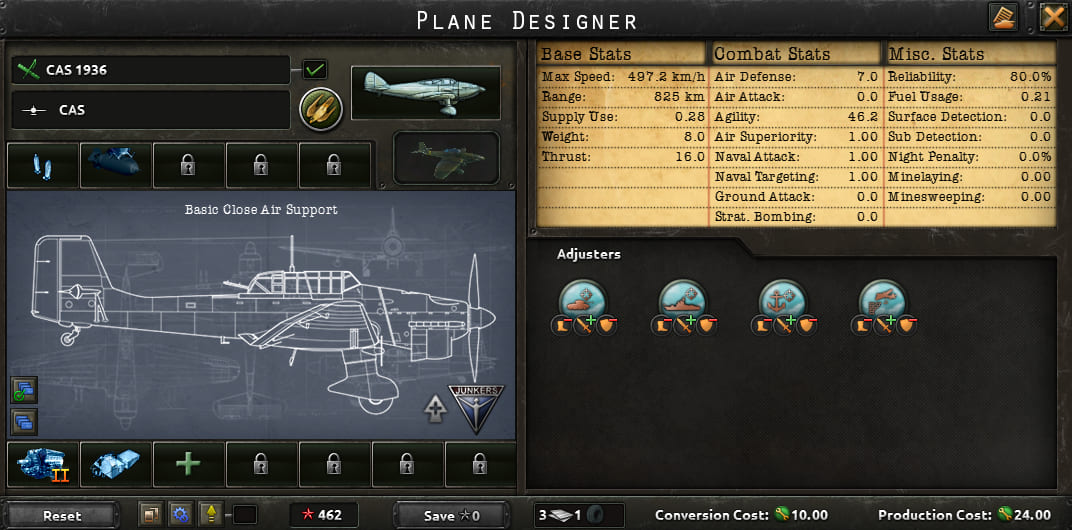
Built on the 1936 Basic Small Airframe. The armament consists of a Small Bomb Bay and wing Bomb Locks, paired with one Extra Fuel Tanks module in the special slot.
A simple and cheap template for the very start. Costs 24 IC, requires 3 Aluminum and 1 Rubber. It provides 15.4 Ground Attack and 825 km operational range. This is not enough for the late game, but early on it deals solid, dependable damage to enemy divisions.
Its range won't cover massive continents, but it comfortably reaches enemy frontlines across Europe where provinces and airfields are dense. Allocating 5–10 military factories is usually enough to steadily build up stockpiles. Early in the campaign, even 5–10 factories can feel like a major commitment.
I recommend replacing this template by 1939–1940, as it becomes obsolete. It is best to transition directly to the 1940 CAS template.
Specifications
| Statistic | Value |
|---|---|
| Operational Range | 825 km |
| Ground Attack | 15.4 |
| Production Cost | 24 IC |
| Resources | 3 Aluminum, 1 Rubber |
| Recommended Military Factories | 5–10 |
Pros
- Cheapest IC production cost.
- Available immediately without advanced research.
- Deals solid ground damage in early combat.
Cons
- Becomes obsolete by 1939–1940.
- Modest operational range.
- Low Ground Attack scaling.
Verdict. Great for the very start. Lacks the range and firepower for serious war after 1940. Build what you need early, but make sure to transition to the 1940 template as soon as possible.
1940 CAS Template
- Mid-Game
- All-Game Viable
- Meta Pick
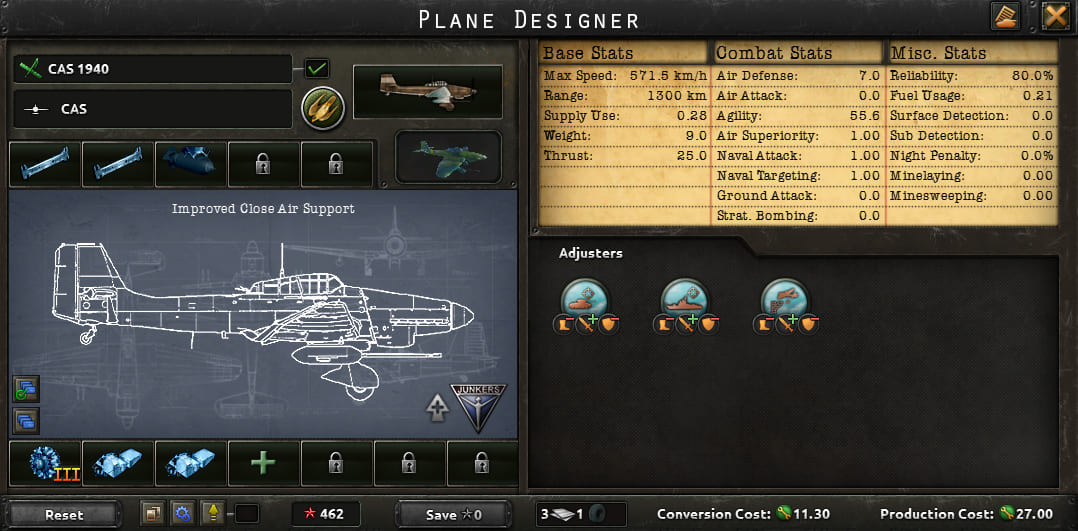
 1x Engine III
 2× Heavy Bomb Locks
 Bomb Locks
 2× Extra Fuel Tanks
Template Overview
Built on the 1940 Improved Small Airframe. The armament includes two Heavy Bomb Locks and one Bomb Locks module, with two Extra Fuel Tanks in the special slots.
This is the primary meta CAS template in HoI4 for almost any campaign, widely favored by top competitive and single-player strategists. Packing a 1,300 km range and 24.2 Ground Attack, it costs 27 IC, and requires 3 Aluminum and 1 Rubber. Under air superiority, this design routinely inflicts 60–150 damage to enemy divisions across the air zone — which completely shreds enemy frontlines.
You can start production in 1939 if you prioritize the required air research. I recommend allocating 10–30 military factories to this line. Playing as Germany in early 1939, I allocate 20–30 factories to it and comfortably produce the required number of planes by the outbreak of war. The range lets it perform in Africa and other vast theaters where range is critical. Many players design this template in 1939–1940 and never change it: it handles every combat theater with ease.
The template can be upgraded once you research Engine IV: add a third Extra Fuel Tank, replace the standard Bomb Locks with Heavy Bomb Locks, and install Engine IV. It will fly farther and hit even harder, though Engine IV is usually accessible closer to 1943.
Specifications
| Statistic | Value |
|---|---|
| Operational Range | 1,300 km |
| Ground Attack | 24.2 |
| Production Cost | 27 IC |
| Resources | 3 Aluminum, 1 Rubber |
| Recommended Military Factories | 10–30 |
Pros
- Versatile template viable across the entire campaign.
- Superb 1,300 km range — eliminates mission efficiency penalties even in Africa.
- High Ground Attack with high industrial efficiency.
Cons
- Requires 1940 airframe and engine research.
- Late-game upgrade requires Engine IV.
- Vulnerable to heavy disruption without air superiority.
Verdict. The best choice for most players. If you don't want the micromanagement of retooling for 1944 templates — build this one and don't worry. It performs superbly all the way to the end of the campaign.
1944 CAS Template
- Late Game
- Apex Stats
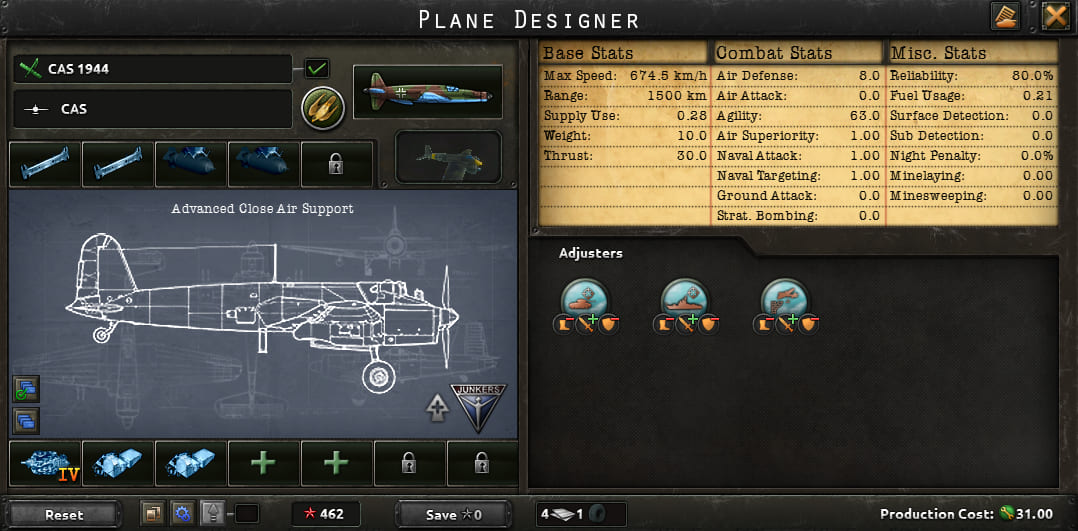
 1x Engine IV
2× Heavy Bomb Locks
2× Bomb Locks
2× Extra Fuel Tanks
Template Overview
Built on the 1944 Advanced Small Airframe. The armament consists of two Heavy Bomb Locks and two Bomb Locks, with two Extra Fuel Tanks in the special slots.
The strongest template of the three: 1,500 km range and 30.8 Ground Attack. Production cost is 31 IC, requiring 4 Aluminum and 1 Rubber. That is 1 Aluminum more than previous templates, but by late-war industrial standards that is negligible.
The main bottleneck is research, not cost: you need the 1944 airframe and Engine IV. At best, that unlocks closer to 1943. Many players stick with the 1940 template and never look back: it gets the job done, whereas a new template demands research slots, time, and resets factory production efficiency.
Against standard AI opponents, this template is not strictly necessary. But if you want absolute peak combat performance or are fighting a late-war campaign with AI overhaul mods, allocating 25–50 factories to this template is a formidable choice. By this stage of the war, you usually have surplus military factories.
Specifications
| Statistic | Value |
|---|---|
| Operational Range | 1,500 km |
| Ground Attack | 30.8 |
| Production Cost | 31 IC |
| Resources | 4 Aluminum, 1 Rubber |
| Recommended Military Factories | 25–50 |
Pros
- Best operational range of any single-engine CAS design.
- Highest Ground Attack of all templates (30.8).
- The absolute pinnacle CAS design in the game.
Cons
- Gated behind late-game research.
- Slightly higher production cost (31 IC).
- Requires 1 additional Aluminum and resets production efficiency.
Verdict. The ultimate template for the late game. If your industry and research tech tree allow it — build it. If not, the 1940 template is more than enough to comfortably steamroll the AI.
How Did I Design These Templates?
First, I identified what matters most: in HoI4, CAS relies primarily on Ground Attack and operational range. Maximum speed, agility, and air defense are nice secondary perks, but they don't determine how much damage enemy ground divisions will suffer during battles.
Next, I compared module trade-offs. Heavy Bomb Locks provide the highest Ground Attack per slot, but carry substantial weight. Standard Bomb Locks are lighter, and internal Bomb Bays avoid harsh aerodynamic drag penalties. Extra Fuel Tanks expand mission range, though they add weight and slightly lower air defense. I balanced engine thrust against total airframe and module weight: if you overload an aircraft, you cannot save the template because weight exceeds available engine thrust.
I deliberately avoided defensive modules. CAS aircraft are not meant to dogfight enemy interceptors: their real defense is your fighter wings establishing air superiority. Adding armor plates increases weight and IC production cost without shielding them from ground anti-air (AA) fire. It is far more effective to invest those IC hammers into engines, fuel tanks, and bombs.
I also tested the 1940 upgrade path: Engine IV, a third fuel tank, and heavy bombs in place of standard bomb locks. The aircraft performs exceptionally well, but requires late-game tech, which is why I didn't make it the baseline 1940 template.
I benchmarked all three templates across single-player campaigns against the AI: tracking division damage in battle logs, verifying that range covered shifting frontlines, and ensuring production didn't lag. I also tested them with and without air superiority. Without green air, even the best template achieves very little and suffers punishing losses.
Key Takeaways
1. Ground Attack and operational range are what matter. Air attack, defense, and agility aren't needed on CAS: they add unnecessary weight, while your real defense is fighter air superiority.
2. For the early game, pick Template 1. Costs 24 IC, provides 825 km range and 15.4 Ground Attack. Great for opening moves, but becomes obsolete by 1939–1940.
3. For the mid-game, pick Template 2. Costs 27 IC, provides 1,300 km range and 24.2 Ground Attack. Build it from 1939 through 1944.
4. For the late game, pick Template 3. Costs 31 IC, provides 1,500 km range and 30.8 Ground Attack. Requires the 1944 airframe and Engine IV, available around 1943–1944. The most powerful CAS template in the game.