How does Mission Efficiency work?
Air Mission Efficiency in Hearts of Iron IV: How It Works and What It Affects
A comprehensive breakdown of air combat’s core multiplier: why planes stay grounded, how hidden debuffs gut air superiority and CAS damage, and how to hold a flat 100% efficiency.
Summary
1. Mission efficiency represents the actual percentage of planes in an air wing actively carrying out combat orders: at 50% efficiency, only 50 out of 100 aircraft take to the skies.
2. The stat directly scales CAS ground support damage and fighter air superiority value: low efficiency spells rapid defeat even for the most advanced aircraft designs.
3. The most common hidden penalty is incomplete air zone coverage: if plane operational range covers only 60% of the zone, wing efficiency is instantly capped at 60%.
4. Overcrowded air bases and fuel shortages cripple sorties: empty fuel reserves cut mission efficiency by 75%, while an overloaded airfield can shut down sorties entirely.
5. Activating More Ground Crews for 20 Command Power grants an immediate +10% mission efficiency boost to all friendly aircraft operating in the selected air region.
This guide breaks down the core mechanics of air mission efficiency in Hearts of Iron 4. You will learn how this percentage is calculated, why sheer numbers in reserve hangars never guarantee air dominance, how range penalties, fuel deficits, and zone reassignment debuffs work, and how to hit the 100% cap using air doctrines and ground crews.
Specific fighter and CAS meta builds, aircraft designer module setups, and airfield micro-management are covered in dedicated guides across our knowledge base.
What Is Air Mission Efficiency?
What Does the Mission Efficiency Percentage Mean?
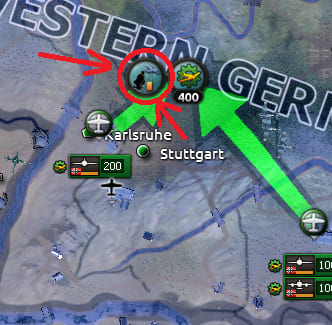
When you open the air map mode with F3 and assign an air wing to an operational mission in a region, a percentage badge appears next to the wing’s name . That is your mission efficiency.
 . That is your mission efficiency.
Put simply: mission efficiency represents the actual proportion of your aircraft currently executing their combat orders. An air base hangar may hold a full wing of 100 fighters, but if mission efficiency sits at 60%, only 60 planes will contest the skies over the battlefield. The remaining 40 aircraft sit idle on the tarmac due to logistical bottlenecks, insufficient operational range, or supply delays.
Veteran players follow an iron rule: never judge air power by the nominal count of planes sitting in your stockpiles, but by the actual number of airframes flying combat sorties with mission efficiency accounted for.
How Efficiency Amplifies Aircraft Combat Power
Mission efficiency functions as a direct linear multiplier across all core air combat calculations in the region. It directly dictates how many interceptors scramble, how much air superiority value the wing generates, and how many bombs your CAS planes drop onto enemy divisions.
When efficiency drops, your combat power evaporates before your eyes. Even a top-tier 1940 fighter loaded with heavy machine guns and upgraded engines operating at 40% mission efficiency will be severely outnumbered and butchered by outdated biplanes boasting 100% efficiency.
How mission efficiency scales actual combat presence and generated air superiority
Yet raw stats alone do not win air campaigns: to prevent wasting costly production, you need to know exactly how this percentage shapes tactical ground battles and air dogfights.
What Does Mission Efficiency Affect in the Air?
Air Superiority and Dogfight Exchanges
The primary and most vital consequence of high mission efficiency is control of the skies. Air superiority score, which fills the green dominance meter across an air region, is awarded for every active aircraft multiplied directly by its mission efficiency.
During air combat, the engine pairs opposing wings in localized dogfights. If your 100-plane fighter wing operating at 50% efficiency engages an enemy wing of 100 fighters at 100% efficiency, combat resolves as a 50 vs 100 engagement. The enemy enjoys a 2:1 local numerical advantage, focuses fire, and dismantles your squadrons with catastrophic casualty ratios.
In single-player games, I often see beginners deploy a thousand modern fighters deep into the frontline with only 25–30% efficiency due to range limitations. Their expensive air fleet burns away in weeks against vastly smaller enemy forces: air superiority is generated exclusively by aircraft physically present on active patrol over the region.
Close Air Support (CAS) Output and Strategic Bombing
For strike aircraft—CAS, tactical bombers, and strategic bombers—mission efficiency is even more decisive. In ground combat, CAS inflicts direct damage against enemy division organization and strength, helping rupture defensive entrenchments and secure armored breakthroughs.
The number of CAS planes permitted to join a land combat during each three-hour battle tick is strictly gated by efficiency. Under a 50% efficiency penalty, your frontline divisions receive exactly half the expected air support, allowing enemy lines to hold.
Strategic bombing suffers the exact same penalty: damage dealt to enemy factories, railway networks, and supply hubs drops in direct proportion to efficiency loss. Competitive multiplayer players never deploy air wings blindly: concentrating fewer aircraft at 100% efficiency yields far better combat value than scattering massive air wings with poor operational output.
Now that the strategic value of this stat is clear, let us examine the hidden factors and penalties that cause mission efficiency to tank.
Factors and Penalties: Why Does Mission Efficiency Drop?
Aircraft Range and Incomplete Zone Coverage

The most frequent cause of lost combat efficiency is insufficient operational range. Every air region in HoI4 covers a specific land area and sits at a certain distance from your air base. If the operational radius of your planes cannot cover the entire air region from the home airfield to the furthest provincial borders, the game applies a linear coverage penalty.
For instance, if an air wing’s operational range covers only 65% of a massive air region like Egypt or Tripoli, base mission efficiency is automatically capped at 65%. High-output engines and heavy cannons cannot compensate for planes that simply run out of fuel before reaching two-thirds of the operational theater.
That is why experienced players live by this rule: in the aircraft designer, operational range takes priority over armor plates whenever fighting across expansive Eastern theaters. Equipping extra fuel tanks instead of armor is often the difference between winning and losing air control over large regions.
Overcrowded Airfields and Fuel Bottlenecks
Air base capacity is strictly limited: each level supports 200 aircraft, up to a maximum level 10 base housing 2,000 planes. If you station even 100 planes beyond that threshold, an overcrowding penalty is applied to every single wing operating out of that base.
The penalty scales brutally: at 200% capacity (for example, basing 4,000 planes at a 2,000-capacity airfield), mission efficiency drops virtually to 0%. Aircraft congest runways, suffer ground accidents during takeoff, and cannot launch coordinated combat sorties.
Furthermore, every plane in the air continuously drains fuel . If national fuel stockpiles run dry, planes cannot take off, leaving a mighty air armada stranded on the ground as useless scrap metal.
 . If national fuel stockpiles run dry, planes cannot take off, leaving a mighty air armada stranded on the ground as useless scrap metal.
Fuel Shortage and Air Region Reassignment Penalties
When national fuel reserves drop to zero, a total military paralysis sets in. Mechanically, a complete lack of fuel inflicts a severe -75% mission efficiency penalty across all air operations (a 0.25 multiplier). Air combat without fuel is impossible: operational sorties grind to a near-total halt.
A second insidious penalty catches players who constantly juggle wings between regions. The moment an air wing is reassigned to a new air zone, the game hits it with a -90% region reassignment penalty. Pilots need time to scout terrain, establish navigational bearings, and coordinate communication networks with ground units.
This penalty recovers gradually every hour, but recovery rates differ drastically depending on aircraft type:
Fighters and CAS recover efficiency at a rapid rate of +88.8% per day, needing only 24–27 in-game hours to return to full combat readiness. In contrast, heavy strategic bombers require nearly two weeks to readapt to a new air region (gaining just +7.2% efficiency per day). Therefore, constantly shuffling heavy strategic bombers between different air zones every few days is a massive tactical blunder.
Weather Conditions and Nighttime Penalties
Weather in HoI4 is far more than visual polish. Sandstorms in North Africa, tropical monsoons in Asia, and blizzards or severe thunderstorms on the European front inflict direct mission efficiency penalties ranging from 10% to 50%, while dramatically increasing accident rates.
At night, daytime missions (especially interception and CAS strikes) suffer noticeable efficiency drops unless specialized radar tech or nighttime modules are researched. Fortunately, these penalties can be counterbalanced with proper operational preparation.
With the causes of efficiency loss mapped out, let us look at proven practical techniques to push and maintain efficiency at the coveted 100% cap.
How to Increase and Hold Mission Efficiency at 100%?
Designing for Range and Smart Airfield Placement
The foundation of 100% efficiency begins in the plane designer. When drafting a 1940 small airframe fighter or CAS, always install drop tanks or extra fuel tanks in special module slots if you plan to contest airspace over enemy territory. This provides a massive boost to operational radius, allowing your wings to achieve complete zone coverage over broad air regions.
Step two is forward infrastructure planning. Prior to launching an offensive, upgrade frontline airfields to at least level 4–6 (800–1,200 plane capacity). Position air wings at bases located as close as possible to the geometric center of the target air region.
In my campaigns, I follow a simple rule of thumb: it is always better to invest two weeks building a couple of airfield levels than to lose half your wing’s combat output to overcrowding and range penalties.
Assigning More Ground Crews in the Air Region
Inside every air region window, there is a dedicated button: “More Ground Crews”. Activating this feature requires a flat expenditure of 20 Command Power and remains active until manually turned off.
 and remains active until manually turned off.
More Ground Crews grants an immediate, flat +10% mission efficiency bonus to all friendly planes operating within that air region. This bonus stacks directly onto base efficiency and helps offset minor penalties from bad weather or slight range deficits along the outer edges of the zone.
In competitive multiplayer and challenging single-player scenarios, top players consistently pop More Ground Crews along the primary axis of advance—where the fate of the frontline is decided.
Air Doctrines and Air Spirits
Air doctrines provide a powerful, permanent boost to mission efficiency. Doctrine branches such as Strategic Destruction, Battlefield Support, and Operational Integrity feature dedicated nodes providing direct mission efficiency bonuses for specific mission profiles.
Additionally, within the Officer Corps menu, Air Spirits can be unlocked using Air Experience. Spirits enhance crew coordination, mitigate bad weather penalties, and accelerate ace generation, producing a compounding combat advantage over the frontline.
This is how you build air dominance: combining a high-range plane template with drop tanks, doctrine progression, well-developed airfields, and the More Ground Crews toggle ensures near-permanent 100% mission efficiency across almost any air zone.
To cement these principles and avoid common interface pitfalls, here are clear answers to the most frequent beginner questions.
Frequently Asked Questions (FAQ)
No, Hearts of Iron IV enforces a strict hard cap of 100% on mission efficiency—it cannot exceed 100% under any circumstances. Bonuses from air doctrines, air spirits, and More Ground Crews act as a buffer against penalties: they restore reduced efficiency back up to the 100% ceiling by offsetting debuffs from bad weather, night sorties, or incomplete range coverage.
If an air wing’s mission efficiency drops (for example, to 55% due to partial range coverage or a recent reassignment penalty), the combat engine sends only 55 planes into combat calculations during each battle tick. The remaining 45 aircraft are treated as unready and contribute nothing. To deploy the full 100 planes, eliminate range, fuel, and airfield capacity penalties.
No, spreading Command Power across secondary theaters is a waste of resources. Activate More Ground Crews strictly in critical hotspots: where major armored spearheads are pushing, naval invasions are landing, or brutal air superiority dogfights against heavy enemy concentrations are taking place. In quiet rear sectors, save Command Power for general abilities and military high command.
Recovery speed depends on the plane category. Fighters and CAS regain efficiency at +88.8% per day, meaning the initial -90% penalty clears in roughly 24–27 in-game hours. Naval and tactical bombers require about 5 days (+19.2% per day), while heavy strategic bombers need nearly two weeks (+7.2% per day) to reach full operational efficiency.
Key Takeaways
Mission efficiency is the single most important practical combat multiplier in Hearts of Iron IV: without it, numerical superiority in the air is completely wasted.
- Real combat multiplier: Mission efficiency dictates the actual percentage of planes flying combat sorties—at 50% efficiency, half your air wing sits out the fight.
- Mind your operational range: Always inspect plane coverage on the air map; insufficient range imposes a direct linear penalty for incomplete air zone coverage.
- Never overload air bases: Do not exceed airfield capacity by even a single plane—overcrowding inflicts brutal efficiency penalties across all stationed wings.
- Fuel dictates air superiority: Empty fuel stockpiles slash mission efficiency by 75%, quickly surrendering air dominance to the enemy.
- Tools to hit 100%: Equip extra fuel tanks in the designer, research air doctrines, and toggle More Ground Crews for 20 Command Power across critical battlefields.